
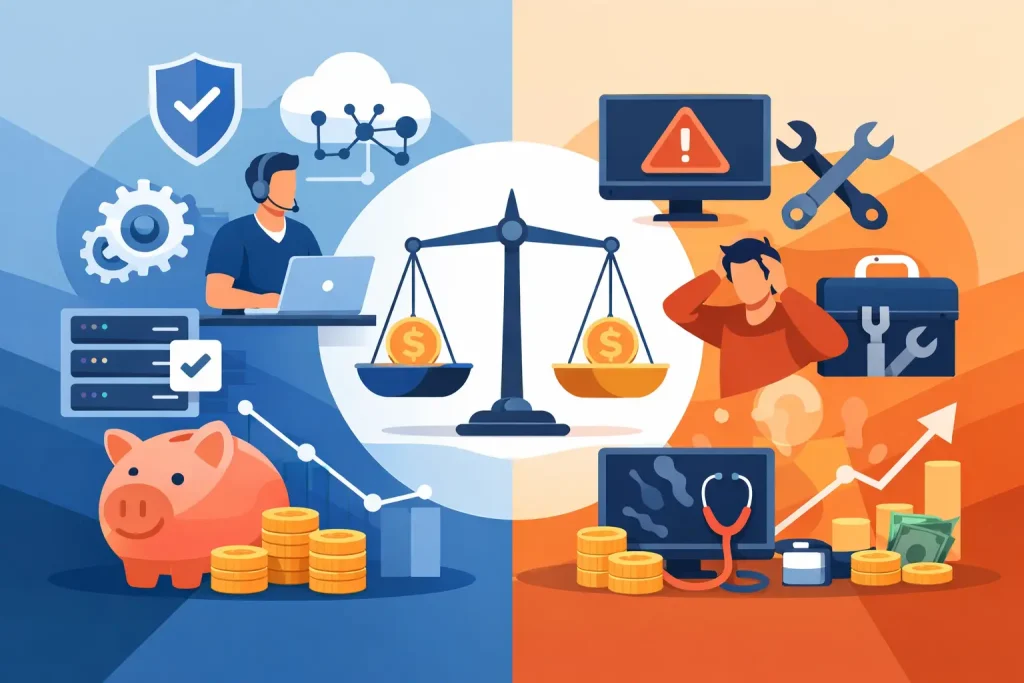
When the server goes down on a Monday morning, the real question is not who can fix it fastest. It is why your business was put in that position at all. That is the core difference in managed IT vs break fix. One model waits for trouble and bills you when it happens. The other works to prevent the trouble, reduce downtime, and keep your systems aligned with how your organization actually operates.
For small to mid-sized businesses, nonprofits, healthcare offices, and community organizations, this is more than an IT preference. It affects productivity, budgeting, cybersecurity, customer trust, and your ability to grow without constant technical interruptions. If your team depends on email, phones, internet, cloud apps, payment systems, websites, or shared files, your IT support model touches nearly every part of your operation.
What managed IT vs break fix really means
Break fix is exactly what it sounds like. Something breaks, you call a provider, and they fix the issue. You pay for labor, parts, and time when a problem occurs. This model can feel simple because there is no ongoing service agreement driving monthly cost. For organizations with very limited technology use, it may appear economical at first.
Managed IT works differently. Instead of waiting for failures, a provider monitors systems, applies updates, reviews security, manages backups, supports users, and helps plan for equipment lifecycles and business continuity. The goal is to reduce emergencies, not just respond to them.
That difference changes the relationship. Break fix is transactional. Managed IT is ongoing and strategic. One treats IT as a repair expense. The other treats IT as an operating system for the business itself.
Why break fix can look cheaper than it is
On paper, break fix often wins the first comparison. If you only pay when something goes wrong, it can seem easier to control spending. There is no monthly contract to approve and no service package to evaluate.
The problem is that most technology costs do not show up neatly on an invoice from the repair company. They show up in lost staff time, missed appointments, interrupted sales, delayed billing, frustrated customers, and security gaps that sit unnoticed until something serious happens. A three-hour outage may not look devastating in a support ticket, but if your front desk cannot access scheduling, your accounting team cannot process payments, or your staff cannot reach shared files, the business impact starts climbing fast.
Break fix also rewards delay. Businesses in this model often postpone upgrades, patching, hardware replacement, and security improvements because there is no provider watching the full environment over time. That creates a cycle where systems age, vulnerabilities increase, and emergencies become more common.
Managed IT offers predictability, not just support
The strongest case for managed IT is not that nothing ever goes wrong. Problems still happen. Hardware fails. Users click things they should not click. Internet providers have outages. Software vendors change platforms overnight.
The advantage is that managed IT gives your business a system for dealing with those realities before they turn into chaos. With proactive monitoring and routine maintenance, many issues are caught early. With security controls in place, the risk profile improves. With documented backups and recovery planning, a bad day is less likely to become a business crisis.
There is also a budgeting benefit. Monthly service costs are easier to forecast than surprise repair bills. For leaders trying to manage cash flow, board reporting, department budgets, or grant-funded operations, predictable IT spending matters.
This is especially true for organizations that cannot afford a full in-house IT department but still need professional oversight. Managed IT gives access to broader expertise without requiring you to hire multiple specialists.
Managed IT vs break fix for security
Security is where the gap between these models becomes hard to ignore.
In a break fix setup, security often receives attention only after an incident. Maybe a device is infected. Maybe an account is compromised. Maybe backups fail during recovery because no one has checked them recently. The provider may resolve the immediate issue, but the larger question remains unanswered: what was being monitored before the incident, and what protections were actually in place?
Managed IT is better suited to modern security demands because it builds in routine oversight. That can include patch management, antivirus and endpoint protection, email security, backup verification, access control reviews, and response planning. For healthcare offices, nonprofits handling donor data, or local businesses processing customer payments, that structure is not optional anymore. Risk does not wait until a support call is convenient.
It is also worth noting that cybersecurity is no longer separate from reputation. A security incident can disrupt operations and damage public trust at the same time. For community-facing organizations, that cost can be much larger than the repair bill.
When break fix still makes sense
Managed services are not automatically the right answer for every organization.
If you run a very small operation with minimal technology, no compliance concerns, limited remote access, and little dependence on cloud platforms, break fix may still be workable. The same can be true for businesses with a strong internal IT lead who only need outside support for occasional projects or specialty repairs.
There are also cases where budget pressure is immediate and leadership chooses break fix as a short-term measure. That decision is understandable. Not every organization can shift overnight into a fully managed model.
But it is important to be honest about the trade-off. Choosing break fix usually means accepting more risk, less visibility, and less planning. It can be a temporary fit, but it rarely supports steady growth well.
When managed IT becomes the better investment
Once your organization depends on technology for daily operations, managed IT usually delivers better value over time.
That includes businesses with multiple employees, shared devices, cloud software, customer data, remote work needs, hosted email, websites tied to daily operations, or any expectation of reliable uptime. It also includes organizations trying to consolidate vendors and reduce the strain of coordinating separate providers for support, security, communications, and digital infrastructure.
A managed relationship becomes even more valuable when your technology connects directly to customer experience. If your phones, scheduling tools, email, website, digital signage, internal network, and marketing systems all play a role in how people interact with your business, downtime is not just an internal inconvenience. It affects public confidence and revenue.
This is where an integrated partner can make a real difference. A company like Epuerto can support the technical foundation while also helping businesses strengthen the public-facing channels that depend on that foundation. That creates more continuity between operations and growth, which is often missing when IT and digital presence are managed in separate silos.
Questions to ask before you choose
A better decision usually starts with a few direct questions.
How expensive is one hour of downtime for your team? How current are your backups, security tools, and software updates? Do you know the age and condition of critical hardware? If a ransomware event or server failure happened tomorrow, how quickly could you recover? And who is responsible for spotting problems before staff members start reporting them?
If those answers are unclear, break fix may be costing more than it appears.
It also helps to consider leadership bandwidth. Many office managers and executive directors are already juggling vendors, staffing, compliance, and customer service. If IT is handled only when something breaks, the burden often lands on whoever is available rather than whoever is best equipped to manage it. Managed IT reduces that scramble and replaces it with a clearer support structure.
The better question is not price alone
Businesses often frame this choice as a simple comparison between monthly cost and hourly repair bills. That is too narrow.
The better comparison is between reactive spending and operational stability. Between isolated fixes and continuous oversight. Between hoping your systems hold up and knowing someone is actively working to keep them healthy, secure, and aligned with your business goals.
For most growing organizations, managed IT is less about buying support and more about removing friction. Your staff can work. Your systems stay current. Risks are addressed earlier. Planning gets easier. That creates real, measurable outcomes across both operations and customer experience.
If your technology is central to how you serve your community, communicate with customers, and keep business moving, your support model should do more than wait for failure. The right IT partner helps enhance your business before the next emergency decides your priorities for you.