
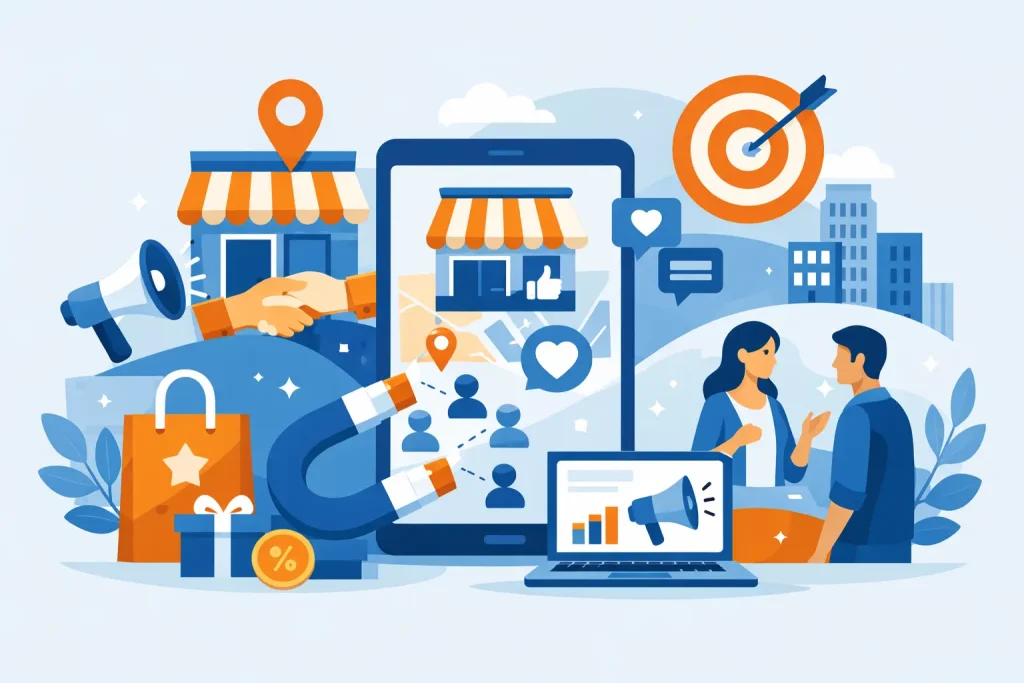
A business can have a great location, a strong team, and loyal customers, then still lose attention to a competitor that simply shows up more often. That is why the best local marketing ideas are not just about promotion. They are about visibility, consistency, and making it easy for people in your community to choose you.
For small and mid-sized organizations, local marketing works best when it connects digital reach with real-world presence. A website, social media page, mailer, event sponsorship, Google Business Profile, and in-store signage should not feel like separate efforts. They should reinforce each other. When they do, your business becomes more familiar, more trusted, and far easier to remember.
What makes the best local marketing ideas actually work
Local marketing is different from broad brand advertising. You are not trying to speak to everyone. You are trying to stay relevant to the people who live nearby, work nearby, visit nearby, or support nearby institutions. That calls for practical tactics that fit your market, your staff capacity, and your buying cycle.
The strongest local strategies usually share three traits. First, they make your business easy to find. Second, they build credibility through repetition and proof. Third, they create multiple touchpoints so a customer sees your name in more than one place before making a decision.
That last point matters more than many businesses realize. Someone may notice your sign, then check your reviews, then visit your website, then see your organization mentioned in a community newsletter. None of those moments alone may close the sale. Together, they often do.
12 best local marketing ideas for steady growth
1. Strengthen your Google Business Profile
For many local businesses, this is the first impression that matters. If your profile has outdated hours, weak photos, missing service details, or few reviews, you are making it harder for nearby customers to trust you.
A strong profile includes accurate contact information, current business categories, service descriptions, recent photos, and a steady flow of reviews. If you serve multiple nearby towns or neighborhoods, reflect that clearly in your service descriptions and website content. This is one of the fastest ways to enhance your business visibility without a major ad budget.
2. Make your website locally useful
A website should do more than look current. It should answer local customer questions quickly. Who do you serve, where do you serve, what do you offer, and why should someone contact you today?
Many organizations lose local leads because their website is too general. Add location-specific service pages, community references, local testimonials, and clear calls to action. If your audience includes nonprofits, healthcare groups, or public-facing institutions, clarity matters even more. People need confidence that you are established, responsive, and easy to work with.
3. Build a review strategy, not just a review request
Most businesses ask for reviews when they remember. That is not a strategy. A better approach is to create a repeatable process after a successful service call, purchase, event, or project milestone.
The trade-off is simple. If you ask too aggressively, it can feel forced. If you never ask, satisfied customers stay silent. The right balance is polite, timely, and consistent. A healthy review profile helps with search visibility, but just as important, it gives local prospects proof that other people in their community trust you.
4. Use social media to reflect the community, not just the brand
Local social media performs better when it feels rooted in place. That means highlighting local events, customer stories, staff involvement, community partnerships, seasonal updates, and behind-the-scenes moments that show your business is active and present.
This does not mean every post has to be casual. Professional service providers can still maintain authority while being locally visible. A healthcare office, museum, chamber, or contractor can all use social channels to show engagement and reliability. The point is not to post constantly. It is to stay relevant.
5. Combine print with digital follow-up
Print still works in local markets, especially when paired with digital reinforcement. A postcard, community mailer, rack card, event handout, or printed menu can keep your name in front of people who may not click an ad.
The mistake is treating print as a one-time push. Stronger campaigns connect print to a landing page, a QR code, a branded offer, or a seasonal promotion. That creates a clearer path from awareness to action. For many community-based organizations, this mix delivers more real, measurable outcomes than digital-only efforts.
6. Participate in local events with a plan
Sponsoring a fair, festival, fundraiser, business expo, or school event can be valuable, but only if your presence is intentional. Showing up with a banner and a table is not enough.
Think about what happens before, during, and after the event. Promote your participation ahead of time. Collect contact information or offer a reason for people to visit your booth. After the event, follow up through email or social media while the interaction is still fresh. Event marketing works best when it extends beyond the day itself.
7. Create local partnerships that share audiences
Some of the best local marketing ideas come from collaboration rather than advertising. A coffee shop can partner with a bookstore. A museum can cross-promote with a local hotel. A clinic can coordinate educational outreach with a nonprofit or chamber group.
Good partnerships are built on audience overlap and mutual value. The goal is not just exposure. It is trusted exposure. When another respected local organization introduces your business to its audience, your credibility starts higher than it would with a cold ad.
8. Use email to stay top of mind locally
Email remains one of the most practical tools for local retention and repeat engagement. It works especially well for businesses and institutions with ongoing relationships, seasonal promotions, recurring events, or educational updates.
The key is relevance. A monthly newsletter packed with generic content will be ignored. A focused email with local updates, timely offers, community involvement, or service reminders is far more effective. Even a small but consistent list can produce meaningful results over time.
9. Invest in local SEO beyond basic keywords
Local SEO is not just adding city names to a few pages. It includes technical site performance, mobile usability, location signals, content relevance, directory consistency, and structured information that helps search engines understand your business.
This is where many organizations hit a wall. They may have a decent-looking website but weak search performance because the underlying setup is outdated or fragmented. If your site loads slowly, lacks clear service pages, or sends mixed signals about your location and offerings, your rankings will likely reflect that. Better local visibility often starts with stronger digital infrastructure.
Best local marketing ideas depend on your capacity
Not every business should try all twelve ideas at once. A small office with limited staff may need to focus on reviews, website updates, and email first. A visitor-driven business in a tourism market may get more traction from events, social content, and print distribution. A nonprofit may benefit most from partnerships, local storytelling, and community calendars.
What matters is choosing a mix you can maintain. Local marketing breaks down when execution becomes inconsistent. A polished launch followed by months of silence usually underperforms a simpler plan that stays active.
Why integration matters more than individual tactics
This is where many businesses gain or lose momentum. If your marketing tools do not work together, every channel has to do too much on its own. If they are connected, each one becomes stronger.
For example, a digital display ad can support event attendance. The event can generate photos and email signups. The email can drive website visits. The website can produce calls and review requests. That kind of system creates compounding value. It also gives leadership better visibility into what is actually working.
For organizations that want to consolidate vendors and reduce complexity, integrated execution is often the most efficient path. Technical performance, security, web updates, branding, search visibility, and community outreach affect each other more than people think. Epuerto works in that overlap because growth is rarely just a marketing issue or just a technology issue. In local markets, it is usually both.
Start with visibility, then build repetition
If you are deciding where to begin, start with the areas customers check first. Make sure your website is current, your Google Business Profile is complete, and your reviews reflect the quality of your work. Then expand into the channels that fit your audience and market behavior.
The businesses that grow locally are not always the loudest. They are the ones that appear credible, current, and consistently present in the places their community already looks. When your message, systems, and visibility align, local marketing stops feeling scattered and starts supporting real business growth.
A good local marketing plan should make your organization easier to trust before a prospect ever picks up the phone.