
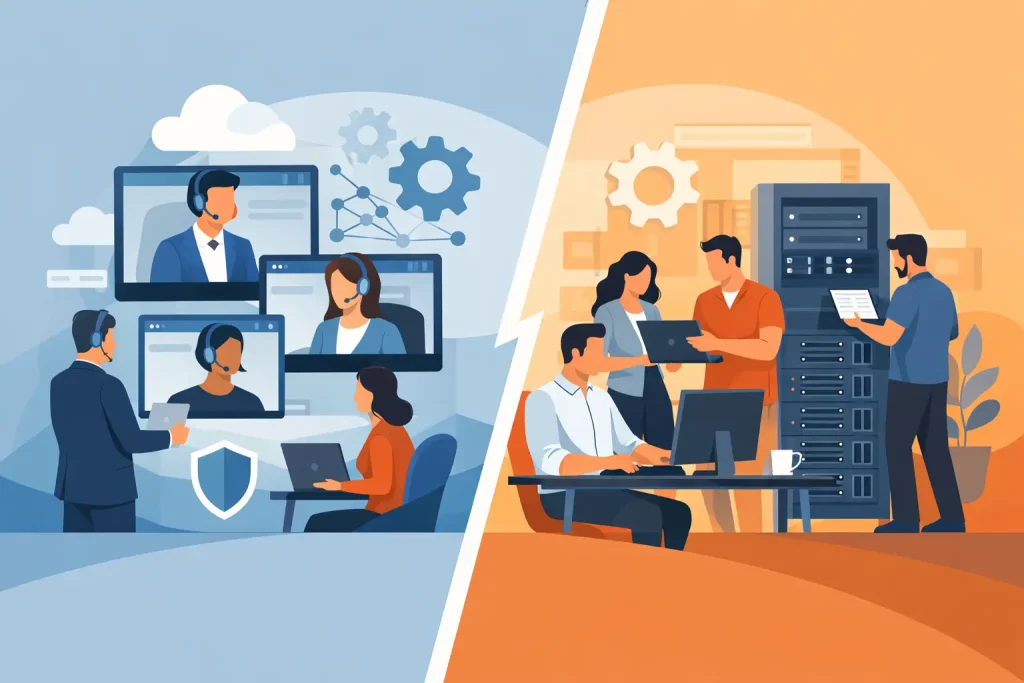
When a server goes down, email stops syncing, or staff cannot access shared files, the outsourced IT vs in house question stops being theoretical. It becomes a business continuity issue. For small and mid-sized organizations, the right choice affects cost, security, response time, staffing pressure, and your ability to keep operations moving without constant technology headaches.
For many businesses, nonprofits, healthcare offices, and community organizations, this is not really a debate about which model sounds better. It is about which model gives you dependable support at the right level without overbuilding your internal team or underprotecting your systems. The answer depends on your size, complexity, risk exposure, and growth plans.
Outsourced IT vs in house: what is the real difference?
In-house IT means your organization hires employees to manage technology internally. That may be one generalist handling everything from password resets to printer issues, or it may be a full department covering cybersecurity, infrastructure, procurement, cloud systems, and user support.
Outsourced IT means you work with an external technology partner for some or all of those responsibilities. That can include help desk support, network management, cybersecurity, backup and disaster recovery, hosted email, cloud oversight, 24×7 monitoring, hardware planning, and strategic guidance.
The biggest difference is not just where the work happens. It is how expertise, availability, and accountability are structured. An in-house employee gives you direct daily access and internal familiarity. An outsourced provider gives you broader bench strength, more specialized skills, and a service model built around ongoing coverage.
Why smaller organizations often struggle with in-house IT
A lot of organizations start with an in-house approach by default. Someone in the office is good with computers, then that turns into a part-time tech role, and eventually one employee becomes responsible for nearly every system issue. That setup can work for a while, but it usually creates a hidden concentration of risk.
If one person manages your devices, network, licenses, backups, cybersecurity alerts, website logins, and vendor relationships, what happens when they are sick, on vacation, or leave the organization? Knowledge gaps show up fast. Documentation is often incomplete. Projects stall. Problems that were manageable suddenly become urgent.
Hiring a larger in-house team can solve some of that, but cost becomes a real barrier. Salary is only part of the expense. You also have recruiting, benefits, training, software tools, turnover risk, and the challenge of finding one person who can truly cover infrastructure, security, cloud platforms, and user support well.
For many small and mid-sized organizations, in-house IT is not too expensive because technology is unnecessary. It is expensive because the business needs more expertise than one hire can realistically provide.
Where outsourced IT creates an advantage
Outsourced IT works well when your organization needs consistency, range, and predictable support. Instead of relying on a single internal person, you gain access to a team with different specialties. That matters when one day brings a phishing incident, the next involves network performance, and the next requires planning a website migration or a cloud rollout.
This model is especially useful for organizations that cannot justify multiple full-time IT salaries but still need professional-grade support. A managed provider can spread those capabilities across many clients, which makes advanced services more accessible.
That often includes proactive monitoring rather than waiting for something to break. It can also include scheduled maintenance, patch management, backup testing, vendor coordination, cybersecurity oversight, and planning for future upgrades. Those are the kinds of tasks that protect the business quietly in the background, but they are easy to neglect when internal staff are overloaded.
For organizations that value vendor consolidation, outsourced IT can also make day-to-day operations simpler. When your technology partner understands not only your systems but also your website, email infrastructure, digital visibility, and communications tools, decisions become more coordinated and more useful to the business as a whole.
The trade-offs of outsourced IT vs in house
Outsourcing is not automatically better in every situation. There are trade-offs, and decision-makers should look at them honestly.
An in-house team usually has deeper familiarity with your culture, staff habits, workflows, and institutional history. They are physically present, often more embedded in daily operations, and easier to pull into quick conversations. That can be valuable in organizations with highly customized systems or frequent on-site needs.
Outsourced IT, on the other hand, may require more defined processes. Good providers solve this with documentation, service protocols, and scheduled check-ins, but the relationship still works best when expectations are clear. If a business expects instant on-site help for every minor issue without a service structure in place, frustration can follow.
There is also a perception issue. Some leaders worry that outsourced support will feel less personal. In practice, that depends on the provider. A strong partner learns your environment, keeps records current, responds consistently, and acts like an extension of your organization rather than a disconnected help desk.
Cost is more than salary
The cost conversation around outsourced IT vs in house often starts too narrowly. Owners compare a monthly service fee to one employee salary and assume in-house must be cheaper. Usually, it is not that simple.
A single internal IT hire may cover basic support, but not necessarily strategic planning, advanced cybersecurity, after-hours monitoring, compliance awareness, disaster recovery design, or high-level cloud administration. Once you add the tools and outside specialists needed to fill those gaps, the economics shift.
Outsourced IT tends to make spending more predictable. Instead of reacting to emergencies, replacing unsupported hardware late, or paying premium rates during outages, you move toward a planned service model. That does not eliminate all unexpected costs, but it usually reduces the expensive surprises that hurt smaller organizations the most.
The bigger question is not whether one option looks cheaper on paper this month. It is whether your current approach reduces downtime, lowers risk, and supports growth without draining leadership time.
Security changes the equation
Cybersecurity has made this decision more urgent. Even smaller organizations are targets for phishing, ransomware, credential theft, and data exposure. If you handle donor data, patient information, financial records, or internal communications, the stakes are even higher.
An in-house generalist may be capable and committed, but security now moves too fast for many one-person departments to manage alone. Threat monitoring, patching, backup validation, access controls, email protection, user training, and incident response planning all require ongoing attention.
This is where outsourced IT often delivers clear value. Not because internal staff are ineffective, but because specialized security practices need structure, tools, and team capacity. Organizations that take a reactive approach usually discover the gap after a breach, not before one.
A hybrid model may be the best fit
Many organizations do not need to choose one side completely. A hybrid model is often the smartest answer.
You might keep an internal operations lead or tech-savvy office manager who understands staff needs and daily workflows, while outsourcing monitoring, cybersecurity, cloud management, backups, procurement guidance, and escalated support. That gives you local continuity without forcing one employee to carry the full weight of modern IT.
For growing businesses, this approach can be especially practical. It preserves internal ownership where it matters and adds outside depth where risk or complexity is rising. It also creates a more stable path for scaling, because support expands with your needs instead of depending entirely on the next hire.
How to decide what fits your organization
Start with your real environment, not an idealized version of it. If your staff regularly lose time to technical issues, if your cybersecurity measures are inconsistent, if backups are uncertain, or if one person holds too much system knowledge, your current model is already under strain.
Ask how much downtime your organization can tolerate. Ask whether your technology supports growth or simply keeps up with emergencies. Ask whether your internal team has enough time to plan, document, secure, and improve systems instead of only reacting to tickets.
If you run a small or mid-sized organization, outsourced support often makes the most sense when you need dependable coverage, broader expertise, and a clearer path to stability. If you are larger, highly specialized, or heavily dependent on on-site technical operations every day, an in-house or hybrid model may be more effective.
The right IT structure should do more than fix problems. It should enhance your business, reduce risk, and give your team the confidence to focus on serving customers, patients, members, or your local community. For organizations that want both dependable technology and coordinated digital growth, a partner like Epuerto can bring those pieces together in a way that produces real, measurable outcomes.
The best choice is the one that gives your organization room to operate well now and grow without technology becoming the thing that holds you back.