
- What Townsquare Media Offers Small Businesses
- Where Small Businesses Start to Feel the Friction
- What a Local Digital Partner Does Differently
- A Side-by-Side Look at the Key Differences
- Questions to Ask Before You Commit to Either
- The Real Cost of Misalignment
- What to Look for in a Local Digital Partner
- FAQs
- Make the Decision Deliberately
If you've been searching for Townsquare Media alternatives, you've probably already sensed something isn't quite fitting. Maybe the reporting feels generic, the account manager has rotated twice in a year, or the campaigns look suspiciously similar to what your competitor down the street is running. That feeling is worth paying attention to.
This article breaks down what Townsquare Media actually delivers for small businesses, where the gaps tend to show up, and what a locally focused digital partner can offer instead. The goal isn't to tear down a large company — it's to help you make a more informed decision about where your marketing and IT budget actually goes.
What Townsquare Media Offers Small Businesses
Townsquare Media started as a radio broadcasting company and has spent the past decade expanding into digital marketing services. For small businesses, the pitch usually centers on a bundle: digital advertising, SEO, social media management, and sometimes display or programmatic ads, all through a single account team.
That bundled approach has genuine appeal. One invoice, one point of contact, and a company with enough brand weight that it feels like a safe choice. For a business owner who doesn't want to juggle five different vendors, the simplicity is real.
Where the Model Works
Townsquare's scale gives it legitimate advantages in certain areas. Its programmatic ad network is broad, so your display ads can reach a wide audience across many sites. The company also has relationships with local radio stations in many mid-size markets, which can be useful if you want to pair digital with audio advertising.
For businesses that primarily need awareness-level advertising without deep customization, the platform can produce results. If you're a regional retailer pushing seasonal promotions to a general audience, the infrastructure is there to support that.
Where Small Businesses Start to Feel the Friction
The complaints that surface most often from small business owners aren't really about the technology — they're about fit, flexibility, and accountability.
One-Size Campaigns in a Many-Sizes Market
Large digital marketing companies build their delivery models around repeatability. That's how they stay profitable at scale. The templates, the reporting dashboards, the ad creative — they're designed to work reasonably well for a wide range of clients, not exceptionally well for yours.
A plumber in a mid-size city has different competitive dynamics than a boutique clothing store in the same city. When both are running campaigns built from the same playbook, neither one is getting a strategy designed around their actual situation.
Account Turnover and the Knowledge That Walks Out With It
This is one of the most consistent frustrations small business owners report with large agencies. When your account manager leaves — and at high-volume agencies, turnover is frequent — the context about your business, your past campaigns, and your local market goes with them. The new person starts from a file, not from a relationship.
That institutional knowledge matters more than most people realize. Knowing that your best leads come from a specific neighborhood, that your busy season starts three weeks earlier than the industry average, or that a key competitor just closed — these details shape better campaigns. They rarely survive a handoff at a large agency.
Reporting That Tells You What Happened, Not What to Do Next
Most large platforms produce detailed reports. Impressions, clicks, CTR, cost per click — the numbers are all there. What's often missing is the interpretation layer: what does this actually mean for your business, and what should change next month?
At scale, that interpretive layer is expensive to provide. So it tends to get replaced with automated summaries that look thorough but don't answer the question a business owner is really asking: "Is this working, and should I keep spending?"
What a Local Digital Partner Does Differently
A local digital partner — one that operates as a done-for-you service rather than a self-serve platform — starts from a different place entirely. Your business isn't a line item in a portfolio of hundreds of accounts. It's a client whose success the agency depends on.
Strategy Built Around Your Market, Not a Template
When a local agency builds your campaign, they're working from real knowledge of your geography, your competitive set, and your customer base. That specificity shows up in everything from the keywords targeted to the creative messaging to the channels chosen.
For businesses serving a defined local area, this matters enormously. A campaign that resonates with your actual customers in your actual market will outperform a generic campaign aimed at a demographic profile — even if the generic campaign has more budget behind it.
IT and Digital Under One Roof
One thing large marketing platforms rarely offer is IT support. Your website goes down on a Saturday night before a big sale — who do you call? Your marketing agency says that's not their department. Your web host has a ticket queue. Your IT vendor doesn't touch marketing infrastructure.
A full-service local partner closes that gap. At Epuerto, the same team that builds and hosts your website also handles network security, cloud computing, and data backup. When something breaks, there's no finger-pointing between vendors. For small businesses without an internal IT department, that operational continuity is genuinely valuable.
Multi-Channel Reach That Includes Offline Touchpoints
Local marketing isn't only digital. Reaching customers in a defined geographic area often means combining digital channels with physical ones — mailers, digital screens in high-traffic locations, and community-facing apps that local residents actually use.
Epuerto's approach includes a proprietary network of mobile apps, digital screens, direct mailers, and social media, all coordinated as part of a single campaign strategy. That kind of multi-channel reach is difficult to replicate through a platform that operates purely in the digital ad space.
A Side-by-Side Look at the Key Differences
Here's how the two models compare across the dimensions that matter most to small businesses:
| Factor | Large National Platform | Local Done-For-You Partner |
|---|---|---|
| Campaign customization | Template-based, scalable | Built around your market and goals |
| Account continuity | High turnover risk | Long-term relationship |
| IT support | Not included | Often bundled |
| Reporting depth | Data-heavy, interpretation-light | Actionable, context-specific |
| Offline marketing channels | Rarely included | Can include mailers, screens, apps |
| Flexibility | Contract-driven, slow to adjust | Responsive to business changes |
| Local market knowledge | Limited | Core competency |
Neither model is universally better. If your business needs national reach and has the budget to match, a large platform's scale can work in your favor. But if you're serving a local or regional market and need a partner who actually understands it, the comparison shifts significantly.
Questions to Ask Before You Commit to Either
Before signing with any digital marketing provider, these questions will help you cut through the sales pitch:
Who specifically will manage my account, and what happens if they leave? Ask for a name, a direct line, and a clear answer about continuity. Vague references to "teams" are a warning sign.
Can you show me examples from businesses in my industry and market? Generic case studies from unrelated industries don't tell you much. You want to see work that's relevant to your actual situation.
What do you do when something isn't working? Every campaign underperforms at some point. How an agency answers this question tells you more than any success story will.
Does your service include anything beyond digital advertising? If your website, IT infrastructure, and marketing are all siloed with different vendors, you're managing complexity that a full-service partner could eliminate.
How do you define success for my business specifically? If the answer is impressions or clicks, push harder. The metric that matters is revenue, leads, or whatever conversion event actually drives your business.
The Real Cost of Misalignment
Switching providers is disruptive. There's a ramp-up period, a learning curve, and usually some lost momentum while a new team gets up to speed. That friction is real, and it's one reason business owners stay with underperforming agencies longer than they should.
But the cost of staying with the wrong partner is usually higher than the cost of switching. If your campaigns are producing generic results, if your IT infrastructure is handled by a vendor who doesn't know your marketing setup, and if your reports don't help you make decisions, you're paying for a service that isn't serving you.
The right time to evaluate alternatives is before you're frustrated enough to make a reactive decision. A calm, deliberate comparison — one where you ask the questions above and weigh the answers honestly — leads to better outcomes than a switch made in the middle of a bad quarter.
What to Look for in a Local Digital Partner
Not every local agency is a better choice than a national platform. Some are under-resourced, some lack the technical depth to handle complex campaigns, and some will overpromise on local market knowledge they don't actually have.
When evaluating a local partner, look for:
- Breadth of services: Can they handle your website, IT, and marketing, or will you still be managing multiple vendors?
- Demonstrated local knowledge: Do they understand your market, your competitors, and your customer base — or are they applying a generic framework?
- Clear ownership: Is there a specific person accountable for your account, with direct contact information and a track record you can verify?
- Transparency in reporting: Do they explain what the numbers mean and what they're changing as a result, or do they just send a PDF?
- Flexibility: Can they adjust quickly when your business situation changes, or are you locked into a campaign plan that was set six months ago?
Epuerto is built around exactly this model. The team handles web design, hosting, IT support, network security, cloud computing, and multi-channel marketing campaigns — all coordinated for businesses that need a single accountable partner rather than a collection of specialized vendors. You can learn more at epuerto.com.
FAQs
What is Townsquare Media and what services does it offer small businesses?
Townsquare Media is a media and digital marketing company that originally focused on radio broadcasting before expanding into digital advertising, SEO, social media management, and programmatic display ads. It markets bundled packages to small and mid-size businesses looking for a single vendor for their digital marketing needs.
What are the main drawbacks of using a large national marketing platform for a small local business?
The most common issues are lack of campaign customization, high account manager turnover that erodes institutional knowledge, and reporting that delivers data without actionable interpretation. Large platforms are built for repeatability at scale, which often means your campaigns look similar to what competitors in your category are running.
What does a local digital partner offer that a national platform typically doesn't?
A local partner brings specific knowledge of your market and competitive environment, greater flexibility to adjust strategy quickly, and often a broader service scope — including IT support, website hosting, and offline marketing channels like direct mailers and digital screens — none of which are typically part of a national platform's offering.
How do I evaluate whether my current marketing provider is the right fit?
Start by asking whether your campaigns are producing results tied to revenue or leads, not just impressions. Then assess whether you have a consistent account manager who understands your business history, and whether the reporting you receive actually helps you make decisions. If the answers are unclear or unsatisfying, it's worth exploring alternatives.
Can a local digital agency handle both IT and marketing for my business?
Yes, though not all local agencies offer both. Full-service partners like Epuerto are specifically structured to handle web design, hosting, IT infrastructure, cybersecurity, and multi-channel marketing under one roof — eliminating the coordination burden of managing separate vendors for each function.
Is switching from a national platform to a local partner disruptive?
There's always a transition period when switching providers. A well-organized local partner will have an onboarding process designed to minimize disruption and get up to speed quickly. The short-term friction of switching is usually smaller than the long-term cost of staying with a provider that isn't delivering results.
What questions should I ask any digital marketing provider before signing a contract?
Ask who specifically will manage your account and what happens if they leave, whether they can show relevant examples from your industry and market, how they respond when campaigns underperform, what metrics they use to define success for your business, and whether their services extend beyond digital advertising to include IT or offline channels.
Make the Decision Deliberately
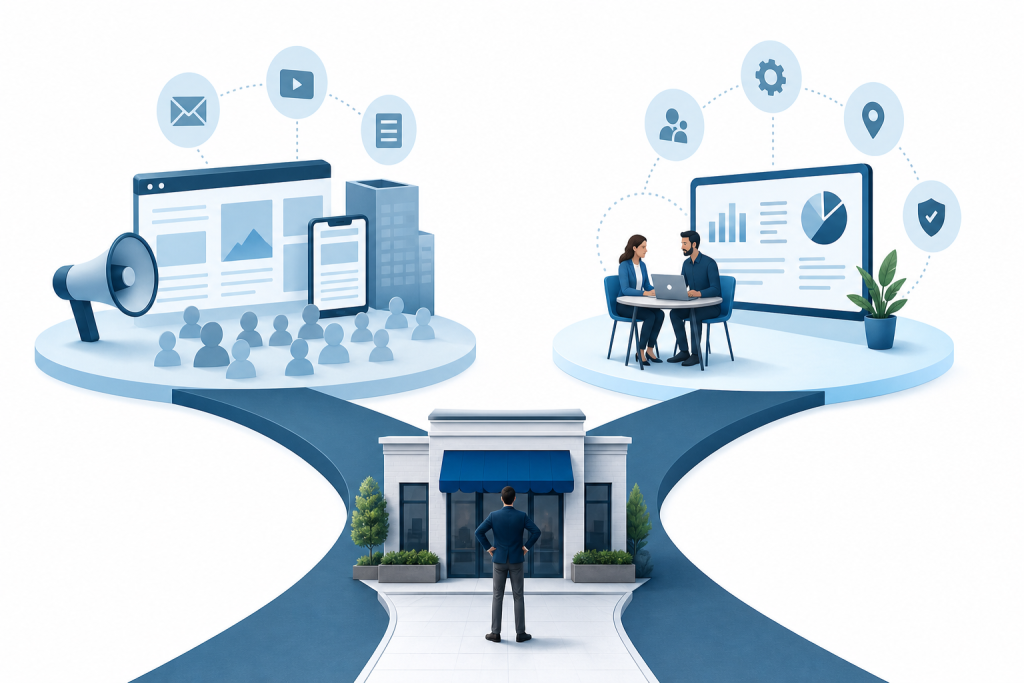
The choice between a large national platform and a local digital partner isn't about which type of company is better in the abstract. It's about which model fits your business, your market, and the level of service you actually need.
If you're serving a local or regional customer base and want a partner who knows your market, handles your IT alongside your marketing, and gives you a direct line to someone accountable for your results, a local done-for-you agency is worth a serious look. Start that conversation before frustration forces your hand — it leads to a much better outcome.