
- Why Consistency Breaks Down Across Multiple Locations
- The Core Framework: Brand Standards Plus Local Flexibility
- Building a Shared Asset Library
- Managing Multiple Google Business Profiles Without Losing Your Mind
- Multi-Channel Campaigns Across Locations
- Local SEO for Multiple Locations
- Keeping Location Teams Aligned
- When to Bring in Outside Help
- FAQs
- Keep the Thread Across Every Location
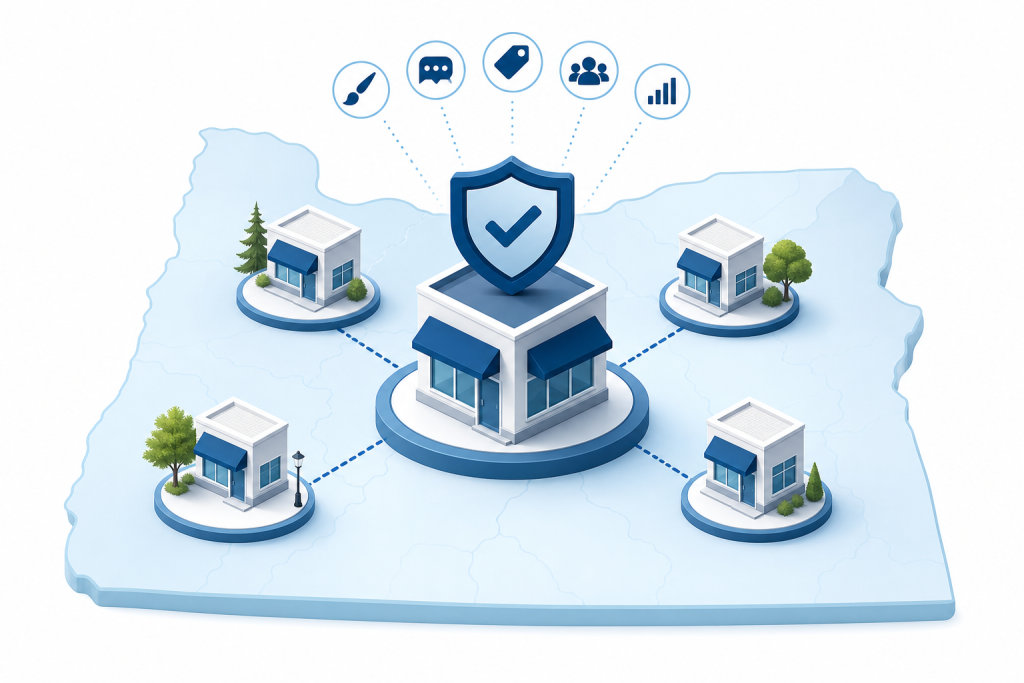
Running two locations is harder than running one. Running five is a different problem entirely. Oregon businesses with multiple sites face a tension that single-location owners rarely have to think about: how do you stay recognizable across every storefront, service area, or office while still speaking to the specific community each location serves?
Multi-location marketing is the discipline that answers that question. Done well, it lets your Portland flagship and your Bend satellite feel like the same brand without sounding like the same script. Done poorly, it produces a fragmented customer experience where no one quite knows what you stand for — or where to find you.
Here is how Oregon businesses are solving that problem in 2026, and what the practical building blocks of consistent multi-location messaging actually look like.
Why Consistency Breaks Down Across Multiple Locations
The failure mode is predictable. A business opens its second location and hands the marketing to whoever is on-site. That person starts a separate Instagram account, creates a Google Business Profile with slightly different hours and a different phone number, and prints flyers using an older version of the logo. Within six months, the two locations feel like competitors rather than siblings.
The root cause is almost always the same: no shared system. Without a central source of truth for brand assets, messaging guidelines, and campaign approvals, each location improvises — and that improvisation compounds over time.
For Oregon businesses specifically, there is an added layer of complexity. The state's markets are genuinely different from each other. A restaurant chain with locations in Eugene and Astoria is not serving the same demographic. A home services company operating in the Portland metro and in Medford faces different seasonal demand, different competitors, and different community expectations. Messaging that lands well in one market can feel tone-deaf in another.
The goal of multi-location marketing is not to eliminate that local variation. It is to manage it without losing the thread of who you are as a brand.
The Core Framework: Brand Standards Plus Local Flexibility
The most effective approach treats brand consistency and local relevance as two separate levers, not one dial.
What Should Never Change
Certain elements belong to the brand, not the location:
- Your logo, color palette, and typography
- Your core value proposition and tagline
- Your tone of voice — whether formal, conversational, technical, or warm
- Your pricing structure and service descriptions
- Your customer service standards and response protocols
These are the things a customer should recognize whether they walk into your Salem location or your Grants Pass location. Inconsistency here is not local flavor. It is brand erosion.
What Can and Should Vary
Local relevance is not a threat to brand consistency — it is a feature. Elements that should flex by location include:
- Promotions tied to local events like the Eugene Marathon, the Pendleton Round-Up, or the Portland Night Market
- Staff introductions and community involvement posts
- References to local landmarks or neighborhoods
- Responses to local news or weather-driven demand
- Partnerships with other businesses in that community
The practical way to manage this split is a tiered content system. Central marketing produces brand-level content: campaigns, seasonal promotions, product launches, brand storytelling. Local teams fill in the local layer within defined guardrails.
Building a Shared Asset Library
If your locations are improvising with brand assets, the first fix is a shared library. It does not need to be expensive. It needs to be accessible.
A shared asset library should contain approved versions of every logo variant, every approved photo or image set, every social post template, every email header, and every print-ready file for signage or mailers. When a location manager needs to promote a new service, they pull from the library rather than recreating assets under time pressure.
This alone eliminates a significant share of brand inconsistency. Most drift happens not because people are trying to go off-brand, but because they cannot find the right files and improvise when they are in a hurry.
Pair the library with a short brand guide. Not a 60-page brand bible — a one- or two-page reference covering logo rules, color codes, approved fonts, and a few examples of on-brand versus off-brand copy. Something a busy location manager can actually read and use.
Managing Multiple Google Business Profiles Without Losing Your Mind
For most Oregon businesses with multiple locations, Google Business Profile is the most important local marketing asset they have. It is where customers find your hours, read your reviews, get directions, and decide whether to call.
Each location needs its own profile — that is not optional. But managing multiple profiles creates real operational risk: outdated hours, unanswered reviews, inconsistent business descriptions, wrong phone numbers. Any of these can cost you customers.
A few practices that prevent the most common problems:
Centralize profile ownership. All profiles should be owned by a single Google account controlled by the business, not by an individual employee. When that employee leaves, you do not want to lose access to your listing.
Standardize your NAP data. Name, address, and phone number should be formatted identically across every profile, every directory listing, and your website. Even small variations — St. versus Street, Suite versus Ste. — create inconsistency that affects local search rankings.
Create a review response protocol. Decide who responds to reviews, how quickly, and in what tone. Reviews left unanswered for weeks signal neglect. Responses that sound like they came from different companies signal fragmentation.
Audit profiles quarterly. Hours change. Services change. Photos get stale. A quarterly audit of all profiles takes less than an hour and prevents the kind of outdated information that frustrates customers before they ever walk through your door.
Multi-Channel Campaigns Across Locations
A single-location business can run a campaign on one or two channels and call it done. A multi-location business needs to think about how a campaign lands differently depending on where the customer encounters it.
Consider a seasonal promotion. Central marketing creates the offer, the creative, and the messaging. Now that campaign needs to reach customers in Portland, Bend, Medford, and Astoria — through whatever channels those customers actually use.
In 2026, that typically means a combination of:
- Social media — location-specific pages or a single page with location-tagged posts
- Email — segmented by customer location or zip code
- Paid search — geo-targeted campaigns for each service area
- Physical channels — direct mail, in-store signage, local print
- Digital out-of-home — screens in high-traffic local areas
The mistake most multi-location businesses make is running the same campaign uniformly across all channels in all markets and calling it done. The smarter approach is to run the same core campaign with local adaptation. The offer is the same. The headline might reference a local landmark or event. The distribution is targeted to each market.
This is where a done-for-you agency relationship becomes genuinely valuable. Coordinating five channels across four markets is not a part-time job. It requires systems, relationships with channel partners, and the capacity to produce localized variations without starting from scratch each time.
Epuerto works with Oregon businesses to manage exactly this kind of multi-channel coordination, using a proprietary network that spans mobile apps, digital screens, direct mailers, and social media. Rather than juggling separate vendor relationships for each channel, businesses work with a single team that handles the full distribution picture. You can learn more at epuerto.com.
Local SEO for Multiple Locations
Search is where multi-location marketing gets technically complex. Each location needs to rank in its own market — which means each location needs its own set of signals: its own Google Business Profile, its own page on your website, its own local citations, and ideally its own stream of local reviews.
Location Pages That Actually Work
A location page is not a duplicate of your homepage with the city name swapped in. Search engines recognize thin, templated pages and do not reward them. A useful location page includes:
- The specific address, phone number, and hours for that location
- A description of the services available there, which may differ from other locations
- Photos of the actual location, staff, or work done in that market
- Local context: neighborhoods served, nearby landmarks, community involvement
- Reviews or testimonials from customers at that location
Each location page should feel like it was written for someone who lives in that city — not someone sitting at corporate headquarters.
Citations and Directory Listings
Beyond Google, your locations need consistent listings across Yelp, Bing Places, Apple Maps, and relevant industry directories. Each listing signals to search engines that your business is legitimate and located where you say it is. Inconsistent or missing listings weaken that signal.
For a business with four or five locations, managing citations manually is time-consuming. There are tools that automate citation management, and agencies that handle it as part of a broader local SEO service.
Keeping Location Teams Aligned
Systems only work if people use them. The operational side of multi-location marketing matters just as much as the strategic side.
A few practices that help:
Monthly or quarterly marketing syncs. Bring location managers together — in person or on a call — to review what is coming up, what worked last month, and what local events or opportunities are on the horizon. This keeps everyone moving in the same direction and surfaces local intelligence that central marketing would otherwise miss.
Clear escalation paths. Location teams should know what they can approve locally and what needs sign-off from the center. A social post about a local event? Probably fine to publish. A new promotion with a price discount? That needs approval. Ambiguity here leads to either over-caution — nothing gets posted — or overreach, where off-brand content goes live.
Feedback loops. If a local campaign performs unusually well in one market, that is information the whole organization should have. Build in a way for location teams to report back on what is resonating.
When to Bring in Outside Help
Most Oregon businesses with multiple locations reach a point where the marketing complexity outpaces their internal capacity. That is not a failure — it is a growth problem, which is a good problem to have.
The signal that outside help makes sense usually looks like one of these: campaigns are inconsistent because no one has time to coordinate them, local SEO is being neglected because it requires technical work no one on staff knows how to do, or new locations are opening faster than the marketing infrastructure can scale.
A full-service agency that handles web, SEO, multi-channel distribution, and IT infrastructure under one roof removes the coordination overhead that slows most multi-location businesses down. Instead of managing a web agency, an SEO consultant, a social media manager, and a direct mail vendor separately, the business gets a single point of contact and a team that already knows how the pieces fit together.
FAQs
What is multi-location marketing and why does it matter for Oregon businesses?
Multi-location marketing is the practice of managing brand messaging, campaigns, and customer communications across two or more physical or service locations. For Oregon businesses, it matters because the state's markets are genuinely diverse — customers in different cities have different expectations. A consistent but locally relevant approach builds trust and drives business at each location without diluting the overall brand.
How do I keep my brand consistent across multiple locations without sounding generic?
The key is separating brand-level elements — logo, tone, core messaging, service descriptions — from location-level elements like local promotions, community references, and staff introductions. Brand elements stay fixed. Location elements flex within defined guardrails. A shared asset library and a short brand guide give location teams what they need to stay on-brand while still speaking to their local audience.
Does each location need its own website page?
Yes. Each location should have a dedicated page on your website with its own address, phone number, hours, services, and locally relevant content. Thin, templated location pages do not perform well in local search. Pages that include genuine local context, photos, and customer reviews from that location perform significantly better.
How should I handle Google Business Profiles for multiple locations?
Each location needs its own Google Business Profile. All profiles should be owned by a single business account, not individual employees. Name, address, and phone number should be formatted identically across all profiles and directory listings. Review responses should follow a consistent protocol, and profiles should be audited at least quarterly for accuracy.
What channels work best for multi-location marketing in Oregon?
The right mix depends on your industry and customer base, but most Oregon businesses benefit from a combination of local SEO, social media with location-specific content, email segmented by customer location, and physical channels like direct mail or in-store signage. Digital out-of-home screens in high-traffic local areas are increasingly effective for businesses with a strong local presence.
How do I coordinate campaigns across locations without creating extra work for everyone?
A tiered content system helps: central marketing produces the campaign framework and core assets, and location teams adapt within defined parameters. Monthly syncs keep everyone aligned. Clear approval paths prevent both over-caution and off-brand improvisation. For businesses with more than three or four locations, a done-for-you agency relationship often makes more sense than trying to coordinate everything internally.
When does it make sense to hire an agency for multi-location marketing?
When the coordination overhead is eating into time that should go toward running the business. Signs include inconsistent campaigns across locations, neglected local SEO, no clear owner for multi-channel distribution, or new locations opening faster than the marketing infrastructure can scale. An agency that handles web, SEO, and multi-channel distribution together removes the fragmentation that comes from managing multiple vendors separately.
Keep the Thread Across Every Location
Consistency is not about uniformity. It is about giving customers a reliable experience regardless of which location they walk into or which channel they find you on. Oregon's markets are too distinct for a one-size-fits-all approach, but they are not so different that your brand needs to reinvent itself in every city.
The businesses that get this right build systems before they need them. They create the asset library, the brand guide, the location page templates, and the review protocols when they open their second location — not their fifth. That infrastructure is what makes scaling feel manageable rather than chaotic.
If you are running multiple locations in Oregon and the marketing coordination is starting to feel like a second job, Epuerto works with businesses to handle the full picture — from local SEO and website management to multi-channel campaign distribution across mobile, digital, print, and social. The goal is the same one you have: every location pulling in the same direction, speaking to its community, and growing the business.