
- Why Most Restaurant Marketing Budgets Get Wasted
- Build a Foundation That Works Before You Spend a Dollar
- Local SEO: How Nearby Customers Find You Organically
- Social Media That Actually Brings People In
- Email Marketing: The Channel Restaurants Underuse
- Hyperlocal Distribution: Reaching People Who Aren't Online
- Online Reviews: Your Best Free Sales Tool
- Paid Advertising: When and How to Use It Wisely
- A Realistic Marketing Plan for a Small Restaurant
- FAQs
- The Restaurants That Stay Full Have a System, Not a Budget
Running a restaurant means you're already stretched thin. Digital marketing is one of those things that keeps getting pushed aside because there's no time, no dedicated person, and no obvious place to start. But filling tables consistently doesn't require a massive ad budget — it requires showing up in the right places, for the right local audience, at the right moment.
This guide covers practical channels that work for independent and small-chain restaurants, with a focus on high-impact moves that don't demand a full-time marketing team.
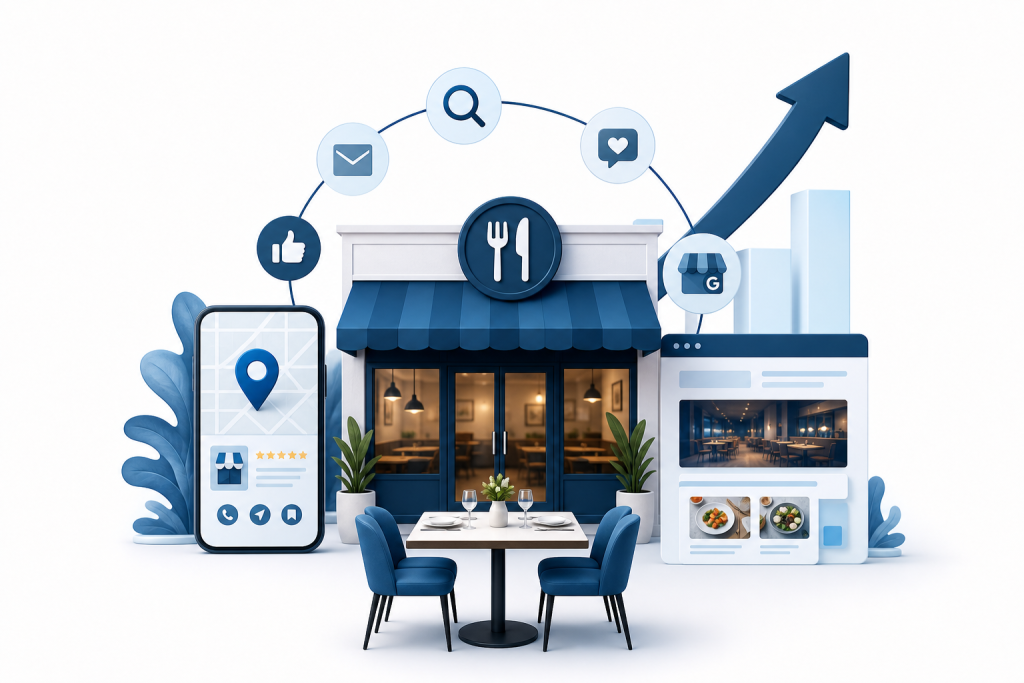
Why Most Restaurant Marketing Budgets Get Wasted
It helps to understand where restaurant owners typically lose money before talking about what to do instead.
The most common mistake is paying for broad digital advertising — Facebook or Google ads targeting wide geographic areas — when nearly every customer lives within a few miles of the front door. A second mistake is leaning on platforms that charge high commission fees, which erodes margin even when the seats fill up.
A third, less obvious problem: the restaurant's website or Google Business Profile has outdated hours, a broken menu link, or a phone number that goes nowhere. Someone searches for you, hits a wall, and walks to the place down the street. The ad budget didn't fail. The foundation did.
Fix the foundation first. Everything else builds on it.
Build a Foundation That Works Before You Spend a Dollar
Your Google Business Profile Is Your Most Important Free Asset
When someone searches for a restaurant nearby, Google's local pack — the map results with photos, hours, and reviews — shows up before any paid ads. Claiming and fully optimizing your Google Business Profile costs nothing and has a direct effect on how often you appear.
The basics that many restaurants still miss:
- Hours must be accurate, including holiday hours. Google penalizes profiles with reported inaccuracies.
- Photos matter more than most owners realize. Restaurants with 100-plus photos on their profile consistently outperform those with fewer than 20. Post food photos, interior shots, and staff photos regularly.
- Respond to every review, positive or negative. A thoughtful response to a critical review tells prospective customers more about your operation than the review itself does.
- Use the Posts feature to announce specials, events, and seasonal menus. These appear directly in search results and cost nothing.
Your Website Needs to Do One Job Well
A restaurant website has a single primary job: turn a curious visitor into a seated customer or a placed order. That means fast load times, a mobile-friendly layout, a menu that doesn't require a PDF download, and a clear path to reservations or directions.
If your site loads slowly on a phone, you lose the customer before they read a word. If your menu is a scanned image, you lose them before they see your prices. These aren't design preferences — they're conversion problems.
Local SEO: How Nearby Customers Find You Organically
Local SEO for restaurants is about ranking when someone nearby searches for "pizza near me," "best brunch in [your city]," or your restaurant's name. It's different from general SEO because proximity, relevance, and reputation signals carry the most weight.
Citations and Consistency
Your restaurant's name, address, and phone number need to appear consistently across every directory that lists you: Yelp, TripAdvisor, OpenTable, Bing Places, Apple Maps, and any local chamber or tourism site. Inconsistencies confuse search engines and quietly drag down your local ranking.
This sounds tedious because it is. But it's a one-time cleanup that pays off for years.
Schema Markup for Restaurants
Adding structured data to your website tells search engines exactly what type of business you are — your hours, cuisine type, whether you offer delivery or reservations. Restaurants with proper schema markup are more likely to appear in rich results and Google AI Overviews, which now handle a significant share of local queries.
Most restaurant websites have none of this. That's a real opportunity.
Social Media That Actually Brings People In
Social media works for restaurants when it's visual, consistent, and local. It doesn't work when it's generic, infrequent, or treated as a one-way broadcast.
Instagram and Facebook: The Two Platforms Worth Your Time
Instagram remains the dominant platform for food content. Short videos of dishes being plated, staff behind the scenes, or a packed Friday night create genuine engagement and reach people who weren't already following you.
Facebook is still relevant for local restaurants, particularly because of its Events feature and its older demographic — which tends to skew toward higher disposable income. Posting weekly specials, promoting a live music night, or running a simple "tag a friend" giveaway costs nothing and reaches your existing audience directly.
What to Post and How Often
You don't need to post every day. Three to four times a week with quality content outperforms daily posts of low effort. A practical content mix:
- 2x per week: Food or drink photos, ideally shot in natural light
- 1x per week: Behind-the-scenes content — prep, staff, or a supplier story
- 1x per week: A promotion, event, or community mention
Consistency matters more than volume. A restaurant that posts reliably for six months builds a larger organic following than one that posts daily for three weeks and then goes quiet.
Email Marketing: The Channel Restaurants Underuse
Email is the most direct line to your existing customers, and it's largely free if you already have a list. A monthly email with upcoming events, a featured dish, and a simple offer — "show this email for a free dessert this weekend" — keeps your restaurant top of mind without any ad spend.
Building the list is the harder part. The most effective methods:
- A sign-up prompt on your website
- A tablet or paper sign-up at the host stand
- A QR code on the table tent linking to a sign-up form with a small incentive
Once you have 200 to 300 subscribers, a monthly email becomes a meaningful traffic driver on its own.
Hyperlocal Distribution: Reaching People Who Aren’t Online
Not every potential customer finds you through Google or Instagram. Older demographics, tourists, and community members who aren't heavy social media users are often best reached through physical channels.
This is where hyperlocal distribution networks become genuinely useful. A monthly mailer reaching households in your area, digital screens in local hotels and community spaces, or a local mobile app with a strong download base can put your restaurant in front of people who would never have found you through search.
For restaurants in smaller markets like Coos County, this kind of physical-world presence is often more effective than a digital-only approach. Epuerto's proprietary local marketing network combines a mobile app with over 7,000 downloads, digital display screens placed in restaurants, malls, gyms, hotels, airports, and schools, and a physical mailer that reaches more than 26,000 recipients per month across the area. That's meaningful local reach that no national marketing platform can replicate at the community level.
If you're a restaurant owner in the region, that kind of distribution is worth understanding. You can see what Epuerto offers across web, IT, and local marketing at epuerto.com.
Online Reviews: Your Best Free Sales Tool
For restaurants, reviews aren't a "nice to have." They're the primary decision-making factor for new customers. A restaurant with 200 reviews at 4.4 stars will consistently outperform one with 40 reviews at 4.8 stars — because volume signals legitimacy.
How to Get More Reviews Without Begging
The most effective approach is timing. Ask when the customer is happiest — right after they've complimented the meal, when they're paying the check, or via a follow-up email if they booked online.
A simple table card that says "Enjoyed your meal? We'd love a Google review — scan here" with a QR code pointing directly to your review link removes all friction. Most people who intend to leave a review never do because they can't find the right page. Make it one tap.
Responding to reviews — especially negative ones — matters just as much. A calm, professional response to a complaint tells every future reader that you take your operation seriously.
Paid Advertising: When and How to Use It Wisely
Paid ads aren't necessary to fill tables, but they can accelerate results once the foundation is solid. The key is targeting tightly.
Google Search Ads
Targeting phrases like "restaurants open now near [your city]" or "[cuisine type] restaurant [neighborhood]" can work well with a small daily budget — but only if your website converts and your reviews are strong. Without those, paid traffic rarely sticks.
Facebook and Instagram Ads
A boosted post targeting a 5-mile radius around your restaurant, tied to a specific event or promotion, is one of the lowest-cost paid tactics available. You don't need a sophisticated funnel. You need a good photo, a clear offer, and a tight geographic target.
Avoid broad audience targeting. A restaurant in a town of 25,000 people doesn't benefit from ads shown to people 40 miles away.
A Realistic Marketing Plan for a Small Restaurant
You don't need to do everything at once. A practical sequence for a restaurant with limited time and budget:
- Month 1: Audit and fix your Google Business Profile, update your website's menu and contact information, and set up a review request system.
- Month 2: Start a consistent social media posting schedule (3–4x per week) and begin building an email list.
- Month 3: Launch a monthly email newsletter and explore local distribution options — mailers, community apps, or digital screen placements in your area.
- Month 4 and beyond: Add paid ads once organic channels are generating consistent engagement, and track which channels are actually driving reservations or walk-ins.
This isn't a sprint. It's a system you build once and maintain. The restaurants that do this consistently are the ones that stay full even when a new competitor opens nearby.
FAQs
What is the most important digital marketing channel for a small restaurant?
Your Google Business Profile is the single highest-impact free channel available. It directly affects whether you appear in local search results when someone nearby is looking for a place to eat. Keeping it accurate, photo-rich, and review-active should come before any paid advertising.
How much should a restaurant spend on digital marketing?
There's no universal answer, but many independent restaurants see strong results with a modest monthly investment focused on local channels rather than broad advertising. The more important question is whether the foundation — website, Google profile, reviews — is working before any money goes toward ads.
Do restaurants need to be on every social media platform?
No. Instagram and Facebook offer the clearest return for most restaurants. Trying to maintain TikTok, Pinterest, Twitter/X, and LinkedIn simultaneously with a small team leads to inconsistent posting across all of them. Pick two and do them well.
How do I get more Google reviews for my restaurant?
Ask at the right moment — when a customer compliments the food or service — and make the process frictionless with a QR code that links directly to your Google review page. Timing and simplicity matter more than incentives.
What is local SEO and why does it matter for restaurants?
Local SEO is the practice of optimizing your online presence so nearby customers find you when they search for restaurants. It includes your Google Business Profile, consistent directory listings, website structure, and reviews. Restaurants that invest in local SEO appear higher in map results and attract more walk-in and reservation traffic without paying for ads.
Should a restaurant use email marketing?
Yes, especially for building repeat business. Email reaches customers who already chose you once and costs far less than acquiring new customers through advertising. A monthly email with events, specials, and a simple offer keeps your restaurant in front of your best customers on a regular basis.
What's the difference between digital marketing and hyperlocal marketing for restaurants?
Digital marketing refers to online channels — search, social media, email, and paid ads. Hyperlocal marketing includes physical-world channels like direct mail, in-venue digital screens, and community apps that reach people in a specific geographic area regardless of their online behavior. For restaurants in smaller markets, hyperlocal channels often reach audiences that a digital-only approach misses entirely.
The Restaurants That Stay Full Have a System, Not a Budget
The difference between a restaurant that struggles to fill seats and one running a waitlist on weekends usually isn't the size of the ad budget. It's whether the marketing is consistent, local, and built on a solid foundation.
Start with what's broken — your Google profile, your website, your review count. Then build outward into social, email, and local distribution. If you're in a market like Coos County and want help running all of it without adding to your own workload, Epuerto handles web, marketing, and IT under one roof so you can stay focused on the kitchen.