
- What the Dark Web Actually Contains
- What Dark Web Monitoring Actually Finds for a Business
- What Monitoring Cannot See or Verify
- How to Triage a Finding Before You Escalate
- Why Small Businesses Are Exposed Even Without a Direct Breach
- What to Ask a Vendor Before You Sign
- Monitoring as Part of a Broader Security Stack
- Frequently Asked Questions
- Take the Next Step
Dark web monitoring for business gets recommended constantly and explained almost never. You hear that your credentials might be "on the dark web," but what does that actually mean for a small business in 2026? What shows up, what does a real finding look like, and what are you supposed to do with it?
This article answers those questions directly — including the parts most vendors skip: what monitoring cannot see, how to triage a finding before you panic, and how to turn a raw alert into a concrete next step.
What the Dark Web Actually Contains
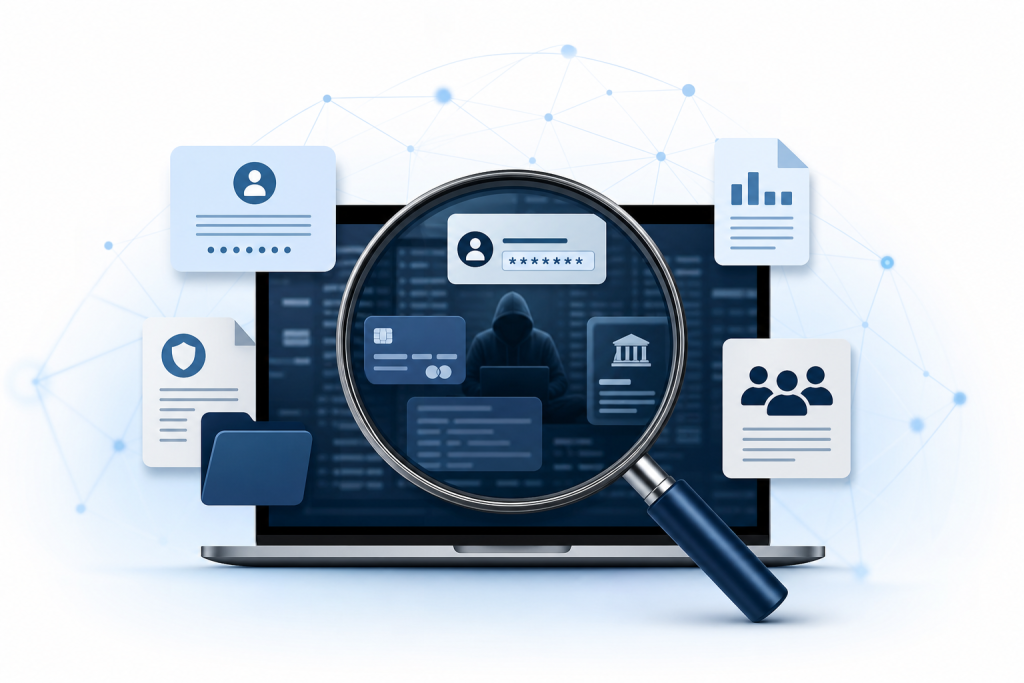
The dark web is not a single place. It is a collection of networks, forums, marketplaces, paste sites, and private channels that standard search engines cannot index and that require specific software or credentials to access. Some of it is criminal infrastructure. Some is privacy-focused communication. What matters to your business sits in a narrower slice: breach data repositories, credential marketplaces, and leak forums where stolen information gets posted, sold, or traded.
A 2024 article published in the International Journal of Information Engineering and Electronics described the dark web as containing passwords, financial data, stolen credit cards, and attack tooling used against vulnerable systems. That is the category of content dark web monitoring is designed to surface.
The sources that monitoring tools and services typically scan include:
- Breach databases and credential dumps posted after a third-party service is compromised
- Paste sites where stolen data is shared in bulk, sometimes publicly
- Criminal forums and marketplaces where data is actively bought and sold
- Ransomware leak sites where attackers publish data from victims who refused to pay
- Closed Telegram channels and private communities that require infiltration or purchased access
Coverage varies significantly between vendors and managed services. No tool sees everything.
What Dark Web Monitoring Actually Finds for a Business
Most explainers stay vague here. Here is what a real finding looks like once it surfaces.
Compromised Employee Credentials
The most common finding is a username and password combination tied to your business domain. An employee used their work email to sign up for a third-party service, that service was breached, and the credentials ended up in a dump. The finding arrives as: email address, password (sometimes plaintext, sometimes hashed), source breach name, and approximate date of exposure.
The real problem is password reuse. A credential stolen from a fitness app becomes the key to your company email or accounting software if the password was never changed.
Research cited in a 2025 paper from faculty.marshall.usc.edu found that 98 percent of organizations use at least one third-party vendor that has experienced a breach in the last two years. Your employees' credentials are almost certainly in at least one breach dataset, whether or not your own systems were ever directly touched.
Session Tokens and Stolen Cookies
Less commonly discussed but increasingly common in the wild: session tokens stolen by infostealer malware. These are not passwords. They are the authentication tokens your browser holds after you log in, and they can be used to access accounts without ever knowing the password — bypassing multi-factor authentication in many configurations.
A finding in this category looks different from a credential dump. It includes the token itself, the associated URL, browser fingerprint data, and sometimes the IP address of the infected machine. This type of exposure is harder to remediate because resetting a password does not invalidate the session.
Business Email and Financial Account Data
Monitoring can surface exposed email account credentials, payment processor logins, or banking credentials tied to your domain or business name. These are higher-severity findings because the downstream risk is direct financial loss or full account takeover.
Internal Documents and Source Code
Not every finding involves credentials. Monitoring can surface internal documents, configuration files, or source code posted to paste sites or sold on forums. A disgruntled employee, a misconfigured repository, or a contractor who stored files carelessly can all result in internal data appearing somewhere it should not.
Personal Data of Customers or Patients
For healthcare clinics, nonprofits, or any business that stores customer records, monitoring may surface patient or customer data tied to your organization. This carries regulatory weight. HIPAA-covered entities have specific notification and response obligations when protected health information is found to have been exposed.
What Monitoring Cannot See or Verify
Honest vendors will tell you this. Many do not.
Dark web monitoring is passive surveillance of publicly accessible or purchased datasets. It does not have access to private criminal channels that have not been infiltrated. It cannot tell you whether a credential it found has already been used against you. It cannot confirm that the data is current rather than years old and already rotated out.
A significant limitation is deduplication and data freshness. Many breach datasets circulate for years. A finding that looks alarming may trace back to a 2019 breach that your employee already addressed. Without clear metadata about when the data was first posted versus when the monitoring service collected it, you cannot easily tell the difference.
UpGuard's 2026 vendor comparison analysis noted that 79 percent of organizations first learn about active threats from outsiders rather than their own tooling — which says something about the gap between what monitoring promises and what internal teams actually catch in time. The same analysis cited a 2025 SANS survey finding that 73 percent of organizations list false positives as their top detection challenge. That is not a reason to skip monitoring. It is a reason to build a triage process before you subscribe.
How to Triage a Finding Before You Escalate
Most small businesses receive a dark web alert and either ignore it or overreact. Neither is useful. Here is a practical triage sequence.
Step 1: Confirm the credential is real and current. Check the email address. Is it an active employee or a former one? Is the password format consistent with your current password policy? If the password was changed after the breach date, the exposure is historical, not active.
Step 2: Check for password reuse. Even if the breached service is low-risk, the password itself may still be in use elsewhere. Ask the employee to check every account where that password was used and change it.
Step 3: Assess the data type. A hashed password from a 2020 breach carries different urgency than a plaintext password from last month or a session token from an infostealer infection. Prioritize accordingly.
Step 4: Look for signs of active exploitation. Check login logs for the affected account. Look for unusual access times, unfamiliar IP addresses, or forwarding rules set up in email. A credential on the dark web is a warning. Evidence of login attempts using that credential is an incident.
Step 5: Document and remediate. Force a password reset, revoke active sessions, enable MFA if it is not already on, and log the finding with the date and action taken. If patient or customer data is involved, loop in your compliance or legal contact immediately.
Why Small Businesses Are Exposed Even Without a Direct Breach
A 2025 paper from faculty.marshall.usc.edu cited survey evidence that roughly half of companies have experienced a direct cyber breach. But the third-party exposure problem is larger. The same research found that 98 percent of organizations use at least one vendor that has been breached in the last two years.
For a small business without dedicated IT staff, this is the realistic threat model. You were not hacked directly. But your payroll provider, your point-of-sale software vendor, your email marketing tool, or your cloud storage service was — and your employees' credentials were in the data that was stolen.
A 2024 Business Wire analysis of 9,410 organizations found that compromised users identified on the dark web were associated with a 2.56 times increased likelihood of a cyber incident. That is not a guarantee, but it is a meaningful signal that monitoring findings deserve a response rather than a shrug.
What to Ask a Vendor Before You Sign
Most dark web monitoring services are sold on breadth of sources and speed of alerting. Those matter, but they are not the whole picture. Before committing, ask:
- How do you handle deduplication? If the same credential appears in five different breach dumps, do I get five alerts or one?
- What is the average age of data in your database? Fresh findings are actionable. Five-year-old findings create noise.
- Do you monitor session tokens and infostealer logs, or only credential dumps? The answer tells you whether the service is keeping pace with current attack methods.
- How do you handle false positives? What is the process for disputing or suppressing a finding that turns out to be irrelevant?
- What evidence do you provide with each finding? A vendor that gives you only an email address and a breach name is giving you less than one that provides the source, approximate date, and data type.
- Do you offer remediation guidance or just alerting? Alerting without guidance puts the entire response burden on you.
Monitoring as Part of a Broader Security Stack
Dark web monitoring is not a standalone security program. It is one layer of a broader approach that should also include endpoint detection and response, patch management, firewall management, encrypted email, and employee security awareness training.
For businesses in Coos Bay and across Oregon without internal IT staff, assembling and managing those layers independently is not realistic. A managed IT provider that includes cybersecurity services can handle monitoring, triage, and remediation as part of a single engagement — rather than leaving you to coordinate multiple vendors and piece together a response on your own.
Epuerto provides managed IT and cybersecurity services to small businesses, nonprofits, and healthcare organizations in Coos County and Oregon, covering the full stack from endpoint protection and patch management to backup and disaster recovery, with 24/7 monitoring included. When a dark web finding surfaces for a client, there is already a team in place to respond.
Frequently Asked Questions
What is dark web monitoring for business?
Dark web monitoring for business is a security service that continuously scans dark web forums, breach databases, paste sites, ransomware leak pages, and criminal marketplaces for data tied to your organization — employee credentials, customer records, internal documents. When a match is found, the service generates an alert so your team can respond.
How does dark web monitoring actually work?
Monitoring services use a combination of automated crawlers, human intelligence, and purchased access to dark web sources. They index data from breach dumps and forums, then match it against identifiers you provide — typically your email domain, IP ranges, or specific user accounts. When a match is found, an alert is generated with details about the finding.
What kinds of data does dark web monitoring find for businesses?
Common findings include compromised employee credentials from third-party breaches, session tokens stolen by infostealer malware, business email or financial account logins, internal documents posted without authorization, and customer or patient data tied to your organization.
Can dark web monitoring prevent a breach?
Not directly. Monitoring is a detection tool, not a prevention tool. It tells you that your data has already been exposed somewhere. The value is in how quickly you detect and respond. Acting on a finding fast — such as forcing a password reset before an attacker uses the credential — can prevent the exposure from becoming a full incident.
How should a small business respond to a dark web alert?
Confirm whether the credential is current, check for password reuse across other accounts, assess the data type and severity, review login logs for signs of active exploitation, force a password reset, enable multi-factor authentication, and document the finding and your response. If customer or patient data is involved, consult your compliance obligations before taking further steps.
What are the main limitations of dark web monitoring?
Monitoring cannot access every private criminal channel. It cannot confirm whether a stolen credential has already been used against you. Data freshness is a real issue — many breach datasets circulate for years, making some findings historical rather than active. False positives are common, with a 2025 SANS survey cited by UpGuard's 2026 analysis finding that 73 percent of organizations name false positives as their top detection challenge.
Does a small business really need dark web monitoring?
If your employees use work email addresses to access any third-party services — and almost all do — your credentials are likely in at least one breach dataset. Research cited in a 2025 paper from faculty.marshall.usc.edu found that 98 percent of organizations use at least one vendor that has been breached in the last two years. For a business without dedicated IT staff, monitoring paired with a managed response process is a practical way to catch exposures before they become incidents.
Take the Next Step
Dark web monitoring is most useful when it is part of a managed security program — not a standalone subscription that generates alerts no one has time to triage. If your business is in Coos Bay, Coos County, or elsewhere in Oregon and you want cybersecurity coverage that includes monitoring, endpoint protection, and a team that handles the response, reach out to Epuerto to talk through what that looks like for your situation.