
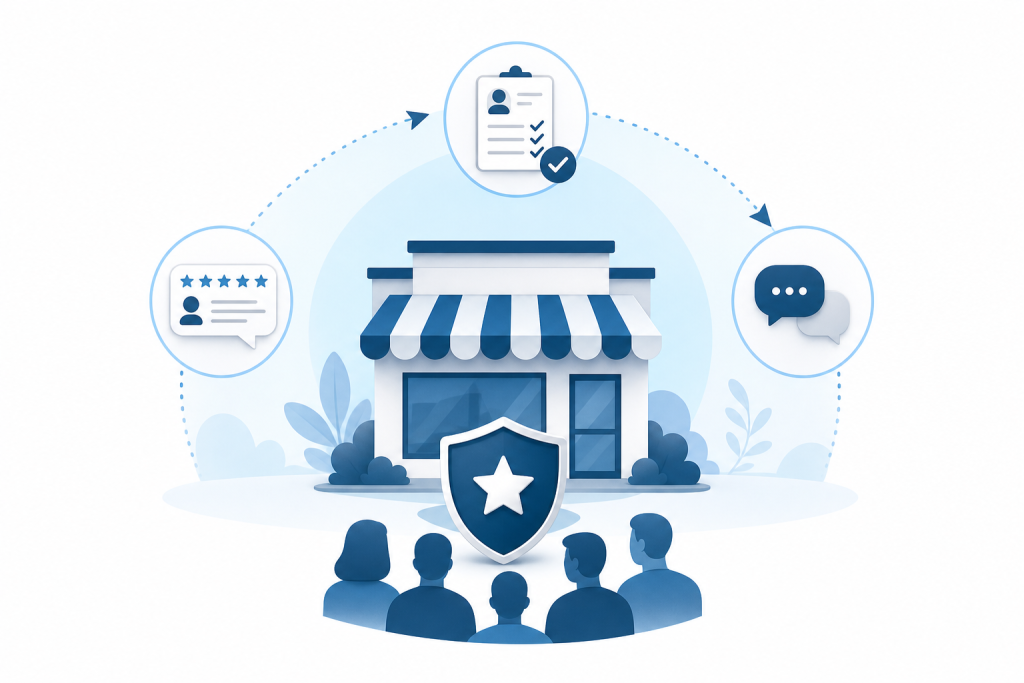
Reputation management for small businesses means claiming your profiles, earning genuine reviews, responding to feedback, and monitoring what search engines and AI assistants surface about you. You can do it yourself for free, use affordable software, or hire an agency. The right mix depends on how much time you have and how competitive your market is.
Most guides hand you a list of tools without telling you what to do first or where the legal lines are. This guide walks through each step in sequence, from the free basics any owner can handle today to the paid options worth considering as your business grows.
Why Online Reputation Management Matters for Small Businesses
Your online reputation is often the first thing a potential customer encounters before they call, visit, or click. That first impression now forms across more surfaces than ever: Google search results, review platforms, map listings, and increasingly, AI assistants like ChatGPT and Perplexity that pull from review data to recommend local businesses.
The numbers make the stakes plain. According to BrightLocal's 2026 research, 97% of consumers read online reviews when evaluating local businesses. A missing profile, a cluster of unanswered complaints, or a thin review count can send a customer to your competitor before you ever had a chance to compete.
AI assistants add a newer layer of urgency. When someone asks an AI tool to recommend a local plumber, accountant, or restaurant, that tool synthesizes review sentiment, star ratings, and profile completeness to form its answer. A business with a sparse or neglected profile may not appear at all, even if it ranks reasonably well in traditional search.
Google holds roughly 91% of global search engine market share, which means your Google Business Profile is the single most visible representation of your business online. What that profile says, and what your reviews say about you, shapes the decision of most people who search for what you sell.
Online reputation management, or ORM, is not the same as search engine optimization, or SEO, though the two overlap. SEO focuses on ranking your website higher in results. ORM focuses on controlling what those results say about you once people find them. Both matter, but ORM is where small and mid-sized businesses often have the most immediate ground to gain.
Step 1: Claim and Complete Every Business Profile
Free online reputation management for small businesses starts here, before any software or agency enters the picture.
-
Claim your Google Business Profile. Go to business.google.com, search for your business name, and follow the verification steps. Google typically verifies by postcard, phone, or video, depending on your business type. This profile controls what appears in Google Maps and the local "map pack" at the top of search results.
-
Fill out every field completely. Add your business name, address, phone number, website, hours, category, and a description. Upload at least five photos. Incomplete profiles rank lower and give AI assistants less to work with when generating recommendations.
-
Claim your Yelp, Bing Places, and Apple Maps listings. Each platform has its own claim process, but all three are free and take under an hour combined. Yelp matters for restaurants and service businesses. Apple Maps feeds Siri recommendations on iPhones.
-
Check industry-specific directories. A medical office should be on Healthgrades and Zocdoc. A contractor should be on Angi and HomeAdvisor. A restaurant should be on TripAdvisor. List the two or three directories your customers actually use.
-
Keep your name, address, and phone number identical across every listing. Even small variations, like "St." versus "Street," can confuse search algorithms and reduce how often your business appears in local results. Consistent citations across directories are a foundational part of local SEO for small businesses.
Google's dominance in search, at roughly 91% market share, means your Google Business Profile deserves the most attention. But the other listings reinforce it. AI assistants draw from multiple sources, so a business that appears consistently across platforms is more likely to be recommended.
Step 2: Build a Steady Stream of Genuine Reviews
Star ratings affect whether customers choose you, and 97% of consumers read reviews before evaluating a local business. Building that review count ethically is the second step in managing your reputation.
Ask every satisfied customer directly. The most effective method is a personal ask right after a positive interaction: "We'd really appreciate a Google review if you have a moment." Follow up with a short text or email containing a direct link to your Google review page. Most customers who intend to leave a review never do simply because they forget or can't find where to go.
Do not gate reviews. Review gating means filtering customers before asking, only sending review requests to people you expect will leave positive feedback. Every major platform prohibits it, and the legal risk is real. An FTC rule established in 2024 allows fines of up to USD 51,744 per instance of a fake or manipulated review. Gating is treated as manipulation under that rule.
Never buy reviews or offer incentives. Paid reviews and incentivized reviews both violate FTC guidelines and platform terms of service. The fine risk applies per instance, meaning a batch of purchased reviews could create significant liability.
Build the habit into your workflow. Set a reminder to send review requests weekly rather than in sporadic bursts. A steady trickle of new reviews signals to Google that your business is active. A sudden spike followed by silence looks unnatural and can trigger platform filters.
Aim for consistency over volume. Ten genuine reviews earned over three months serve you better than thirty earned in a week.
Step 3: Respond to Every Review, Positive and Negative
Public responses to reviews do more than acknowledge the person who wrote them. Every prospective customer who reads that review also reads your reply. How you handle criticism, or whether you handle it at all, tells them how you treat people.
For positive reviews, keep your response short and specific. Thank the reviewer by name if they used one, mention something they called out, and invite them back. A generic "Thanks for the great review!" adds little. A response that references the actual service or experience shows you read it.
For negative reviews, follow a simple framework: acknowledge, apologize for the experience (not necessarily the facts), and offer to resolve it offline. Never argue in the reply. Never identify the customer's private details in public. Move the conversation to a phone call or email where you can actually fix the problem. A calm, professional response to a harsh review often impresses prospective customers more than the negative review damages you.
AI tools can help you draft responses faster. Feed the review text into a tool like ChatGPT and ask for a professional reply in your brand's tone. Edit before you post. The goal is to sound like you, not like a template. This approach cuts the time you spend on responses without sacrificing quality.
Aim to respond within 24 to 48 hours. Platforms like Google display how recently you responded, and a months-old unanswered complaint signals neglect. Set a weekly block of time, even just 20 minutes, to work through new reviews across all your platforms.
Consistency matters more than perfection. A business that responds to every review, even imperfectly, looks more engaged and trustworthy than one that only responds to praise.
Step 4: Monitor What the Web Says About Your Business
Free reputation management for small businesses includes monitoring, and you can start without spending anything.
Google Alerts is the simplest free option. Go to google.com/alerts, enter your business name in quotes, and set it to deliver results daily or weekly. You'll get an email whenever Google indexes a new mention of your business name. It won't catch everything, but it catches most news articles, blog posts, and directory mentions.
For deeper local tracking, BrightLocal audits your review health across platforms, tracks your position in local search results, and shows how your listings appear in the Google map pack. Per reputationx.com, BrightLocal places strong emphasis on local search signals and how reviews affect map pack visibility.
Monitoring matters more now because of how search behavior has shifted. According to Reputation X's 2026 data, approximately 68% of U.S. Google searches resulted in zero clicks in early 2026, up from about 60% two years prior. That means more people are reading your star rating, review snippets, and profile details directly in the search results page without ever visiting your website. What Google surfaces about you is the whole story for a growing share of searchers.
AI assistants compound this. When Perplexity or ChatGPT recommends a local business, it draws from review sentiment and profile completeness across multiple platforms. A business that monitors and maintains those signals consistently is more likely to appear in those answers.
The free tools cover the basics well enough to start.
What Are the Four Elements of Reputation Management?
Most practitioners group reputation management into four broad activities: monitoring what the web says about you, building a steady base of genuine reviews and complete profiles, responding publicly to feedback, and suppressing inaccurate or outdated negative content by creating positive content that outranks it. The steps in this guide cover the first three. Suppression is typically where paid tools or agency help becomes necessary.
How Much Does Reputation Management Cost for a Small Business?
The cost ranges from nothing to a significant monthly retainer, depending on how much you do yourself.
| Approach | What You Pay | What You Get |
|---|---|---|
| DIY (free tools) | No cost | Google Alerts, manual review requests, platform dashboards |
| Local tracking software | Monthly subscription | Review monitoring, map pack tracking, listing audits (e.g., BrightLocal) |
| Full-service agency retainer | Ongoing monthly fee | Done-for-you monitoring, response management, profile optimization |
For context on where the market sits: the average annual spend on online reputation management across businesses is approximately $34k, according to Chris Hinman's 2026 State of ORM report. That figure reflects industry-wide averages and larger organizations, not what a small business owner typically pays to get started.
Most small and mid-sized businesses land somewhere in the middle. Free tools handle the basics. A local tracking tool adds structure and saves time once your review volume grows. An agency makes sense when managing your reputation takes more hours than you have, or when your market is competitive enough that a gap in response time costs you customers.
The reputation management services market was valued at USD 8.02 billion in 2025, per 360iResearch. That scale reflects demand from businesses of all sizes, which means the vendor options available to small businesses have grown considerably. You are not locked into an enterprise contract to get real help.
Match your spend to your situation. A single-location service business in a low-competition market can go far with free tools and a consistent weekly habit. A business in a dense market with multiple locations will likely benefit from software or professional support sooner.
When a Done-for-You Marketing Partner Makes Sense
At some point, the time cost of managing your reputation yourself exceeds what it is worth. That is usually the right moment to consider a full-service partner.
The clearest signals: you are missing review requests because no one has time to send them, negative reviews sit unanswered for days, or your profile information has drifted out of date across multiple platforms. Any one of those gaps costs you customers.
A full-service digital marketing agency handles those tasks as part of a broader scope that typically includes your web presence, local advertising ideas, and content. Reputation and visibility are connected, so gaps in either area can cost you customers.
If you are weighing whether to hire a local digital marketing agency, understanding what a full-service partner actually covers helps you ask the right questions.
Prices and plan limits verified as of October 2026.
FAQs
Does responding to Google reviews help with local search rankings?
Yes, responding to reviews is a confirmed signal in Google's local ranking algorithm. Google's own documentation states that replying to reviews shows you value customer feedback, and businesses that engage consistently tend to perform better in map pack results. Beyond rankings, every public response is visible to prospective customers reading those reviews, so the benefit is both algorithmic and reputational.
Can I ask customers to remove a negative review?
You can ask, but you cannot pressure or incentivize them to do so. A polite, private message explaining that you have resolved the issue and asking if they would consider updating or removing the review is acceptable. Offering a discount, refund, or any other incentive in exchange for removal violates FTC guidelines and platform terms of service. If a review is factually false or violates a platform's content policies, you can flag it for removal through the platform's dispute process.
What is review gating and why is it against the rules?
Review gating means filtering customers before sending a review request so that only satisfied customers are directed to leave a public review. The problem is that it artificially skews your public rating by suppressing negative feedback. Google, Yelp, and the FTC all prohibit it. The FTC's 2024 rule treats selective solicitation as a form of review manipulation, with fines of up to USD 51,744 per instance.
How long does it take to improve a business’s star rating?
It depends on your current review count and how actively you ask for new reviews. A business with fewer than 20 reviews can shift its average meaningfully within 60 to 90 days of consistent, ethical review requests. A business with hundreds of reviews needs a longer runway because each new review carries less weight against the existing average. The key variable is volume of genuine customer interactions and how reliably you ask each one.
Is a Google Business Profile enough, or do I need other directories too?
Google Business Profile is the highest priority because of Google's market dominance, but it is not enough on its own. AI assistants draw from multiple sources when generating local recommendations, and platform-specific directories, like Yelp for restaurants or Healthgrades for medical offices, carry real weight with their own user bases. Maintaining consistent, complete listings across the three or four directories most relevant to your industry gives you broader coverage without a significant time investment.
Conclusion
Managing your small business's online reputation comes down to four consistent habits: claim and complete your profiles, earn genuine reviews, respond to every piece of feedback publicly, and monitor what the web says about you. You can start all four today at no cost. Free tools like Google Alerts and your Google Business Profile dashboard cover the basics well enough to make a real difference.
Where you go from there depends on your time and your market. If reputation tasks are eating more hours than your schedule allows, or if gaps in your profile and review responses are visibly costing you customers, that is the signal to bring in a tool or a partner. Start with the free steps, find where the friction is, and add paid help only where the time savings or competitive pressure justify it.