
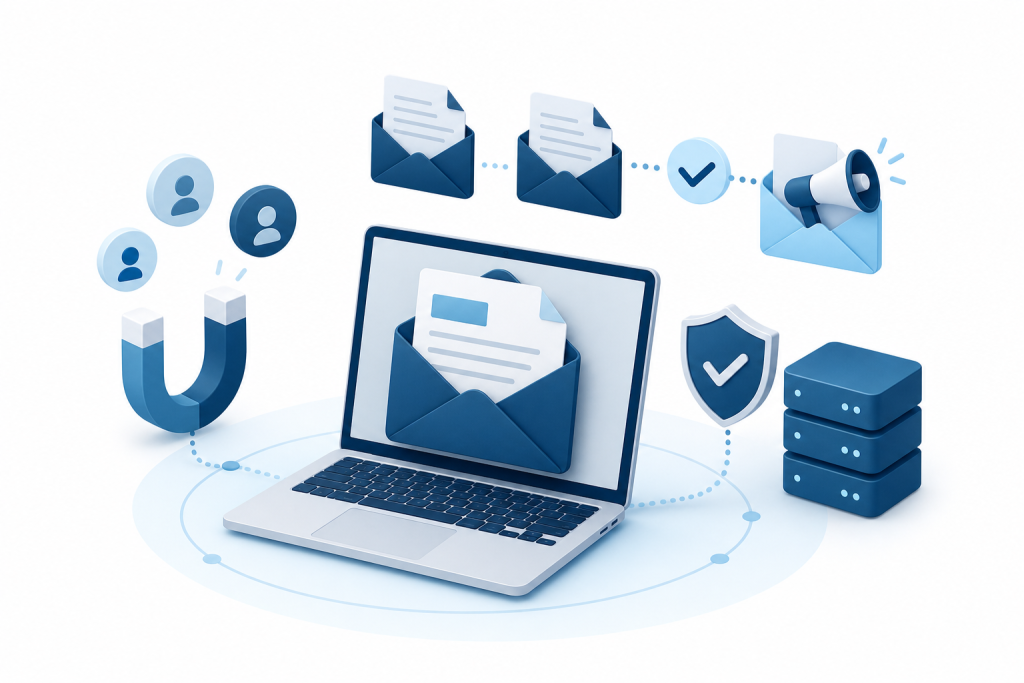
Email marketing for small business works best when you combine a focused lead magnet, a value-first content ratio, and proper domain authentication. Independent research puts the realistic return on investment at 12:1, still strong, but only when your emails actually reach the inbox, which requires meeting Gmail and Yahoo's current technical sending standards.
Most small business owners either skip email entirely or run campaigns that quietly fail in spam folders. This guide covers every step in order: building a list, writing content that gets opened, automating sequences, and setting up the technical authentication records that are a baseline requirement for inbox placement.
Is Email Marketing Still Worth It for Small Businesses in 2026?
Email gives small businesses direct, algorithm-free access to customers. No platform can cut your reach overnight the way a social media algorithm change can. That access is only valuable if you use it consistently.
The return on investment is real, but the inflated figures you see repeated across the web come from vendor surveys. Independent research using holdout tests puts the actual incremental ROI closer to 12:1. That is still a strong return, and it holds up when your campaigns are run with discipline.
The catch is deliverability. According to the Validity 2025 benchmark, the average worldwide inbox placement rate is 87%, meaning a meaningful share of emails never reach the intended recipient. Deliverability is not automatic, and it is getting harder to ignore.
A Service Direct survey of 274 small business marketers found that 24.0% of small businesses do not conduct any email marketing at all. That gap is an opportunity. Businesses that build and maintain a list have a direct line to customers that competitors relying only on social media simply do not have.
How to Build Your Email List with a Lead Magnet
A lead magnet is a free resource you offer in exchange for an email address. The most effective ones solve a single, narrow problem. Broad promises attract low-quality signups; specific ones attract people who actually want to hear from you.
Here is the process in order:
- Create a lead magnet that targets a single, narrow problem for your audience [S1]. A plumber might offer a one-page checklist for spotting early signs of pipe corrosion. A bakery might offer a PDF of three recipes using seasonal ingredients. The tighter the topic, the more relevant the subscribers you attract.
- Use specific call-to-action phrases that describe exactly what the subscriber will receive [S2]. "Get the free checklist" outperforms "Subscribe to our newsletter" because the reader knows what they are getting. Vague promises attract vague interest.
- Place the opt-in form where your audience already spends time: your website's homepage, a blog post that answers a common question, or a link in your social media bio.
- Confirm the subscriber's address with a double opt-in. This reduces fake signups and protects your sender reputation.
- Deliver the lead magnet immediately in the first automated email. Waiting even a few hours drops the engagement rate on that first message.
A focused list of 500 engaged subscribers will consistently outperform a much larger list of people who barely remember signing up.
What Is the 80/20 Rule in Email Marketing?
A practical content ratio for email marketing is to send roughly four value-focused emails for every one promotional message. That 4:1 split is a guideline, not a hard rule, but it reflects a real pattern in how subscribers respond over time.
Educational content generates 27% higher open rates than purely promotional messages, according to data from Campaign Monitor. When most of your emails teach, inform, or entertain, subscribers stay on your list longer and are more likely to open the occasional promotional message when it arrives.
A practical content calendar for a small business might look like this: out of four emails in a month, three cover a useful topic (a how-to, a seasonal tip, a behind-the-scenes story) and one promotes a specific offer or product. That rhythm keeps unsubscribe rates low and makes your promotional sends feel earned.
Email works best as part of a broader local marketing mix. Epuerto covers additional channels that work alongside email.
How to Set Up Welcome and Drip Sequences That Run Themselves
Automated email sequences let you nurture new subscribers without writing a new email every week. Two sequences cover most small business needs.
The welcome sequence runs immediately after someone joins your list. Structure it across three emails:
- Email 1 (sent immediately): Deliver the lead magnet, introduce your business in two or three sentences, and tell the subscriber what to expect next.
- Email 2 (sent two to three days later): Share one useful piece of content with no sales ask. A tip, a short story, or a frequently asked question you answer in depth.
- Email 3 (sent five to seven days later): Make a soft offer. This could be an invitation to book a consultation, a limited discount, or a link to your most popular product.
Research on the Smartlead platform found that the median cold email sequence consists of 3 emails. For warm subscribers who opted in voluntarily, three emails is a reasonable baseline before moving them to your regular newsletter.
The drip sequence runs after the welcome sequence ends. Send one email per week or every two weeks, using the 80/20 ratio described above. Most email platforms let you queue these in advance so the sequence runs without manual effort.
Review your open rates and click rates after 90 days and cut or rewrite any email with consistently low engagement.
Domain Authentication: The 2026 Technical Requirements You Cannot Skip
Authenticating your domain is the single most important technical step for inbox placement. Gmail and Yahoo now require all bulk senders to pass three checks before messages are trusted. Skip any one of them and your emails are more likely to land in spam or be rejected outright.
Here is what each record does:
- SPF (Sender Policy Framework): A DNS record that controls which mail servers can send on behalf of your domain. Your email platform will give you the exact record text to add.
- DKIM (DomainKeys Identified Mail): A cryptographic record that links outgoing messages to your domain. Your email platform generates the key; you paste it into your DNS settings.
- DMARC (Domain-based Message Authentication, Reporting, and Conformance): A policy record that instructs receiving servers how to handle messages that fail SPF or DKIM checks. It also generates reports you can use to spot unauthorized sending.
To set these up [S3], log into your domain registrar (the service where you registered your web address), go to the DNS settings, and add the records your email platform provides. Most platforms give you the exact text to paste in. The process takes about 20 minutes if you have access to your DNS panel.
After adding the records, use a free DNS lookup tool to confirm each one is live. Propagation can take up to 48 hours. Do not skip this step: per the Validity 2025 benchmark, the average inbox placement rate is already only 87%, and sending without authentication pushes your numbers lower.
What Is the Best Email Marketing Platform for a Small Business?
No single platform fits every small business, but the right one shares a few traits: it handles list management, offers automation for welcome sequences, and provides templates that do not require design skills.
Constant Contact is one option built specifically for small businesses and nonprofits. It provides email marketing tools, AI-generated templates and copy assistants, and social media integrations. The built-in AI assistant helps with both layout and copy, which cuts the time it takes to produce a consistent weekly email. Pricing is not publicly listed, so contact them directly for current rates.
Whatever platform you choose, confirm it offers a template library you can edit without design skills, a visual automation builder for welcome sequences, and list segmentation so you can send different content to different groups.
Prices and plan limits verified as of October 2026.
FAQs
How often should a small business send marketing emails?
Once a week is a practical starting point for most small businesses. It keeps your brand present without overwhelming subscribers. Track your unsubscribe rate: a spike after a particular send is a signal to adjust your frequency, your content, or both.
What should a small business include in its first welcome email?
Deliver whatever you promised in the opt-in form, whether that is a checklist, a discount code, or a free guide. Then introduce your business in two or three plain sentences and tell the subscriber what kind of emails they will receive and how often. Keep it short. The goal is to confirm they made a good decision and set clear expectations for what comes next.
How do I grow my email list without paid ads?
Place your opt-in form on your highest-traffic web pages and link to it from your social media profiles. Offer a specific lead magnet rather than a generic newsletter signup. Ask existing customers in person or at checkout if they want to join your list. Partner with a complementary local business to cross-promote each other's lists. Consistent content that answers real questions also brings in organic search traffic that converts to subscribers over time.
Can I use AI tools to write small business email content?
Yes, and the quality has improved enough that AI-drafted copy is a useful starting point. Give the tool a specific prompt: your audience, the topic, the one action you want the reader to take, and your preferred tone. Then edit for accuracy, local detail, and anything that sounds generic. AI speeds up the drafting step but does not replace your judgment about what your specific customers need to hear.
What is a good open rate for small business email campaigns?
Open rates vary by industry. If your open rate falls consistently low, the most common causes are a weak subject line, a list with many inactive addresses, or content that does not match what subscribers expected when they signed up. Cleaning your list every six months by removing subscribers who have not opened in 90 days usually improves both open rates and deliverability.
Conclusion
Email marketing remains one of the most cost-effective channels available to small businesses in 2026. The realistic ROI is closer to 12:1 than the inflated figures you often see, and that return depends entirely on whether your emails reach the inbox and whether your content gives subscribers a reason to open them.
Start by setting up SPF, DKIM, and DMARC records for your domain before you send another campaign. Then build a simple welcome sequence of three emails and apply the 80/20 content ratio to your regular sends. Those two steps alone put you ahead of most small businesses that either skip email or send without any technical foundation.