
A failed email server at 7:30 a.m. can stop a small organization before the day has even started. A phishing email can put client data, donor records, or patient information at risk in minutes. When these issues arise, leaders are not asking for a theory of technology management. They need dependable help, clear accountability, and a plan that keeps the organization moving.
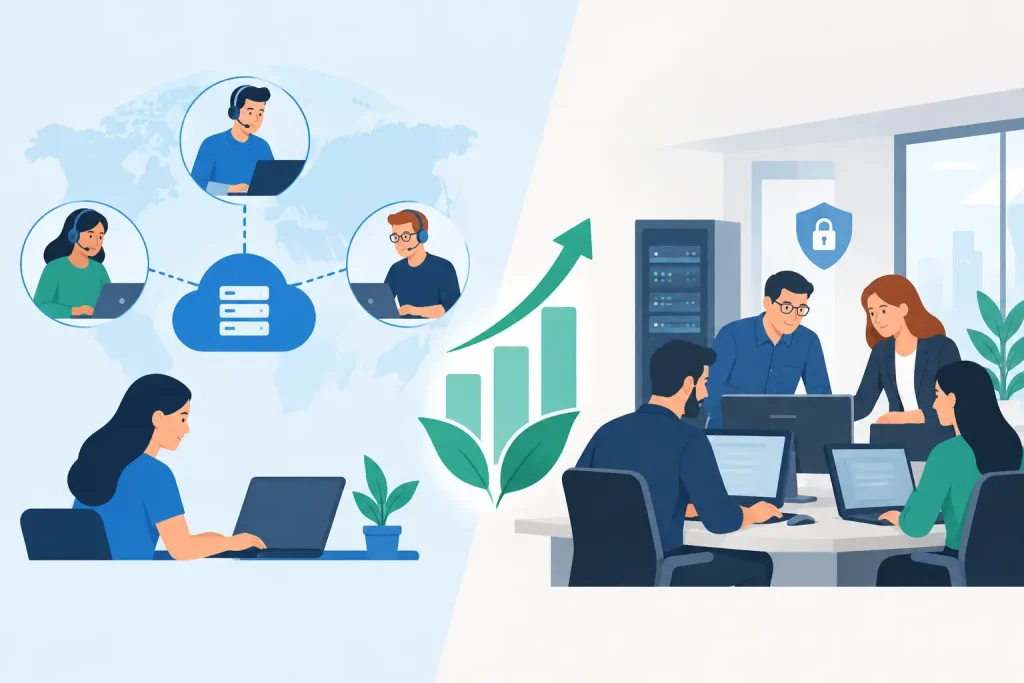
The decision between outsourced IT versus internal IT shapes how a business responds to those moments. It also affects cybersecurity, operating costs, employee productivity, and the ability to adopt new tools without creating more complexity. There is no universal winner. The better model depends on your size, your risks, your goals, and the type of expertise your team needs every day.
What Internal IT Brings to the Table
Internal IT means employing one or more people whose primary responsibility is maintaining your technology. For a larger organization with complex systems, multiple locations, proprietary software, or a high volume of daily technical requests, that proximity can be valuable.
An internal team understands the details that do not always appear in a support ticket. They know which conference room has recurring connectivity problems, which department has a specialized workflow, and which seasonal events put extra pressure on systems. They can build relationships with staff and often respond immediately when they are onsite.
This model also gives leadership direct control over priorities. If a new software rollout, website integration, or network upgrade is central to the organization’s plans, an internal IT manager can focus closely on that project. For institutions with extensive compliance demands or highly customized technology environments, dedicated in-house expertise may be the right investment.
The challenge is coverage and breadth. One capable technician cannot be a cybersecurity analyst, cloud architect, network engineer, help desk specialist, backup expert, and strategic technology advisor all at once. Vacation, illness, turnover, and after-hours emergencies can quickly expose a single-person IT department as a point of failure.
Hiring also comes with costs beyond salary. Benefits, training, tools, certifications, recruiting time, and ongoing retention all matter. A business may pay for a full-time role while still needing outside specialists for security testing, disaster recovery planning, advanced networking, or major projects.
Where Outsourced IT Creates an Advantage
Outsourced IT, often delivered through a managed services provider, gives an organization access to a broader team for a predictable monthly investment. Instead of depending on one person’s knowledge and availability, businesses can draw on specialists in monitoring, endpoint protection, backups, cloud systems, network management, and user support.
For many small to mid-sized businesses, nonprofits, healthcare entities, and community organizations, this is the most practical way to gain deeper technical coverage without building a large internal department. A managed IT partner can monitor systems around the clock, respond to emerging issues, maintain security standards, and help leadership make smarter technology decisions before a problem becomes expensive.
The value is not limited to fixing computers. Good outsourced IT should improve the health of the entire technology environment. That includes patching devices, protecting email, reviewing backups, managing user access, documenting systems, and creating a recovery plan for events such as ransomware, hardware failure, or a regional outage.
Outsourcing can also make budgeting easier. A clear service agreement helps organizations replace surprise repair bills with a more consistent operating cost. That does not mean every project is included or every need has the same price, but it gives leadership a stronger foundation for planning.
There are trade-offs. An outsourced provider must learn your organization well enough to offer relevant guidance, not generic recommendations. Response time, communication style, service scope, and escalation procedures should be understood before signing an agreement. The right partner feels connected to your operations, even when its specialists are not sitting down the hall.
Outsourced IT Versus Internal IT: The Questions That Matter
The most useful decision is rarely based on whether outsourcing is cheaper than hiring. It is based on which approach reduces risk and supports the work your organization is trying to accomplish.
Start with your daily support volume. If employees need frequent hands-on assistance throughout the day, an onsite internal resource may be justified. If needs are regular but manageable through remote support, scheduled onsite visits, and proactive monitoring, outsourced support can provide strong coverage at a lower fixed cost.
Next, look at your security exposure. Organizations that handle financial data, protected health information, student records, donor information, or sensitive customer communications need more than basic antivirus software. They need disciplined access controls, secure backups, email protection, user training, and a documented response plan. Outsourced providers can bring a full security toolset and specialized knowledge that is difficult for a small internal team to maintain alone.
Consider growth as well. Opening a second location, moving systems to the cloud, replacing outdated hardware, launching a new website, or expanding online outreach all create technology demands. An internal technician may be fully occupied keeping existing systems running. An outsourced team can bring additional capacity when a project requires it.
Finally, consider leadership time. When an office manager, executive director, or business owner has to coordinate separate vendors for internet service, computers, cybersecurity, email, web updates, and marketing tools, valuable time disappears. A coordinated technology partner can reduce that burden and make responsibilities clearer.
The Hybrid Model Is Often the Smartest Choice
Many organizations do not need to choose one model exclusively. A hybrid approach combines internal familiarity with outside depth.
For example, a school, clinic, museum, or growing regional business may have an internal technology coordinator who handles everyday staff needs and understands departmental priorities. An outsourced IT partner can provide 24×7 monitoring, cybersecurity management, backup oversight, higher-level network support, and assistance with major upgrades. The internal employee becomes more effective because they are no longer expected to solve every specialized problem alone.
This arrangement can also give leadership continuity. If an internal employee leaves, documented systems and an external support team help prevent operational disruption. If the organization grows, it can expand managed services without immediately adding several new full-time roles.
The hybrid model works best when responsibilities are documented. Staff should know who handles routine requests, who approves technology purchases, who manages vendor relationships, and who leads response efforts during a security incident. Ambiguity is costly when systems are down.
Look Beyond Support Tickets
Technology decisions should support how your organization serves customers, members, patients, visitors, or the wider community. That means IT cannot be viewed only as a repair function. Your network, cloud tools, email, website, online forms, digital displays, and marketing platforms all influence trust and engagement.
A business with strong technical support but an outdated website may still lose opportunities. A nonprofit with an effective social presence but weak account security may put its reputation at risk. The best technology strategy connects operational reliability with public-facing growth.
That is where a partner with both IT and digital communications expertise can make a meaningful difference. Epuerto helps organizations coordinate managed technology, cybersecurity, web infrastructure, and local visibility so the systems behind the business support the experience in front of the public. The goal is not to add more tools. It is to make each investment work harder for the organization.
How to Choose the Right IT Partner or Internal Hire
Whether you are hiring internally, evaluating an outsourced provider, or building a hybrid model, ask practical questions before making a commitment. You should understand who will support your users, how quickly critical issues are addressed, what security services are included, how backups are tested, and what happens after hours.
Ask for plain-language explanations of responsibilities. A provider should be able to explain the difference between monitoring and management, between backup storage and recoverability, and between basic support and strategic planning. If the answers are vague, the service scope may be vague too.
Also evaluate cultural fit. Local organizations benefit from partners that understand the realities of community-based operations: lean teams, seasonal schedules, public trust, limited budgets, and a need for practical results. Technical skill matters, but so does the ability to communicate clearly and make recommendations that fit the organization rather than a generic sales package.
The right choice is the one that gives your team confidence to focus on its real work. When technology is managed with care, security is actively maintained, and growth plans have capable support behind them, your organization has more room to serve its community well.