
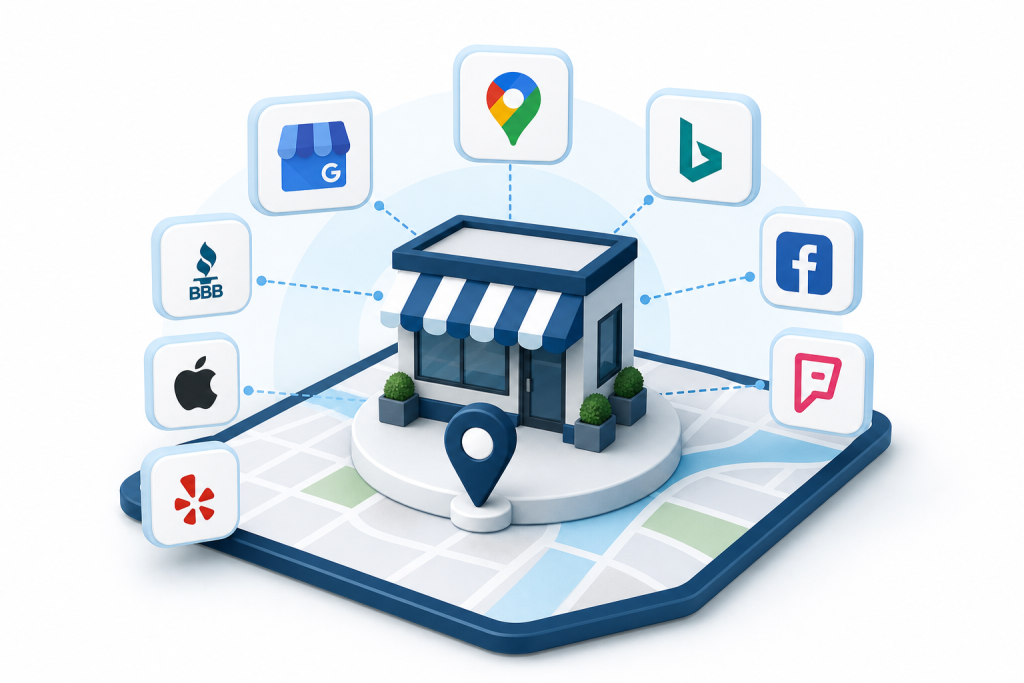
The core free online business listings for driving local traffic are Google Business Profile, Yelp, Better Business Bureau, Facebook, Bing Places, Apple Maps, and Foursquare, plus niche directories matched to your industry. Claiming and optimizing these listings, with consistent NAP (Name, Address, and Phone number) data, puts your business in front of local searchers at the moment they are ready to buy.
Most small and mid-sized businesses (SMBs) set up a website and stop there. Directory listings are where local buyers actually find you first.
Why Online Business Listings Matter for Local SEO
Directory listings are not optional extras. They are a direct path to the first page of Google for local searches.
According to Suff Digital's 2026 study, 67.7% of local Google searches include at least one business directory site on the first page of results. That means when someone searches "plumber near me" or "best coffee shop in Sacramento," a directory listing is almost certainly sitting above or beside any organic website result. Suff Digital's research also found that directory sites hold the top organic position for 10.3% of local queries.
Those numbers matter because first-page placement is where buying decisions happen. A business that appears only on its own website misses the majority of local search real estate.
Listings also reinforce your credibility. A complete profile with accurate hours, photos, and reviews signals to both search engines and potential customers that your business is active and legitimate. That credibility compounds across platforms: the more consistent your information is, the more confidently search engines can surface your business for relevant queries.
What Are the Best Free Business Listing Sites in the USA?
Seven general-purpose platforms form the core of any free online business listings strategy in the USA, and two categories of niche directories round out the nine. The table below gives you a quick reference before the detailed sections that follow.
In 2026, Yelp led the business listing platform market with a 43.5% share, followed by the Better Business Bureau at 29.4%. These figures reflect platform market share, not SEO authority rankings.
| Platform | Primary Audience | Free to Claim | Best For |
|---|---|---|---|
| Google Business Profile | General local searchers | Yes | Maximum local search visibility |
| Yelp | Consumers researching local businesses | Yes | Reviews and trust signals |
| Better Business Bureau | Consumers and B2B buyers | Yes | Credibility and complaint resolution |
| Social media users | Yes | Community engagement and social proof | |
| Bing Places | Non-Google search users | Yes | Reaching audiences outside Google |
| Apple Maps | iPhone and Mac users | Yes | Restaurant and travel discovery |
| Foursquare | Global and mobile audiences | Yes | Check-ins and location-based discovery |
All seven platforms offer free basic profiles. Some offer paid advertising or enhanced features on top of that free tier, but claiming your listing costs nothing on any of them.
Google Business Profile: Your Most Important Free Listing
Google Business Profile (GBP) is the single highest-priority listing for any business targeting local customers in the USA. It controls how your business appears in Google Search knowledge panels, Google Maps, and the local pack results that dominate mobile searches.
A Crawlora analysis found that 60.8% of businesses do not have a website listed in their Google Maps profile. That gap hands potential customers to competitors who filled in one extra field. A 2026 BasedOnBusiness study found that only 73.0% of local listings included a website link, even though 93.6% included a phone number. Completing every field in your GBP profile puts you ahead of a significant portion of your competition before you do anything else.
Follow these steps to set up and optimize your profile:
- Go to Google Business Profile and sign in with a Google account tied to your business.
- Search for your business name to check whether a listing already exists, then claim it or create a new one.
- Choose the correct primary business category, since Google uses this to match your listing to relevant searches.
- Enter your complete NAP details, making sure they match exactly what appears on your website and other directories.
- Add your website URL, business hours, and a description of your services.
- Upload at least five photos, including your storefront, interior, and any products or services you offer.
- Complete the verification step, which Google typically handles by postcard, phone, or video, before your listing goes live.
Once verified, return to your profile regularly to post updates, respond to reviews, and keep your hours current for holidays and special closures.
Yelp, BBB, and Facebook: Three Listings That Build Trust
These three platforms do something the others cannot replicate as directly: they show potential customers what other people think of your business before a single conversation happens.
Yelp is a crowd-sourced review platform where users publish ratings for local businesses. It holds the largest market share among analyzed listing platforms, at 43.5% in 2026. To claim your listing, search for your business on Yelp's business owner portal, verify ownership, and complete your profile with hours, photos, and a service description. Yelp offers paid advertising options on top of the free profile, but the basic listing itself costs nothing to claim.
The Better Business Bureau (BBB) takes a different approach. Rather than crowd-sourced reviews, it assigns letter-grade ratings based on how a business handles customer complaints, its transparency, and its responsiveness. That makes a BBB profile particularly persuasive for B2B buyers and consumers making high-stakes purchases. Claiming your free BBB listing is straightforward: search for your business on bbb.org, request ownership, and complete the verification process. BBB also offers paid accreditation, which adds a trust badge and additional visibility, but the free listing alone puts your grade in front of buyers who check.
Facebook rounds out this group with a different kind of trust signal: social proof from people in a buyer's own network. A Facebook business page lets you post updates, collect reviews, and answer questions publicly. Per suffdigital.com, Facebook pages rank second only to Yelp for first-page Google appearances in local searches. To claim or create your page, go to facebook.com/pages/create, select your business category, and fill in your NAP details, hours, and a profile photo.
All three listings are free to claim. The credibility they build with customers is cumulative: a buyer who sees consistent information and positive reviews across Yelp, BBB, and Facebook is far more likely to call.
Bing Places, Apple Maps, and Foursquare: Listings Most Businesses Overlook
Most SMBs stop at Google and Yelp. That leaves real traffic uncaptured from audiences who search differently.
Bing Places for Business manages your profile across Bing Search and Bing Maps. Bing captures a meaningful share of desktop search traffic, particularly from users on Windows devices where Bing is the default browser search engine. Claiming your listing is free: visit bingplaces.com, sign in with a Microsoft account, and either import your existing Google Business Profile or build a new listing from scratch. Per wytlabs.com, Bing Places reaches audiences that fall entirely outside Google's primary search ecosystem, making it a low-effort addition with genuine incremental reach.
Apple Maps controls how your business appears to iPhone and Mac users searching for local options. Given how many people use Apple devices for navigation and local discovery, an unclaimed Apple Maps listing is a missed opportunity, especially for restaurants, cafes, and any business with a travel or hospitality angle. Claim your listing through Apple Business Connect at businessconnect.apple.com. The process requires an Apple ID and basic business verification.
Foursquare operates as a location-based discovery platform used by global and mobile audiences. Users search for nearby businesses and leave check-ins and tips. While its consumer-facing profile has shifted over the years, Foursquare's location data feeds into dozens of third-party apps and mapping services, so a claimed and accurate Foursquare listing extends your reach well beyond the platform itself. Some advanced Foursquare features require a paid subscription, per wytlabs.com, but the basic business listing is free to claim at foursquare.com.
Claiming all three puts your business in front of audiences your competitors have likely ignored.
How to Choose Industry-Specific Directories for Your Business
General directories give you broad reach. Industry-specific directories put you in front of buyers who have already narrowed their search to your category, which often means higher intent and better conversion.
The right niche directories depend on your industry and location. Start by identifying the directories most relevant to your specific field and geographic area [S1]. Those platforms vary by industry: healthcare providers appear on health-focused review and provider directories, contractors on home improvement and project-matching platforms, and restaurants on food discovery and reservation platforms. The table below maps common business types to the directory categories worth prioritizing.
The table below maps common business types to the categories of directories worth prioritizing.
| Industry | Directory Type to Prioritize | What Buyers Use It For |
|---|---|---|
| Healthcare and medical | Health-focused review and provider directories | Finding and vetting local practitioners |
| Home services and contractors | Home improvement and project-matching platforms | Getting quotes and checking credentials |
| Legal and financial services | Professional services and attorney directories | Verifying credentials and reading peer reviews |
| Restaurants and hospitality | Food discovery and reservation platforms | Browsing menus, hours, and user photos |
| B2B and professional services | Business-to-business directories and agency listings | Evaluating vendors and comparing service providers |
| Automotive | Vehicle dealer and service shop directories | Checking inventory, pricing, and service reviews |
Traditional directory sites, including general-purpose platforms that have been around since the print era, still index well in some local searches and are worth a basic listing if your industry has historically relied on them.
One practical rule: prioritize depth over breadth. A complete, photo-rich, review-active profile on three well-matched directories outperforms a bare-minimum listing on fifteen. For ideas on how to reach local buyers across channels beyond directories, the local marketing ideas guide covers tactics that pair well with a strong listings strategy. For guidance on how citations across these platforms affect your overall local search presence, the local citations for SEO managed service guide explains what consistent citation management actually involves.
How to Keep Your Listings Accurate and Consistent Across Every Platform
Claiming your listings is the first step. Keeping them accurate is the ongoing work that determines whether those listings help or hurt your rankings.
Search engines compare your business information across directories. When your Name, Address, and Phone number (NAP) appear differently from one platform to the next, that inconsistency creates doubt about which version is correct. A listing with an old phone number or a slightly different address spelling can quietly undermine the credibility you built by claiming the profile in the first place.
Follow this process to stay consistent:
- Standardize your NAP details first. Decide on one exact version of your business name, address format, and phone number, then use it identically everywhere [S2]. Include suite numbers, abbreviations (St. vs. Street), and local area codes exactly as they appear on your website.
- Verify each platform individually. Each directory has its own verification method, whether by postcard, phone call, email, or video [S3]. Complete each one fully before moving on.
- Keep hours and services current. Update every listing when your hours change for holidays, seasonal closures, or new service offerings [S4]. A customer who shows up based on outdated hours is a lost customer.
- Respond to reviews on every platform. Answering both positive and negative feedback shows potential customers, and search engines, that your business is active [S5].
A 2026 study by BasedOnBusiness found that only 73.0% of local listings included a website link, even though 93.6% included a phone number. That gap is exactly the kind of incomplete profile that a quarterly audit catches. Set a reminder every three months to log into each platform, confirm your details are current, and check for any duplicate listings that may have been auto-generated.
When to Get Professional Help Managing Your Online Listings
DIY listing management works well when you have one location, a stable address and phone number, and time to log into each platform every few months. When any of those conditions change, the work compounds quickly.
Multiple locations mean multiple profiles on every platform. A rebrand, address change, or new phone number requires updates across every directory you have claimed, and missing even one can send conflicting signals that affect your local rankings. Businesses that also run paid advertising, manage social media, and maintain a website often find that listings become the task that slips.
This is where a full-service agency makes practical sense. A managed service takes over the ongoing work of updating, auditing, and correcting listings across every platform, so nothing slips when your business changes. If your listing needs have grown beyond a single spreadsheet and a quarterly reminder, that kind of support removes the maintenance burden entirely.
For SMBs that want to understand the full scope of what managed local marketing covers, the local SEO services guide for nearby business outlines what a managed approach looks like in practice. You can also explore the full range of local search services at epuerto.com.
Prices and plan limits verified as of October 2026.
FAQs
Where can I find free business listings in the USA?
The seven general-purpose platforms covered in this guide are all free to claim at the basic level: Google Business Profile, Yelp, Better Business Bureau, Facebook, Bing Places, Apple Maps, and Foursquare. Beyond those, search your primary service plus your city in Google and note which directory sites appear on the first page. Those are the platforms your local buyers already use, and most offer a free basic listing.
Are Google business listings really free?
Yes. Creating and claiming a Google Business Profile costs nothing. Google does not charge to appear in Google Search knowledge panels, Google Maps, or local pack results. Some third-party services charge to manage your GBP on your behalf, but the listing itself is free directly through Google Business Profile.
How long does it take for a new business listing to appear in search results?
Timing varies by platform and depends on when verification completes. Google requires verification before your listing goes live, and that step alone can take several days if you choose the postcard method. Other platforms may publish your profile sooner, but search engines index new pages on their own schedule. Plan for a few weeks before you see consistent visibility across platforms.
What happens if my NAP information is inconsistent across directories?
Inconsistent NAP data creates conflicting signals that can reduce your local search visibility. When your business name, address, or phone number appears differently across platforms, search engines have less confidence in which version is accurate. The practical fix is to standardize one exact version of your NAP and update every listing to match, then run a quarterly audit to catch any drift.
Do I need to list my business on every directory, or just a few?
You do not need to be everywhere. A complete, actively maintained profile on the seven general platforms in this guide, plus two or three niche directories matched to your industry, covers the majority of local search real estate. Spreading thin across dozens of directories with incomplete profiles does less for your visibility than a smaller set of fully optimized ones.
What is the difference between a general directory and an industry-specific directory?
A general directory like Google Business Profile or Yelp accepts businesses from any category and serves broad local search traffic. An industry-specific directory focuses on one field, such as healthcare, home services, or legal, and attracts buyers who have already narrowed their search to that category. Both types are worth claiming, but industry-specific directories often reach buyers with higher purchase intent for your specific service.
Conclusion
The nine listings covered here, seven general platforms plus two or more niche directories matched to your industry, give you the most direct path to first-page local search visibility without any ad spend. The data is clear: directory sites appear on the first page of local Google searches more than two thirds of the time, and the businesses that show up there have simply done the work of claiming and completing their profiles.
Your best next step is to audit what you already have. Search your business name on Google, Yelp, and Bing and note which profiles exist, which are unclaimed, and which have outdated information. Start with Google Business Profile if you have not claimed it, then work through the remaining six general platforms before adding niche directories. A complete profile on the right platforms, with consistent NAP details and a website link, is the most practical thing you can do for your local search presence this week.