
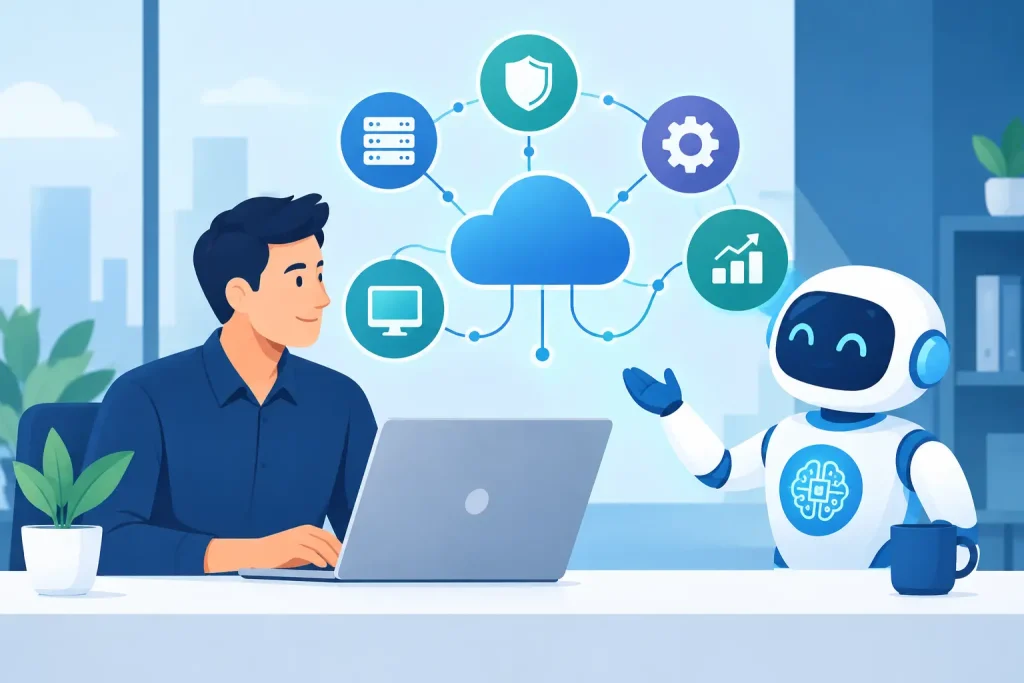
A phishing email reaches an employee at 8:12 a.m. A backup job fails at 8:19. By 8:30, a front-desk computer starts showing signs of a hard drive problem. For a small business or community organization without a large internal IT department, those events can quickly become lost productivity, frustrated staff, and real security exposure. AI tools for managed IT can help identify patterns earlier and focus attention where it is needed most.
The useful question is not whether artificial intelligence will replace IT support. It will not replace the judgment, accountability, and local understanding that businesses need from a technology partner. The better question is where AI can make managed IT more proactive, more efficient, and more useful to the people relying on it every day.
Where AI Tools for Managed IT Create Value
Managed IT has always involved monitoring systems, resolving issues, protecting data, and helping employees work without technology getting in the way. AI improves parts of that work by processing large volumes of system activity faster than a person can. It can recognize unusual login behavior, group repetitive alerts, identify devices that may be headed for failure, and suggest likely causes for common support issues.
For a medical office, that may mean recognizing unusual access attempts before a patient-data incident develops. For a museum or nonprofit, it may mean spotting a server storage problem before an important database or donor file is affected. For a local business with several locations, it may mean seeing that a network pattern is slowing transactions or cloud applications at one site.
The value is not simply speed. It is better prioritization. Most organizations do not need more alerts. They need the right people looking at the right issue before it disrupts operations.
Security monitoring and threat detection
Cybersecurity is one of the clearest applications for AI-assisted management. Security platforms can compare current activity against normal behavior across endpoints, email accounts, networks, and cloud services. When a staff member logs in from an unfamiliar location, downloads an unusual volume of files, or receives a suspicious message designed to imitate a vendor, AI can help flag the event for investigation.
That does not mean every unusual event is an attack. Employees travel, passwords expire, software updates create odd activity, and legitimate vendors may change their sending systems. A managed IT team still needs to validate alerts, understand the organization’s workflows, and decide on the appropriate response. AI helps reduce the time between a possible warning sign and informed human action.
Alert reduction and smarter support queues
A typical business technology environment generates far more notifications than a small IT team can reasonably review one by one. Devices report low disk space, patches fail, users lock accounts, printers disconnect, and internet connections fluctuate. Many alerts are routine. Some indicate a problem that will become expensive if ignored.
AI-assisted operations tools can correlate related alerts and reduce duplicate noise. Instead of receiving separate notices from ten workstations after a network interruption, a technician may see one incident with the likely source identified. That gives the support team more time to resolve the underlying issue rather than repeatedly treating symptoms.
For business leaders, this matters because IT service should not be measured only by the number of tickets closed. A better outcome is fewer repeat issues, less employee downtime, and clearer communication when a meaningful problem occurs.
Predictive maintenance for devices and networks
Computers, firewalls, servers, and network equipment often show warning signs before they fail. Repeated errors, rising temperatures, declining drive health, unusual restart patterns, or increasing bandwidth congestion can point to trouble ahead. AI can analyze these signals over time and help technicians identify which systems deserve attention first.
Predictive maintenance is especially valuable for organizations that cannot afford a surprise outage during business hours. A chamber preparing for an event, a clinic supporting appointments, or a retailer processing payments needs dependable technology when demand is highest. Replacing a failing device on a planned schedule is typically less disruptive than reacting after it stops working.
Still, predictions are not guarantees. A system may be flagged and continue operating normally for months, while another device may fail with little warning. AI should inform maintenance planning, not create false certainty.
Choosing the Right AI Tools for Managed IT
The market is full of products that promise automated security, automated support, and automated decision-making. Small and mid-sized organizations should be cautious about buying tools simply because they include AI in the description. The best fit depends on the systems already in place, the sensitivity of the organization’s data, and who will be responsible for reviewing the results.
Start with the operational problem. If employees lose time to recurring computer issues, an AI-enhanced help desk or remote monitoring platform may be useful. If phishing and account compromise are the greater concern, focus on email security, identity monitoring, and endpoint protection. If leaders lack visibility into aging equipment and network performance, analytics that support lifecycle planning may deliver more value.
A useful managed IT approach connects these tools rather than treating each one as a separate dashboard. Security findings should inform support priorities. Backup reports should be reviewed alongside device health. Network changes should be considered alongside cloud application performance. When technology services are coordinated, leaders get clearer recommendations and fewer competing vendor messages.
Questions to ask before adopting an AI platform
Before approving a new platform, ask how it handles your data, what information it collects, and whether sensitive business or customer information is used to train external models. Ask whether the tool offers clear audit records and whether a human can review or override its recommendations.
It is also reasonable to ask what happens when the platform is wrong. Does it automatically block access? Can it quarantine a legitimate email or device? Is there a defined escalation path for urgent issues? Automation can be valuable, but the business should understand the guardrails before turning it loose on critical operations.
Cost deserves the same scrutiny. A low monthly software price can become expensive when it requires new integrations, ongoing tuning, staff training, or additional security controls. In many cases, a well-managed set of proven tools is more valuable than an oversized collection of advanced features nobody has time to use.
AI Needs Human Accountability
AI can analyze logs and recognize trends, but it does not understand a community organization’s mission, a business owner’s seasonal revenue pressures, or the practical impact of taking a system offline for maintenance. Those decisions require context.
Human accountability also matters when technology intersects with privacy, compliance, and customer trust. Healthcare entities, nonprofits handling donor records, and local businesses managing payment information cannot assume that an automated recommendation is appropriate just because it appears confident. A qualified IT partner should review risks, explain options in plain language, and document the actions taken.
This is where managed IT services remain central. The goal is not to hand business operations over to an algorithm. The goal is to give skilled technicians better information so they can prevent issues, respond faster, and make recommendations that support the organization’s broader goals.
Building a Practical AI-Assisted IT Plan
A sensible first step is to establish a reliable technology baseline. That includes an inventory of devices and software, verified backups, current security protections, documented user access, and monitoring for critical systems. Without that foundation, AI may simply process incomplete information faster.
Next, choose one or two high-value use cases. A business with frequent email threats might begin with AI-supported email filtering and account monitoring. An organization with aging computers may prioritize device health analytics and proactive replacement planning. Measure the results in terms leaders can understand: fewer disruptions, faster response, reduced risk, or less time spent on repeat support requests.
Finally, review performance regularly. AI models, software environments, and cyber threats all change. Rules that made sense six months ago may need adjustment after a new cloud platform, staffing change, office move, or business expansion. Epuerto helps organizations connect managed IT, cybersecurity, cloud services, and the digital systems that support their public presence, so technology decisions can contribute to real, measurable outcomes.
The strongest use of AI is often quiet: an incident prevented, a failing device replaced before it interrupts work, or a suspicious login reviewed before it becomes a breach. When AI is guided by experienced people and aligned with business priorities, it becomes another practical way to protect operations and enhance your business.