
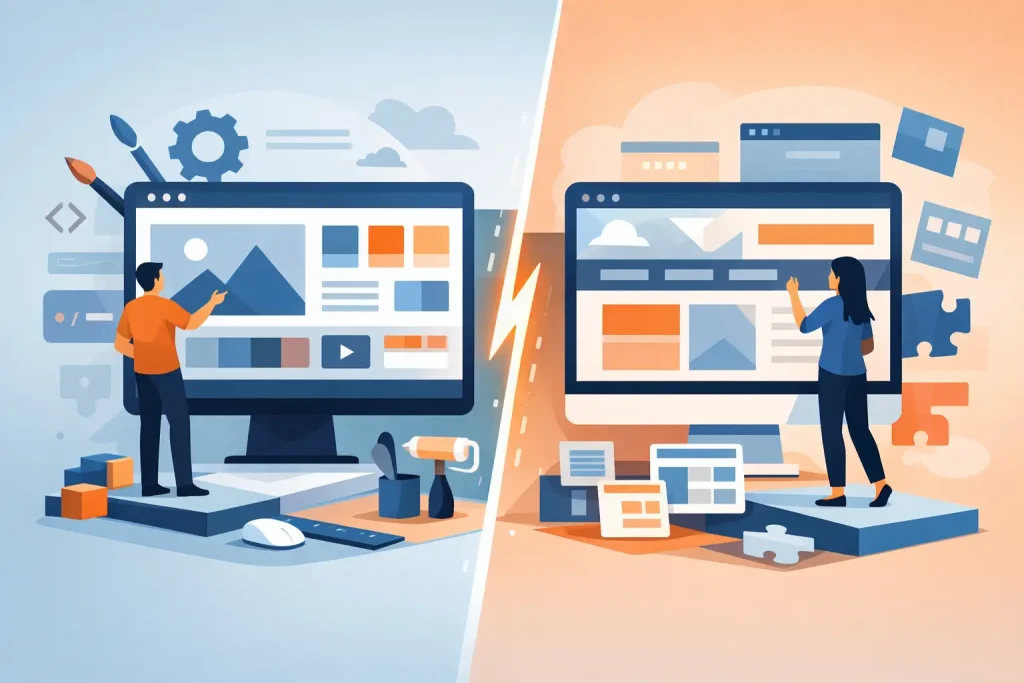
A website decision can affect far more than your organization’s appearance online. When weighing a custom website versus template website, business owners and community leaders are really deciding how much flexibility, support, and future capacity they need from a key business tool.
A polished website should help people find you, understand what you offer, take action, and trust that your organization is established and dependable. For a local business, nonprofit, healthcare provider, museum, or chamber, it may also need to connect with scheduling tools, donations, event calendars, secure forms, local marketing campaigns, and day-to-day operations. The right choice depends less on which option is “best” in general and more on what your organization needs the site to accomplish.
Custom Website Versus Template Website: The Core Difference
A template website starts with a pre-built design framework. Platforms offer layouts, color options, page sections, and add-on features that allow a business to publish a site quickly. You supply the content, select the style, and configure the available settings. This can be an efficient route for organizations with straightforward needs, a limited initial budget, and a clear willingness to work within the platform’s boundaries.
A custom website is designed and built around your organization’s specific goals, audiences, content, and workflows. Rather than forcing your services, programs, or customer journey into preset page blocks, the site structure is planned to support the way people actually engage with you. That can include custom navigation, specialized content areas, integrations, performance improvements, and a visual identity that is distinctly yours.
The difference is not simply visual. A template can look professional. A custom site can use familiar patterns. The practical distinction is control: how closely can the website support your processes today, and how well can it adapt when your organization changes?
When a Template Website Is the Smart Choice
Templates are not a poor choice by default. A well-configured template can give a new business a credible online presence much faster than a fully custom build. If you need a simple site with a few service pages, staff information, contact details, basic blog posts, and a clear call to action, a template may meet the need effectively.
Templates can also work well for a short-term campaign, a temporary event site, or a small organization that needs to establish basic digital visibility before investing further. The initial cost is usually lower, and the available editing tools may let internal staff make simple updates without relying on a developer for every change.
That convenience comes with limits. As more plugins, apps, workarounds, and custom code are added to make a template behave differently, the original cost advantage can narrow. A site that began as a simple solution can become harder to manage when multiple people have adjusted it over time without a clear plan.
For many local organizations, the question is not whether a template can launch a website. It can. The question is whether it will still serve the organization when it adds online scheduling, grows its service lines, expands to multiple locations, introduces membership programs, or relies more heavily on search and digital advertising.
Where a Custom Website Creates More Value
A custom website is most valuable when the website needs to do meaningful work for the organization. It may need to guide different audiences to different services, collect secure inquiries, feature a large calendar, organize a resource library, connect to business systems, or support a carefully planned marketing funnel.
Your brand needs more than a color swap
Template designs are made to appeal to a broad market. Even with different fonts, photos, and colors, many sites using the same framework can feel similar. That may not be a concern for every business, but it matters when trust and differentiation influence the decision to call, visit, donate, or book an appointment.
A custom design can reflect the personality and priorities of your organization from the first interaction. For example, a coastal museum may need a visual experience that highlights exhibits and local history, while a healthcare practice needs information presented with clarity, accessibility, and reassurance. Both need good design, but they need different design decisions.
Your customer journey has specific steps
A visitor should not have to hunt for the next step. Custom planning makes it possible to build pages around the questions people actually ask and the actions you want them to take. That could mean requesting IT support, registering for an event, finding a program, submitting a referral, viewing service areas, or contacting the right department.
This level of planning often improves conversion because the site is organized around real user needs rather than the order of sections supplied by a theme. It also helps staff spend less time answering routine questions that the website should address clearly.
You expect operational complexity
Organizations frequently outgrow a website when it cannot integrate with the tools already used by their teams. Custom development can better accommodate connections to customer relationship systems, email marketing tools, inventory platforms, appointment software, donation systems, membership databases, or secure portals.
Not every integration requires a custom site, and some template platforms offer strong app marketplaces. Still, it is wise to evaluate the full workflow before choosing a platform. An app that appears affordable on its own may create duplicate data entry, inconsistent reporting, or a confusing experience for customers and staff.
Cost Is More Than the Launch Price
The initial price gap between a custom website and a template website is real. Templates typically cost less to launch because the underlying design and functionality already exist. A custom build requires discovery, planning, design, development, testing, content coordination, and quality assurance. That work takes time because it is tailored to your goals.
But launch cost is only one part of the investment. Consider the total cost over several years: platform fees, premium plugins, add-on apps, developer fixes, redesigns, security maintenance, content updates, hosting, backups, and staff time spent managing workarounds.
A lower-cost template can provide excellent value when its capabilities match your needs. It becomes less economical when it repeatedly needs exceptions. Conversely, a custom site is not automatically a wise investment if your organization only needs a concise digital brochure. The goal is to avoid paying for capacity you will never use while also avoiding a platform that limits your next stage of growth.
Security, Maintenance, and Ownership Need Attention
A website is part of your organization’s technology environment, not just a marketing asset. It needs reliable hosting, software updates, backups, access management, monitoring, and a plan for recovery if something goes wrong. This is especially significant for organizations handling customer information, payment details, protected records, or public-facing forms.
Template platforms often manage portions of security and hosting for you, which can reduce administrative work. However, responsibility does not disappear. Account access, third-party applications, form handling, user permissions, and content practices still need oversight.
Custom websites require an intentional maintenance plan, but they can give you greater control over hosting, code, integrations, and data practices. Before committing to either approach, ask who owns the domain name, website files, design assets, content, hosting account, and administrative credentials. A website should remain an asset your organization can manage, not a dependency held entirely by an outside vendor.
Search Visibility and Accessibility Are Planning Issues
Neither a template nor a custom website is guaranteed to rank well in search results. Search visibility depends on helpful content, clear page structure, technical performance, local relevance, accurate business information, and an ongoing strategy. A template can support strong SEO when it is properly configured. A custom site can also underperform if content and technical fundamentals are neglected.
The advantage of custom development is the ability to make decisions around your specific search opportunities from the beginning. Pages can be structured around distinct services, locations, programs, and audience questions without being constrained by a generic theme layout. Speed, mobile usability, navigation, and conversion paths can also be addressed as part of the build.
Accessibility deserves the same consideration. Visitors may use screen readers, keyboards, magnification, or other assistive technologies. A professional website should make it easier for more people to access your information and services. Accessibility is not a final checkbox. It requires thoughtful design, readable content, usable forms, image descriptions, color contrast, and ongoing attention as pages change.
Make the Decision Based on Your Next Three Years
Instead of asking only, “What can we afford this month?” ask what the website must support over the next three years. Consider expected growth, new services, staff capacity, content needs, marketing plans, integrations, compliance requirements, and the cost of an eventual rebuild.
A template website may be right if you need to establish a clean, functional presence quickly and your requirements are simple. A custom website may be the better fit if your website is central to lead generation, community engagement, service delivery, or brand credibility. In some cases, the strongest path is a carefully planned template site now, with a documented plan for a custom build once the organization reaches clear growth milestones.
The best website is not the one with the most features. It is the one that helps people take the next step with confidence while giving your team a dependable foundation to enhance your business as it grows. A partner such as Epuerto can help connect that foundation to the technology, marketing, and local visibility efforts that turn a website from an online brochure into a measurable business asset.