
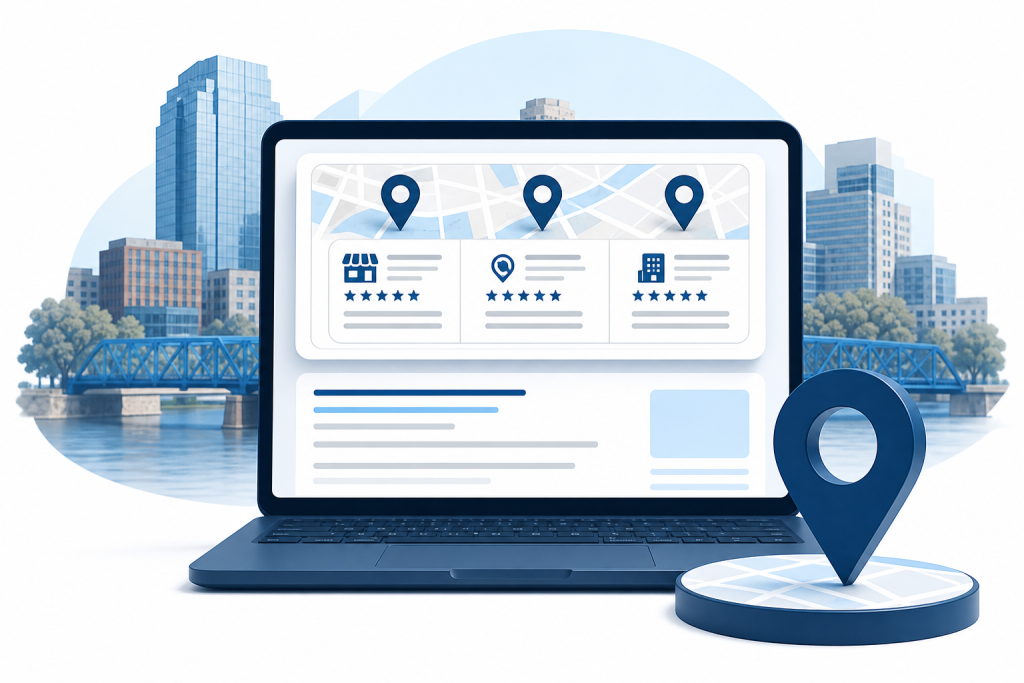
Grand Rapids SEO means making your business visible when West Michigan customers search locally. The core work is fixing your citations, building localized pages, adding schema, earning reviews, speeding up your site, and winning backlinks. After that, you decide whether to run these steps yourself, hire a solo expert, or bring in a full-service agency.
A customer types "plumber near me" or "accountant in Grand Rapids" into a phone, and three businesses appear on a map. The rest sit below, mostly unseen. This guide walks through six steps, then helps you choose who should do the work.
What Grand Rapids SEO Is and Why Local Search Matters Here
Grand Rapids SEO is the work of making your business easy for search engines and AI tools to find, trust, and recommend when someone in West Michigan looks for what you sell. It covers your Google Business Profile, the consistency of your listings across the web, the pages on your site, your reviews, and the links pointing to you.
The goal for most local businesses is the Google Map Pack, the block of three map listings that appears above regular results for local searches. A spot there puts your name, rating, phone number, and directions in front of people who are ready to act. No one can guarantee a Map Pack placement, but you can build the signals that earn one.
The local market gives you a reason to try. The Grand Rapids Chamber reports that the region led the Midwest in population growth, with an 8% increase over the last ten years (2025). More residents means more people searching for services, restaurants, clinics, and contractors.
Demand also varies by niche and by town. According to Ahrefs data cited by ClicksBracket, 700 searches a month are for SEO services that name Grand Rapids, a vendor-reported figure that shows how many local owners are already looking for help. Netvantage SEO research puts the Grand Rapids technology niche at 147,730 in estimated monthly search volume (2026), also vendor-reported. The takeaway: demand is not spread evenly. A suburb like Holland draws a smaller pool of searchers than the city, and a niche like technology draws far more than most trades. Check your own keywords before you budget for them.
How Much Does a Local Click Cost in Grand Rapids?
Paid clicks add up fast. PPC Folks reports that a Google Ads click for the keyword "plumber" in Grand Rapids averages $22.28 (2026). That is one keyword in one trade, so don't treat it as a rule for every business or market.
Still, it shows the math behind the organic effort. Every paid click costs you money. An organic click costs nothing. If a plumber needs ten clicks to land a job from ads, that adds up to a steep ad bill for one customer, before any other cost.
This does not mean SEO is free. It takes time, content, and steady upkeep, and results build slowly rather than on day one. The trade-off is that the work you do on pages, reviews, and links stays with your business instead of disappearing when you stop paying for ads.
The research doesn't show how Grand Rapids click costs compare with other markets, so I won't guess. If you run ads in a trade like yours, check your own account data. That number tells you what a first-page organic position is worth to you.
Steps 1 and 2: Fix Your Citations and Plan Local Keywords
The first two steps lay the foundation. Skip them and the later work has nothing solid to stand on.
Step 1: Audit your local citations
A local citation is any mention of your business name, address, and phone number (often shortened to NAP) on another site: directories, maps, chamber listings, and review platforms. Search engines compare these mentions. When they disagree, your business looks less certain, and that can hurt your visibility.
Audit your citations first, then correct the inconsistencies. Pull up your main listings and check each against your real details. Verify these items:
- Business name, spelled exactly as it appears on your sign and website
- Street address, including suite numbers and abbreviations (St. vs. Street)
- Primary phone number, with the same local area code everywhere
- Website URL, pointing to the same version of your homepage
- Business hours, including holiday changes
- Business category, matching what you actually do
This is where a lot of owners get tripped up. Old addresses and tracking phone numbers linger on directories for years after a move or a rebrand. If you want to see what a managed service handles here, Local Citations for SEO: What a Managed Service Handles breaks it down.
Step 2: Plan local keywords and optimize existing pages
Once your listings agree, turn to your own site. Keyword research is the work of finding the exact phrases West Michigan customers type, then matching each phrase to a page that answers it.
Start with the pages you already have. A service page titled "Our Services" tells search engines little. A page about "emergency furnace repair in Grand Rapids" tells them exactly who it serves and where. Build a short plan that pairs each service with a location phrase, such as a neighborhood, suburb, or nearby city you really serve.
Then optimize what exists before writing anything new. Update titles, headings, and opening paragraphs so they name the service and the place. Keep the writing natural. A page stuffed with the city name reads badly and helps no one.
Key Takeaway: Make your listings consistent first, then match each page on your site to one real search phrase.
Step 3: Add Schema Markup and Optimize Your Pages
Schema markup is a block of structured code on your site that tells search engines exactly what your business is, where it is, and what it offers. Search engines can read your page text on their own. Schema removes the guesswork, which matters when several similar businesses compete for the same map spot.
The markup that fits most local businesses is called LocalBusiness schema. It labels your name, address, phone number, hours, service area, and the services you provide. A Grand Rapids dental office, for example, would mark up its practice name, street address, phone number, weekday hours, and each treatment page. A restaurant would add its menu link and cuisine type.
The markup must match what your visitors can see. If your page says you close at 5 p.m. and your schema says 6 p.m., you have created the kind of inconsistency Step 1 was meant to clear up. Treat the code and the page as one set of facts.
Add the markup, then connect it to your localized plan from Step 2. Each service page should carry the service name, the place you serve, and a clear next step, such as a call button or booking form. Many content management systems offer plugins that generate schema, and your developer can add it by hand. Either way, test the finished page with Google's Rich Results Test, a free tool that flags errors. Passing the test does not guarantee a ranking boost, but broken markup can cost you the benefit.
Key Takeaway: Mark up only what your page already says, then test it before you move on.
Steps 4 and 5: Build Reviews and Speed Up Your Site
Reviews and site speed both shape how customers judge you before they ever call. Step 4 covers what other people say about you. Step 5 covers how your site behaves when they land on it.
Step 4: Set up a review routine
A reputation management system is a repeatable routine for asking customers for reviews and replying to the ones you receive. Reviews protect more than your star rating. They protect your phone calls, your click-through rate, and the trust a stranger needs to choose you.
Build the routine around the moment a customer is happiest: right after a finished job, a good appointment, or a delivered order. Send a short text or email with a direct link to your Google Business Profile review form. Reply to every review, positive or negative, in a calm, specific tone. Never offer payment for reviews or write fake ones; platforms penalize both. For a closer look at the work involved, see Online Review Management: What a Local Agency Should Do.
Step 5: Audit and improve site speed
A technical audit of site speed means measuring how fast your pages load, then fixing what slows them down. Slow pages frustrate visitors, and most of them are on phones.
Run your key pages through Google's PageSpeed Insights, a free tool that scores load time and lists specific fixes. The usual culprits are oversized images, too many plugins, and cheap hosting.
Use this monthly checklist:
- Send review requests to every customer served that month
- Reply to all new reviews within a few days
- Re-run PageSpeed Insights on your homepage and top service page
- Compress any new images before uploading
- Remove plugins you no longer use
- Check that forms and phone links still work on mobile
Key Takeaway: Ask for reviews after every job, and test your speed every month.
Step 6: Earn Backlinks and Get Cited in AI Search Answers
A backlink is a link from another website to yours. Search engines treat links from relevant, trusted sites as votes of confidence. Step 6 is the slowest step, but it often separates businesses that rank from businesses that only look good on paper.
Start with a linkable asset: something worth citing. For a local business, that might be a guide to a seasonal problem, a local cost breakdown based on your own jobs, a neighborhood resource list, or original photos and data from your work. Generic blog posts rarely earn links. Useful, specific ones sometimes do.
Then do outreach. Contact sites that already cover your topic or your area: local news outlets, the chamber of commerce, supplier and partner sites, nonprofit organizations you support, and trade associations. Tell them plainly what you made and why their readers might want it. Expect many to say no or never reply. Quality matters far more than volume.
These signals now feed AI answers too. Generative engine optimization (GEO) is the practice of making your business easy for AI tools like ChatGPT, Gemini, and Google's AI summaries to cite. A Q4 2026 index from AIO Search Console found that 93.7% of AI engine responses to local trade queries include specific business recommendations, a vendor-reported figure. AI tools recommend local businesses, and they draw on the same web evidence you are building: consistent listings, clear pages, reviews, and mentions on other sites.
GEO now sits alongside local and technical SEO in the standard toolkit. No one can guarantee an AI citation, so focus on being clear, consistent, and easy to verify.
Key Takeaway: Publish something worth citing, ask relevant sites to link to it, and keep your facts identical everywhere AI tools might look.
Solo Expert or Full-Service Agency: Which Should You Hire?
You have three paths: do the six steps yourself, hire a solo expert, or hire an agency. Doing it yourself costs time, not fees. A solo expert gives you one person who knows your account, but one person has limited hours. An agency brings writers, developers, and analysts, and usually a more structured process.
Not every business needs the same setup, but contract style and specialty should guide the choice. The agencies below come from published directory and agency listings, so confirm details with each one directly.
| Option | Best for | Services emphasized |
|---|---|---|
| David Kranker Creative | Owners who want direct access to one person and no long-term contract | Organic traffic growth, technical audits, link building; will not work with your direct local competitor |
| Avalanche Creative | Home services, nonprofits, and healthcare | Content writing, web design, SEO; neighborhood targeting across West Michigan |
| Funnel Boost Media | Medical, legal, and manufacturing firms | Organic search, advertising, web design; a paid plan |
| Netvantage SEO | Businesses that want an SEO-only specialist | Organic SEO, paid search management, web analytics |
| JSL Marketing & Web Design | Owners who want a plan built around their business | SEO strategy, brand development, social media |
| Transformed Design Inc | Businesses that want SEO plus site upkeep | Local SEO, GEO, technical SEO, conversion optimization, hosting; based in San Diego and works remotely |
None of these lists a public price, so ask each for a written scope before you compare.
Contract terms deserve a direct question. Month-to-month deals let you leave if results disappoint, while longer retainers can give a team room to finish slow work like link building. SEO results tend to last when the assets stay in place: your content, links, and reviews. Rankings can slip without ongoing upkeep, so ask any provider who owns your site, content, and accounts when the contract ends.
When a Done-for-You Digital Partner Makes Sense
An SEO-only shop is not always the right fit. Some businesses prefer one vendor for their website, IT, and local marketing, while others prefer specialists for each. Epuerto is a done-for-you digital partner that builds and hosts websites, manages IT needs like network security, cloud computing, and backup, and runs campaigns across mobile apps, digital screens, mailers, and social media for small and mid-sized businesses.
A small retailer might use it to launch a site and reach nearby shoppers through local screens and mailers. A manufacturer might lean on the IT and security side while the site stays current. Epuerto is not an SEO-only vendor, so ask what it covers for search before you rely on it for rankings. For a broader comparison, see Done-for-You Digital Agency vs. Managing It Yourself.
Prices and plan limits verified as of November 2026.
FAQs
Is it better to hire a solo SEO expert or a full-service marketing agency in Grand Rapids?
It depends on the scope. A solo expert suits a focused need and gives you direct access to one person, but their hours are limited. A full-service agency handles content, web design, and advertising together, which helps if you need several skills at once. Match the choice to your workload, your budget, and how much oversight you want to give.
How do I optimize my business for AI summaries and generative search engines?
Build the same evidence AI tools draw on: consistent listings, clear localized pages, schema markup, reviews, and mentions on trusted sites. Answer customer questions plainly on your pages. No one can guarantee an AI citation, so focus on being accurate, specific, and easy to verify.
Do SEO results last after I end a contract with an agency?
Often partly, because content, links, and reviews remain on the web. But rankings can slip without ongoing upkeep, and results vary by industry and competition. Before you sign, ask who owns your site, content, and accounts when the contract ends.
Are month-to-month SEO contracts better than long-term retainers?
Month-to-month terms give you flexibility to leave if progress stalls. Retainers can give a team time to finish slower work like link building. Neither is better in every case, so pick based on how much risk you want to carry and how clearly the provider defines deliverables.
How is search demand in Grand Rapids different from suburbs like Holland?
Demand varies by place and by niche. Vendor-reported research shows the Grand Rapids technology niche alone at 147,730 estimated monthly searches. A smaller suburb like Holland draws a smaller pool of searchers. I have no reliable figure for Holland, so check your own keywords in a keyword tool.
Which Grand Rapids agencies specialize in healthcare, legal, or manufacturing?
Per its listing, Avalanche Creative names healthcare among its focus areas, and Funnel Boost Media names medical, legal, and manufacturing. Ask any agency for examples from your industry before you commit.
Conclusion
Grand Rapids SEO comes down to six steps done in order: consistent citations, localized pages, schema markup, reviews, faster pages, and earned links. Whether you do them yourself or hire help, the same assets build your visibility.
Start by checking your name, address, and phone number across your top listings this week. Then decide who should handle the rest: you, a solo expert, or a team.