
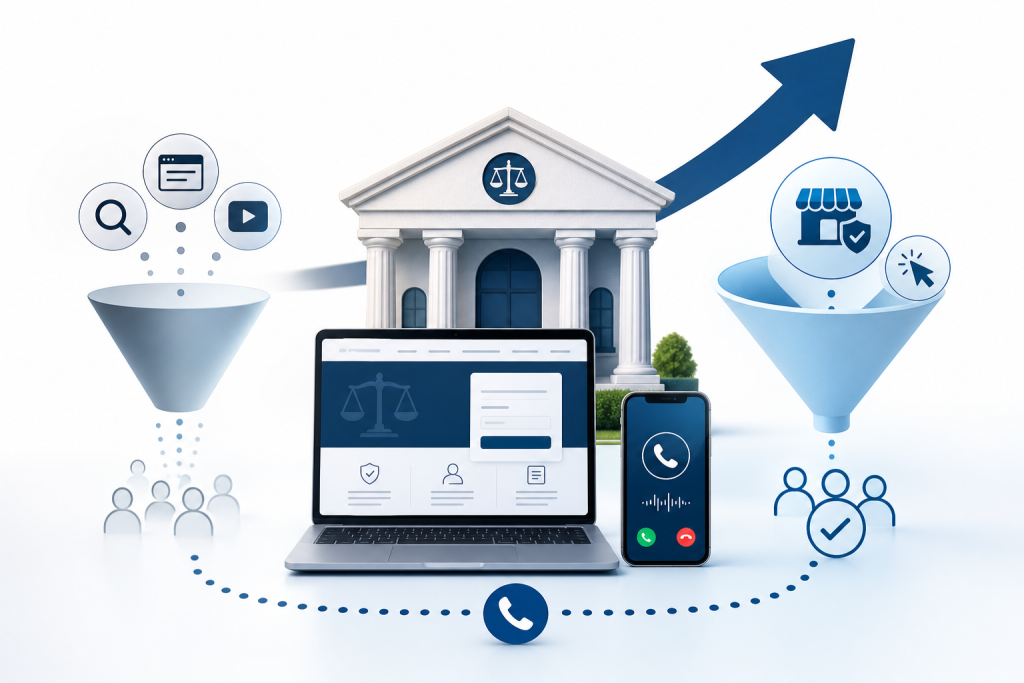
Effective internet marketing for lawyers in 2026 combines a fast, conversion-optimized website, Google Local Services Ads, phone-call tracking, and visibility in AI answer engines. The old approach of pouring budget into search ads alone is losing ground: a CallRail study cited by MyCase found that 82% of law firms running paid search report poor ROI, and organic legal traffic dropped 13.8% in the first half of 2026. This guide walks through a step-by-step system that fixes the conversion gaps first, then shows you where to put your budget. The focus is on Google-based channels, AI search, and short-form video, the areas where the clearest data exists for legal marketing in 2026.
Why the Old Internet Marketing Playbook for Lawyers Is Breaking Down
The standard legal marketing playbook, heavy spend on Google Search Ads paired with a basic SEO strategy, is producing weaker results than it did even two years ago. Three data points explain why.
First, paid search has become expensive and unreliable. According to Probative's 2026 benchmarks, the average cost per click for law firm search ads now runs between $50–75. Getting that click to turn into a signed client costs even more: Probative also reports the advertising cost to acquire a single signed client through search and video ads sits between $5,500–6,000. At those figures, a campaign needs to be dialed in precisely or it bleeds budget fast.
Second, organic search is shrinking as a channel. Konstructive reported that organic search traffic for the legal sector decreased by 13.8% in the first half of 2026 compared to the prior year. That is not a rounding error. Firms that built their entire visibility strategy on ranking for keywords are watching that traffic erode month by month.
Third, the way people find attorneys is changing at the source. An iLawyerMarketing consumer study found that the share of people using Google to research attorneys dropped from 86.7 percent to 71.9% in a single year. Searchers are moving to AI tools, short-form video, and peer recommendations. A strategy built only around Google's ten blue links is chasing a shrinking audience.
Step 1: Build a Conversion Engine Before Spending on Traffic
Most law firms treat their website as a brochure and then wonder why paid campaigns underperform. The problem is rarely the ad. It is what happens after the click.
Ruler Analytics data shows that the legal industry averages a 7.9% conversion rate across all analyzed sessions. That is a useful benchmark. If your site is converting well below that, you are leaving potential leads behind before a single ad dollar does its job. Fix the foundation first.
S1: Establish a conversion engine by optimizing website UX and intake speed.
Start with page speed and mobile layout. More than half of legal searches happen on a phone, and a slow or cluttered mobile page loses visitors before they read a word. Aim for a load time under three seconds on mobile.
Next, put your primary call to action above the fold on every practice area page. That means a phone number in the header, a short contact form (name, phone, brief description, nothing more), and a clear statement of what you handle. Visitors should never have to scroll to find out how to reach you.
Then audit your intake process. If a prospective client submits a form at 9 p.m. and hears back the next afternoon, you have likely lost them to the firm that called within the hour. Set up automated text or email acknowledgments that confirm receipt immediately, and build a follow-up workflow that reaches out within 30 minutes during business hours.
Finally, add live chat or a chatbot for after-hours coverage. A visitor who gets an instant response, even an automated one that books a callback, is far more likely to stay in your pipeline than one who hits a contact form and waits.
Getting this infrastructure in place before you scale any paid channel means every dollar you spend on traffic works harder.
Step 2: Should Law Firms Use Google Ads or Local Services Ads?
Law firms choosing between Google Search Ads (pay-per-click) and Google Local Services Ads (LSA) are really choosing between two different risk profiles. Both channels can generate leads. They work differently, and the right choice depends on your practice area and how much budget you can commit.
| Channel | Typical Cost Model | Benchmark CPC / Lead Cost | ROI Signal |
|---|---|---|---|
| Google Local Services Ads | Pay per qualified lead (not per click) | Not publicly listed; typically lower cost per signed client than standard search ads | Firms receive a "Google Verified" badge after passing background checks, which tends to lift conversion rates |
| Google Search Ads (PPC) | Pay per click, regardless of outcome | Average CPC of $50–75 per click; cost per signed client of $5,500–6,000 | 82% of firms using paid search report poor ROI per a CallRail study cited by MyCase |
Google Local Services Ads operate on a pay-per-qualified-lead model rather than pay-per-click. You pay only when a potential client contacts you through the ad, not every time someone clicks. Firms that pass Google's background check process earn a "Google Verified" badge, which appears directly in the listing and signals credibility before a visitor even reaches your site. Per probativegrowth.com, LSA typically produces a lower cost per signed client than standard search ads.
Standard search ads give you more control over targeting, ad copy, and bidding strategy, which matters for firms in competitive practice areas like personal injury or mass tort where LSA inventory may be limited. The trade-off is cost and risk: in those categories, a poorly optimized campaign burns through budget quickly, and the cost-per-signed-client can far exceed what LSA produces. For a deeper look at how PPC fits into a law firm's channel mix, the PPC Attorney Ads: What Law Firms Should Know in 2026 guide covers bid strategy and targeting in detail.
For most small and mid-sized firms, LSA is the better starting point. Start there, get your cost-per-lead baseline, and layer in search ads once your intake process (Step 1) is proven to convert.
Step 3: Track Phone Calls or You Are Flying Blind
Phone calls are where most legal clients actually commit. Ruler Analytics reports that 56.3% of all legal sector conversions happen over the phone. If your analytics setup only tracks form submissions and web sessions, you are missing more than half of the picture.
That gap creates a specific problem: you cannot tell which campaigns, keywords, or channels are actually generating clients. You see clicks and impressions, but the conversion that matters, the phone call that becomes a signed retainer, stays invisible. You end up cutting campaigns that work and funding ones that do not.
Call tracking fixes this by assigning unique phone numbers to each marketing channel. When a prospect calls the number tied to your LSA campaign, that call is logged against that channel. When they call the number from your organic listing, that logs separately. You can then see cost-per-call and cost-per-client by source, not just cost-per-click.
Here is how to set it up:
- Assign a unique tracking number to each active channel: LSA, paid search, organic, and any offline placements like mailers or signage.
- Forward all tracking numbers to your main office line so staff experience no change in how they answer.
- Set your analytics platform to record call duration. Calls under 30 seconds rarely convert; filtering them out gives you a cleaner lead count.
- Review call recordings weekly for the first 90 days. You will quickly spot whether intake staff are following up promptly and whether callers are reaching a live person or hitting voicemail.
- Feed call conversion data back into your ad platforms. Both Google Ads and LSA can optimize toward phone call conversions once you give them that signal.
Without this data, budget decisions are guesswork. With it, you can allocate spend to the channels that actually produce signed clients.
Step 4: Get Found in AI Search and Short-Form Video
The drop in Google-based attorney research is not going to reverse. The iLawyerMarketing study that tracked the share of people using Google to find attorneys, down from 86.7 percent to 71.9% in a single year, points directly at where that attention is going: AI answer engines and short-form video.
AI tools like ChatGPT, Perplexity, and Google's AI Overviews now answer legal questions directly in the interface. A person asking "do I need a lawyer after a minor car accident" may never click a search result at all. To appear in those answers, your content needs to be structured the way AI systems prefer: clear questions answered in plain language, consistent name-address-phone (NAP) data across every directory, and authoritative backlinks from local and legal publications.
Practically, this means writing content that answers specific questions rather than targeting broad keywords. A page titled "What to Do After a Car Accident in Oregon" with a direct, factual answer in the first paragraph is more likely to surface in an AI response than a page optimized around "car accident lawyer Oregon." Short FAQ sections on every practice area page also give AI systems structured text to pull from.
Short-form video, particularly on platforms like YouTube Shorts and Instagram Reels, is reaching potential clients who have stopped using search engines as their first step. The evidence on conversion rates from short-form video in the legal sector is still limited, so treat it as a brand-building and trust channel rather than a direct-response one. A 60-second video answering a common client question costs little to produce and can reach an audience that your written content never will.
Diversifying into AI-optimized content and video is not optional for firms planning past 2026. Organic search alone will not sustain a firm's visibility when the audience is spreading across multiple platforms.
What Percentage of a Law Firm’s Budget Should Go to Digital Channels?
Budget allocation is one of the most practical questions in legal marketing, and the honest answer is that it varies by firm size and growth stage. What the data does show is that digital spending is rising across the board. A Williams Lea survey found that 80% of senior marketing leaders at large law firms reported budget increases in 2026, even as many described their teams as under-resourced.
For small and mid-sized law firms, a reasonable starting point is allocating the majority of the total marketing budget to digital channels, with the remainder covering traditional placements like local print, radio, or direct mail. That split reflects where legal clients are actually spending their attention, and it leaves room for offline channels that still perform well in specific local markets. For a broader set of tactics that work at the local level, local marketing ideas for small businesses covers options that complement the digital channels described here.
Within the digital portion, prioritize in this order: website and intake infrastructure first, LSA second, call tracking third, and content or video fourth. Paid search can come later, once you have a baseline cost-per-client from LSA to compare against.
One practical rule: set a cost-per-signed-client target before you commit to any channel. Without that number, you have no way to judge whether a campaign is working. Review it quarterly and adjust allocations based on what the call tracking data shows, not on what a platform's dashboard reports as impressions or reach.
When Does a Done-for-You Marketing Partner Make Sense for a Law Firm?
Managing the system described in this guide, website optimization, LSA campaigns, call tracking, AI content, and video, takes consistent time and specialized knowledge. For solo practitioners and small firms where attorneys are also the primary rainmakers, that combination is often unrealistic to handle in-house.
A done-for-you agency makes the most sense when one or more of these conditions apply: your intake process is losing leads but you cannot identify where, your campaigns are running but you have no reliable cost-per-client data, or you are ready to scale spend but lack the infrastructure to convert the traffic you would generate.
The alternative to outsourcing is hiring in-house, which adds salary, benefits, and management overhead while still leaving gaps in specialized skills like paid media or technical SEO.
Epuerto is a digital and IT services agency that provides law firms and other small and mid-sized businesses with a done-for-you approach: custom website builds, multi-channel campaign management, and local audience reach through a proprietary network of mobile apps, digital screens, mailers, and social media. For firms that want a single point of accountability across channels rather than coordinating multiple vendors, that model removes a real operational burden.
If that expertise does not already exist inside your firm, a capable partner closes that gap faster than building it from scratch. For more on what to expect from that kind of relationship, the Local Digital Marketing Agency: What to Expect When You Hire One vs. a National Brand guide covers the key differences.
Prices and plan limits verified as of November 2026.
FAQs
What is gladiator law marketing and how does it differ from standard legal marketing?
"Gladiator law marketing" is a term some agencies use to describe high-budget, high-visibility legal advertising. There is no standard definition, and the tactics it describes vary by provider. Regardless of the label, smaller practices usually get better returns by fixing conversion infrastructure first and scaling spend only after their cost-per-client baseline is established.
How can a small law firm compete with large firms that have bigger ad budgets?
Large firms win on volume, not necessarily on efficiency. A small firm that tracks calls, optimizes its intake process, and targets a narrow geographic area or specific practice area can produce a lower cost per signed client than a large firm running broad campaigns. Google Local Services Ads level the playing field somewhat because the pay-per-qualified-lead model rewards relevance over raw budget. Specificity and speed of follow-up are your real advantages.
Does growing a law firm’s size require a minimum monthly ad spend?
There is no universal minimum, but campaigns with very small budgets in competitive practice areas like personal injury or criminal defense rarely generate enough data to optimize. A more useful framing: set a target number of new signed clients per month, estimate your cost-per-client from LSA benchmarks, and work backward to a budget. Starting with LSA before layering in paid search keeps early spend more predictable.
How long does it take for a new law firm website to generate consistent leads?
A newly launched website typically takes three to six months to build enough organic visibility to generate consistent inbound traffic. Paid channels like LSA can produce leads within days of launch, which is why they are the better starting point for new sites. The two work together: LSA drives immediate volume while organic content builds over time. Expect to review results after 90 days and adjust based on what call tracking data shows.
Is social media marketing worth the investment for solo practitioners?
It depends on the practice area and how you define "investment." Paid social ads for legal services tend to have lower intent than search-based channels, so direct lead generation is harder to measure. Organic social, particularly short-form video answering common client questions, builds trust and keeps your name visible to people who are not yet ready to call. For a solo practitioner with limited time, a realistic commitment is two to three short videos per week on one platform, treated as a long-term brand channel rather than an immediate lead source.
Conclusion
Effective internet marketing for lawyers in 2026 is not about spending more. It is about fixing what happens after someone finds you, tracking where clients actually come from, and showing up in the places where legal research is moving. The firms generating consistent leads built their intake infrastructure first, chose channels based on cost-per-client data, and adapted to the shift toward AI search and short-form video.
Start by auditing your website's mobile speed and contact flow. Then set up call tracking across every active channel before you increase any ad budget. Once you have real cost-per-client numbers from LSA, you will have a clear basis for deciding where to scale next.