
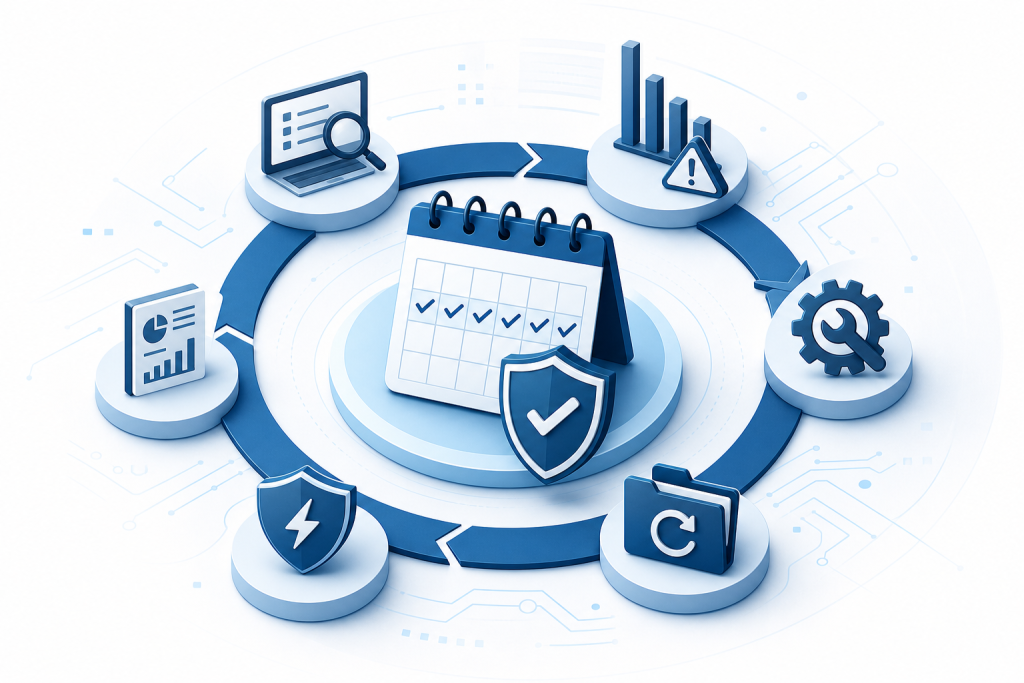
A managed patch management service should cover six core deliverables: full software inventory reconciliation, risk-based prioritization, staged ring deployment, verification and rollback testing, zero-day emergency response, and audit-ready executive reporting. Vendors that skip any step leave measurable exposure gaps. The median organization already takes 43 days to close a known exploited vulnerability, and patching services exist precisely to close that window before attackers find it.
The stakes are concrete. A report by Sophos found that 32% of ransomware attacks in 2024 were initiated through an unpatched software vulnerability. That single statistic explains why buyers are spending more on managed patching every year, and why the monthly deliverables in your vendor contract deserve the same scrutiny you give any other security control.
How Does Patch Management Work as a Managed Service?
When you outsource patching to a vendor, you are buying a repeating monthly cycle, not a one-time project. The vendor takes responsibility for discovering every piece of software running across your environment, scoring each vulnerability, deploying fixes in a controlled sequence, and proving the work was done.
The global patch management market is projected to reach $1.11 billion in 2026, growing at a 14.1% compound annual growth rate. That growth reflects how many small and mid-sized businesses (SMBs), medical offices, and community organizations have decided that managing this cycle in-house is not a reasonable use of their staff's time.
A managed cycle runs in four phases each month. First, the vendor scans your full software estate and reconciles the asset list. Second, it scores each open vulnerability and assigns a remediation priority. Third, it deploys approved patches in stages, starting with a small test group before touching production systems. Fourth, it verifies that patches applied correctly and documents the results.
Step 1: Build and Reconcile a Complete Software Inventory
Before any patch can be deployed, a vendor must know exactly what software is running across your environment. This is not a one-time setup task. It is a monthly reconciliation that accounts for new devices, newly installed applications, and software that staff added without IT approval.
Patch management in cyber security starts with asset visibility. A vendor that cannot see a device cannot protect it. This is where a lot of SMBs get tripped up: they assume the vendor's initial scan captured everything, but endpoints added after onboarding, remote laptops, and cloud-hosted workloads often fall outside the original scope unless the vendor actively reconciles the list each cycle.
Vendors use two primary discovery methods, and a capable service uses both.
Agent-based discovery installs a lightweight software agent on each managed endpoint. The agent reports installed software, versions, and patch status directly to the vendor's platform, even when the device is off the corporate network. This matters for remote staff and field devices.
Agentless (API-native) discovery queries network infrastructure and cloud platforms without requiring software on every endpoint. It is useful for servers, network appliances, and environments where deploying agents is impractical.
A complete inventory reconciliation each month should produce three outputs: a confirmed asset count, a list of newly discovered software since the last cycle, and a list of devices that dropped off the network and need follow-up. If your vendor cannot hand you these three items at the start of each reporting period, the rest of the patching cycle is built on incomplete information.
The reconciliation step also catches software that should not be there. Unauthorized applications, outdated browser plugins, and end-of-life operating system versions all represent exposure that a vendor should flag, not quietly ignore because no patch exists for them.
Key Takeaway: Demand a monthly asset reconciliation report that lists new devices, new software, and any endpoints that went dark during the cycle.
Step 2: Risk-Based Prioritization, How Fast Does a Critical Patch Reach Production?
Patch management vendors should not push every available patch at once. The right approach scores each vulnerability against three factors: its severity rating, its active exploitation status, and the criticality of the asset it affects.
Most vendors use the Common Vulnerability Scoring System (CVSS) as a starting point. CVSS assigns each vulnerability a numeric score from 0 to 10 based on factors like attack complexity and potential impact. A score in the critical range sits at the top of that scale. CVSS alone is not enough, though. A critical-scored vulnerability in a rarely used internal tool carries less urgency than a medium-scored one being actively exploited in the wild.
This is where exploitability data changes the prioritization model. Tools like Automox use AI-based risk scoring to correlate CVE (Common Vulnerabilities and Exposures) data with real-world exploit activity, so a vendor can identify which vulnerabilities attackers are actually using right now rather than just which ones score highest on paper. Qualys Patch Management takes a similar approach, correlating vulnerability data with affected assets to support autonomous remediation decisions, per paritybitsecurity.com.
The remediation speed benchmarks tell a sobering story. According to Qualys's 2026 benchmarks, the average mean time to remediation for complex enterprise applications is 5 months and 10 days. That figure measures the full remediation lifecycle for complicated, deeply integrated software. A separate measure from the Verizon 2026 Data Breach Investigations Report shows that the median organization takes 43 days to fully remediate a known exploited vulnerability. These two figures measure different things: the first captures how long complex app patching takes on average, the second captures how quickly organizations close gaps that attackers are already targeting. Both numbers are too slow for a business that cannot afford a breach.
Research by Adaptiva indicates that 59% of organizations now deploy patches within a six-day window. That improvement reflects better tooling and managed service adoption. Your vendor should be in that group.
A reasonable SLA (service level agreement) for a managed patching service looks like this:
- Critical / actively exploited vulnerabilities: remediation within 24 to 72 hours
- High severity (CVSS high range): remediation within 7 days
- Medium severity (CVSS mid range): remediation within 30 days
- Low severity: remediation within the next scheduled monthly cycle
If a vendor cannot commit to these tiers in writing, that is a signal worth taking seriously before you sign a contract. Ask specifically how they handle patch management vendors that cover network security monitoring and patching as part of a broader service scope.
Key Takeaway: Require written SLA tiers tied to CVSS scores and exploit status, not just a single monthly patching window.
Step 3: Staged Ring Deployment and Rollback Procedures
A vendor that pushes every approved patch directly to your entire fleet in one operation is taking an unnecessary risk with your production systems. Staged ring deployment breaks the process into controlled waves so that a bad patch affects a handful of test machines, not your entire office.
The standard ring model has three stages:
- Canary ring: A small group of non-critical machines, typically two to five endpoints, receives the patch first. The vendor monitors these devices for 24 to 48 hours before moving forward.
- Early adopter ring: A broader set of volunteer or low-risk workstations gets the patch next. This stage catches compatibility issues that did not appear on the canary group.
- Broad fleet ring: The remaining managed endpoints receive the patch after the early adopter stage clears without incident.
Each ring should have a defined hold period and a clear pass/fail criterion before the vendor advances to the next stage. Ask your vendor what those criteria are. "No reported issues" is not a criterion. Specific metrics, such as no application crashes, no failed boot events, and no service disruptions logged within 48 hours, are.
Rollback procedures matter as much as the deployment itself. A capable vendor maintains a pre-patch system snapshot or uses the operating system's built-in restore points so that a problematic update can be reversed within a defined window, typically two to four hours for a critical production system. Ask your vendor to document its rollback workflow and the maximum time it commits to reversing a problematic update on a critical production system.
Third-party application coverage deserves a direct question during vendor evaluation. Operating system patches from Microsoft or Apple are the baseline. Your vendor should also cover browsers, PDF readers, Java runtimes, productivity suites, and any line-of-business software with a vendor-supplied patch feed. Ask for a written list of covered application families before you sign.
Key Takeaway: Require a written ring architecture with hold periods, pass/fail criteria, and a documented rollback window for every deployment cycle.
Step 4: Zero-Day and Emergency Response, What Your Vendor’s SLA Must Include
Zero-day vulnerabilities, meaning flaws that attackers exploit before a vendor patch exists, require a different workflow than scheduled monthly patching. Your vendor needs a documented emergency response process that activates outside the normal cycle.
A credible zero-day response process follows these steps:
- Detection and triage: The vendor monitors threat intelligence feeds and vendor security advisories around the clock. When a zero-day is confirmed affecting your environment, triage begins immediately, not at the next scheduled maintenance window.
- Compensating controls: When no patch exists yet, the vendor deploys interim protections. These may include firewall rule changes, disabling the affected service, network segmentation, or application-layer controls. Qualys Patch Management supports remediation scripts and mitigations specifically for situations where a vendor patch is not yet available, per opsiocloud.com.
- Fast-track patching: Once the software vendor releases a patch, the vendor applies it through an accelerated ring cycle, compressing the normal hold periods while still staging the rollout.
- Post-incident documentation: The vendor produces a written record of what was affected, what compensating control was applied, when the patch deployed, and what verification confirmed remediation.
A report by Sophos found that 32% of ransomware attacks in 2024 started through an unpatched software vulnerability. Zero-days represent the hardest version of that problem because the patch does not exist yet. Compensating controls are what stand between your systems and an active exploit during that window.
One limitation worth flagging: mobile device patching, covering phones and tablets, is often reporting-only in many managed services. A vendor may be able to tell you which mobile devices are running outdated operating system versions, but actual remediation may depend on the device owner accepting an update manually. Confirm exactly what your vendor can enforce versus what it can only report on.
Your contract should include explicit SLA language for zero-day events: a response time for initial triage, a timeline for compensating control deployment, and a commitment to fast-track patching once a fix is available.
Key Takeaway: Confirm that your vendor's contract names specific response windows for zero-day events and defines what compensating controls they will deploy when no patch exists.
Step 5: Compliance Evidence and Monthly Executive Scorecards
A vendor that patches your systems but cannot prove it has done so creates a compliance problem as real as not patching at all. Monthly executive scorecards are not optional extras. They are the documentation layer that makes your patching program auditable.
Three items in that report matter most to auditors and cyber insurers. The exposure window summary shows how many days each closed vulnerability sat open on your systems. The SLA adherence rate shows what percentage of patches met their contracted deadline, with a written explanation for every miss. The open and deferred item log lists what is still unpatched, why, and when it will close. Without those three, a compliance auditor cannot confirm your program is working, and a cyber insurer cannot assess your risk accurately.
A complete monthly report should also include patch coverage rate by severity tier, mean time to remediation by tier, and an asset reconciliation delta showing new devices, removed devices, and any endpoints that went dark during the cycle.
Software solutions accounted for 62.13% of the patch management market share in 2025, which means most organizations are running some form of automated patching platform. The scorecard is what converts that automation into evidence a compliance auditor or cyber insurer can actually use.
When you read patch management services reviews, the most consistent complaint from buyers is not about patching speed. It is about reporting quality. Vendors that deliver raw scan exports instead of interpreted scorecards shift the analytical burden back to your staff. That is not a managed service.
Before signing with any vendor, ask for a sample monthly report. If it does not contain exposure windows, SLA adherence rates, and a deferred item log, ask why.
Key Takeaway: A monthly scorecard with exposure windows and SLA adherence rates is the minimum documentation a managed patching vendor should deliver, not a premium add-on.
When a Fully Managed IT Partner Makes More Sense Than a Point Solution
A dedicated patch management tool handles one job well. But patching does not exist in isolation. When a vulnerability sits on a misconfigured firewall, an unmonitored cloud workload, or a server running an unsupported operating system, a standalone patching vendor may close the CVE and miss the larger exposure entirely.
A fully managed IT partner can prioritize vulnerabilities in context. A critical patch on a server that feeds your billing system carries different urgency than the same patch on a test machine. That judgment call requires knowing your environment, not just your asset list.
For small and mid-sized businesses, medical offices, and community organizations without an internal IT team, the managed partner model typically reduces both risk and administrative overhead. Epuerto is a managed IT and cybersecurity provider that covers network security, cloud computing, backup, and patching for businesses that need coordinated coverage without building an in-house team to run it. If you want to see what that full-service model includes in practice, the managed IT services breakdown for small businesses covers what is actually included and why each piece matters.
Prices and plan limits verified as of October 2026.
FAQs
What is the difference between patch management and vulnerability management?
Patch management is the process of deploying software updates to close known security gaps. Vulnerability management is broader: it includes scanning for weaknesses, assessing risk, and tracking remediation across your entire environment, whether a patch exists or not. Patching is one remediation method within vulnerability management. A strong program uses both, with vulnerability data driving patch prioritization rather than treating every update as equal urgency.
How do patch management vendors handle third-party software like browsers and PDF readers?
Coverage varies significantly by vendor. Operating system patches from Microsoft or Apple are the baseline most services include. Third-party coverage, meaning browsers, PDF readers, Java runtimes, and productivity suites, depends on the vendor's application catalog and patch feed integrations. Before signing, ask for a written list of covered application families. If a vendor cannot produce one, assume third-party coverage is limited or inconsistent.
What are the top vulnerability management tools in 2026?
Two platforms that appear frequently in managed service contexts are Automox and Qualys Patch Management. Automox automates CVE-prioritized remediation across operating systems and third-party software using AI-based risk scoring, per giiresearch.com. Qualys Patch Management provides autonomous remediation with vulnerability-to-patch correlation and supports mitigation scripts when no vendor patch is available, per opsiocloud.com. Both run as cloud platforms. Neither publishes a standard price list, so pricing requires a direct conversation with each vendor.
What is the best patch management software for Windows environments?
No single platform is the right fit for every Windows environment. The more useful question is whether the platform covers your full application stack, supports staged ring deployment, and integrates with your existing endpoint management tools. Automox and Qualys Patch Management both support Windows environments with automated remediation workflows. Evaluate them against your asset count, your compliance requirements, and the level of automation your team can actually manage.
Can a managed patch service cover mobile devices and tablets?
Often only partially. Many managed patching services can report on which mobile devices are running outdated operating system versions, but actual remediation typically depends on the device owner accepting the update manually. A vendor can flag the exposure; it usually cannot force the update on a personally owned phone or tablet. Confirm exactly what your vendor can enforce versus what it can only report on, and document that distinction in your contract.
How do I evaluate patch management services reviews before choosing a vendor?
When reading patch management services reviews, focus on three areas: reporting quality, SLA adherence, and third-party application coverage. The most common complaint in buyer reviews is that vendors deliver raw scan data instead of interpreted scorecards. Ask any shortlisted vendor for a sample monthly report before you commit. Check whether it includes exposure windows, remediation rates by severity tier, and a deferred item log. If it does not, that gap will follow you into your contract.
Conclusion
A managed patch management service earns its place when it delivers six concrete monthly outputs: a reconciled asset inventory, risk-based prioritization with written SLA tiers, staged ring deployment with rollback procedures, verified remediation records, a documented zero-day response process, and an executive scorecard with exposure windows and SLA adherence rates. Vendors that skip any of these steps leave you with gaps you cannot measure until something goes wrong.
Before you sign with any vendor, ask for a sample monthly report, a written list of covered application families, and explicit SLA language for zero-day events. If a vendor hesitates on any of those three requests, that hesitation is the answer. Start your evaluation there, and the rest of the vendor conversation will be much easier.