
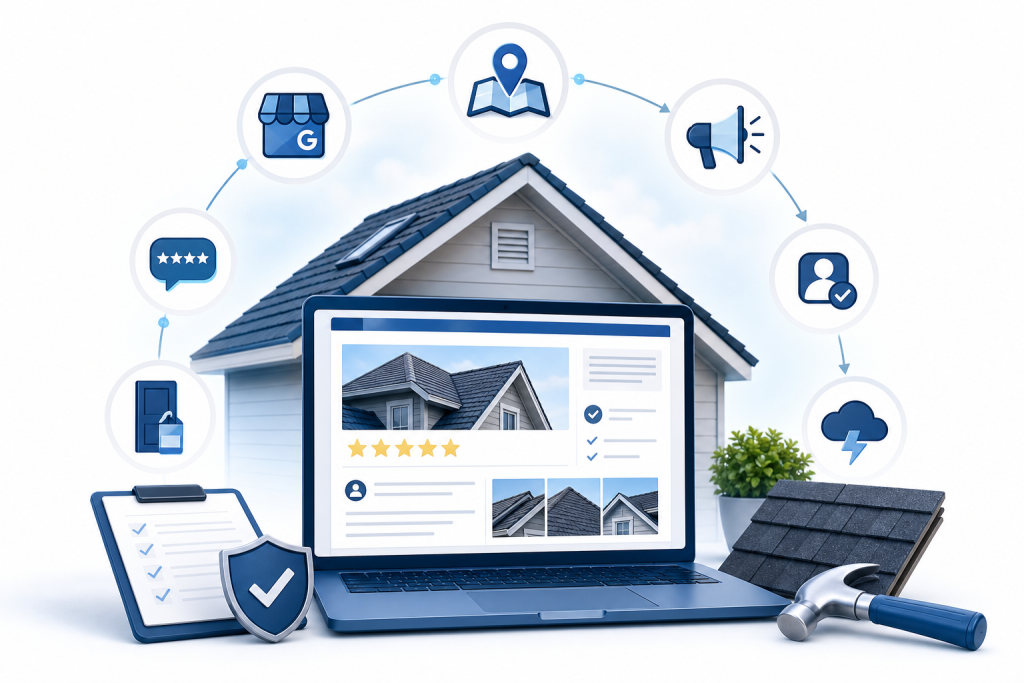
Effective roofer marketing starts with a complete Google Business Profile and a steady stream of customer reviews, then adds a referral system, Local Services Ads, door-to-door canvassing and storm-response campaigns. Track every lead in a CRM so you can see which channels earn jobs, and cut the ones that only produce expensive, unqualified inquiries.
Roofing is a big, review-driven local market. The U.S. roofing contractor market reached $81.3 billion in revenue in 2025, according to the Illinois Roofing Institute. Homeowners spent nearly $31 billion on roof repair and replacement in 2024, per Fixr.com. That money goes to the contractors who show up first and look trustworthy when a homeowner searches.
Getting that call costs real money, so the order of your tactics matters. This guide walks through them as a build sequence: profile, reviews, referrals, paid ads, offline work, storm response, and tracking.
What Is the Best Roofer Marketing Strategy to Start With?
The best roofer marketing strategy to start with is a complete, accurate Google Business Profile, because it controls how you appear when a homeowner searches "roofer near me." Everything else you add later works better once this foundation is in place.
Work through these steps in order:
- Claim and complete your Google Business Profile. Enter your exact business name, address, and phone number. Add your service area, hours, and the roofing services you offer.
- Make your details match everywhere else. Your name, address, and phone number (often called NAP) should read the same on every local directory and citation, from Yelp to your state licensing page. Mismatches confuse search engines and cost you ranking.
- Ask past customers for reviews. Reviews improve your local search position and your click-through rate. The next section covers how to ask.
- Put your strongest selling points on the homepage. Name what sets you apart in the first screen a visitor sees: a manufacturer certification, a workmanship warranty, same-week inspections, or a specific neighborhood you serve.
- Show social proof. Display awards, licensing, and the number of roofs you have completed. Specific counts persuade more than "years of experience."
- Use your own project photos. High-resolution before-and-after shots of finished roofs show craftsmanship in a way copy cannot. Stock photos of shingles tell a homeowner nothing about you.
This is where a lot of roofers get tripped up. They pay for ads that send traffic to a thin website and an unclaimed profile, then conclude that marketing does not work. The profile and the homepage are what convert a click into a call.
Not every roofer needs a full redesign, but the homepage should answer three questions fast: what you do, where you do it, and why a homeowner should trust you. If you want a deeper walkthrough of the ranking side, the guide on how to improve local SEO covers it in more detail.
Key Takeaway: Fix your profile, directory listings, and homepage before you spend a dollar on ads.
How Do Online Reviews Help Roofers Win More Leads?
Online reviews turn a local searcher into a caller because they answer the question every homeowner asks before hiring a stranger to work on their house: can I trust this company? A BrightLocal 2026 survey of 1,002 US adults found that 97 percent of consumers read online reviews for local businesses. If your profile has few reviews, you lose the comparison before you ever speak to the customer.
Reviews also feed your search ranking, so they do two jobs at once. They help you appear in the map results and they persuade the person who sees you there.
Asking is the hard part, and consistency beats volume. Build it into the job:
- Ask at completion. When you walk the finished roof with the homeowner, mention that a Google review helps your crew and helps neighbors find a roofer they can trust.
- Send a direct link. Text or email the link to your review page the same day. Every extra step you add costs you responses.
- Reply to every review. Thank happy customers by name and the project, and answer complaints calmly and specifically. Future customers read your replies as closely as the reviews.
- Never buy or fake reviews. Google can remove them, and a pattern of suspicious five-star posts damages the trust you are trying to build.
Key Takeaway: Make asking for a review part of every job closeout, not something you do when business is slow.
Build a Referral System That Feeds Your Calendar
A referral system works because a recommendation from a neighbor carries more trust than any ad. In a JobNimbus survey reported by Roofing Contractor, 91% of roofing professionals named customer referrals as their most effective source of leads. That is one survey of roofing professionals, not a universal rule, but it matches what most contractors report about where their best jobs come from.
Referrals rarely happen on their own. Satisfied customers are glad to recommend you, but they forget, or they do not know you want the work. A simple system fixes that:
- Ask at job completion. While the crew is cleaning up and the homeowner is happy, say plainly that you build your business on referrals. Ask who else on the street or in their circle might need a roof.
- Follow up after the final invoice. Send a short thank-you within a week, then a check-in a few months later. Keep it personal and brief, and mention the neighbor-referral ask once.
- Make passing your name effortless. Leave a magnet, a yard sign, or a card with your phone number and a one-line description of what you do. A text-ready contact link works even better.
- Thank every referral. Acknowledge the person who sent the lead, whether or not it turns into a job. A handwritten note or a modest gift card is enough.
Referral leads cost little and close at a higher rate, so protect them. Record the source of every referral so you know who sends you work and can thank them again.
Key Takeaway: Ask for referrals at completion, follow up after the invoice, and make your name easy to pass along.
Local Services Ads vs. Standard PPC: Which Fits a Roofer?
Local Services Ads suit most roofers who want leads without managing bids, while standard PPC (pay-per-click advertising) suits contractors who want tighter control over keywords, locations, and landing pages. Both cost real money, so set expectations first. According to LocaliQ 2025 benchmarks, roofing and gutter companies paid a median $228.15 per lead. Treat that as a benchmark from mavixmarketing.com's roundup, not a promise of what you will pay.
| Google Local Services Ads | Standard PPC | |
|---|---|---|
| Cost control | You pay per lead and set a weekly budget. You have little say over which searches trigger your ad. | You pay per click and control keywords, bids, and schedules. Clicks cost money whether or not the visitor calls. |
| Lead intent | Shows a "Google Guaranteed" badge at the top of results, so callers tend to be ready to hire. | Intent varies by keyword. "Roof replacement quote" beats "how long do shingles last." |
| Best use for a roofer | A steady stream of calls with little daily upkeep. | Targeting specific services, neighborhoods, or storm campaigns with dedicated pages. |
The trade-off is control against effort. Local Services Ads are simpler, but you give up keyword and message control. Standard PPC rewards a contractor who can write good ads and review search terms weekly, and it punishes one who sets it and forgets it.
Your marketing materials decide whether paid traffic turns into jobs. At minimum, you need a landing page with your phone number at the top, a short quote form, project photos, your license and insurance details, and a review count. A paid click that lands on a generic homepage wastes the spend.
For a deeper look at running paid campaigns for a local business, see this local digital advertising guide.
Key Takeaway: Start with Local Services Ads for simplicity, and add standard PPC when you can manage keywords and landing pages.
Which Offline Tactics Still Work for Roofers?
Offline tactics still generate roofing leads because roofs are visible, local, and tied to a specific street. A neighbor watching your crew work is a prospect already.
- Door-to-door canvassing. Knock on doors near a job site or in a neighborhood with aging roofs. Lead with a free inspection, not a pitch, and leave with a name and number, not a promise to call back.
- Door hangers after nearby jobs. A hanger that reads "We just replaced a roof on your street" earns attention because it proves local work. Include a photo, a phone number, and your license details.
- Yard signs. Ask permission at every job and keep the sign up until the crew leaves. Signs work as a quiet endorsement all week.
- Mailers. Send postcards to a tight radius around completed jobs or to homes in neighborhoods built in the same decade. Repeat the mailing; one postcard rarely does the work.
- Vehicle and crew branding. Marked trucks and uniform shirts keep your name in front of the neighborhood every day.
You can extend these tactics beyond your own truck route with a local mailer or digital network provider, such as Epuerto, a local marketing company that runs mailers, digital screens, and mobile apps for local businesses. Weigh any provider against doing the canvassing yourself.
What makes a good roof salesman at the door? Honesty about what the roof actually needs. The best ones inspect first, show photos of any damage, explain the options in plain language, and never pressure a homeowner into signing on the spot. A salesperson who pushes a full replacement when a repair would do costs you reviews and referrals, which cost far more than one job.
Key Takeaway: Pair every offline touch with a clear reason to call, such as a free inspection or proof of nearby work.
How Do You Plan Storm Damage Marketing and Seasonal Campaigns?
Storm damage marketing works when you prepare before the weather arrives. After a hailstorm or high-wind event, homeowners search within hours, and the contractors with ready pages and budgets capture the demand.
Before storm season, build a dedicated storm-damage landing page that explains your inspection process, insurance claim support, and emergency tarping. Keep a pre-approved ad budget on hand so you can launch within a day. Write your ad copy and a simple lead form in advance so you only change the location and date.
Split spend between paid and local SEO. Paid ads capture the first wave of searches fast. Local SEO pages for each town you serve keep earning calls long after the storm passes, though they take weeks to rank. A fair starting point is to fund ads for the first few weeks and invest in local pages continuously. Demand is large: nearly $31 billion was spent on roof repair and replacement in 2024, so competitors will chase the same searches.
Seasonal timing shapes your offers too. Many homeowners ask about the cheapest time of year for a new roof, and late fall and winter are often slower for roofers in many regions. Those off-peak months are a natural time to promote scheduling flexibility or early-booking offers, as long as your climate allows installation.
Local marketing works best as a mix rather than a single channel. The pillar guide on local marketing ideas shows how to balance these channels for a local business.
Key Takeaway: Build the storm page and set the budget before the weather arrives, not after.
Track Leads in a CRM Instead of a Spreadsheet
A spreadsheet records who called. A CRM (customer relationship management) system shows which marketing channel turned that call into a signed job. That difference decides which ads you keep and which you cut, and it is hard to see when you log leads by hand.
Three tools come up often among roofers and home service contractors:
- JobNimbus tracks roofing projects from lead to production. The sources behind its card suggest users are more likely to complete 201 to 500 roofs a year than contractors who do not use a CRM.
- ServiceTitan covers scheduling, dispatching, and AI-powered sales coaching. It focuses on work after a customer exists.
- Jobber handles scheduling, quoting, invoicing, and website creation. You will need separate tools for lead generation.
At a median of $228.15 per lead, a channel that produces calls but no jobs gets expensive fast.
Key Takeaway: Tag every lead with its source, then check monthly which channels produced paid jobs.
When Should a Roofer Hire a Marketing Agency?
Hire an agency when marketing keeps slipping behind production. If you cannot answer review requests, update landing pages, or check ad results weekly, the work is not getting done anyway. Do it yourself while you have the time and the interest. Hand it off when your hours are worth more on the roof or at the estimate.
Done-for-you providers bundle websites, local campaigns, and IT support, which suits contractors who want one team handling several pieces. Niche shops in the style of hook roofing marketing are another option. Compare any provider on roofing references and reporting, and see the guide on in-house marketing vs. agency for a fuller decision framework.
Prices and plan limits verified as of November 2026.
FAQs
What are examples of marketing materials a roofer actually needs?
Start with a mobile-friendly website, a complete Google Business Profile, and a quote-focused landing page for paid traffic. Add door hangers, yard signs, and a simple postcard for nearby neighborhoods. Keep a folder of before-and-after project photos, your license and insurance details, and a one-page service sheet. Branded trucks and uniforms round out the set. Start with the digital pieces, since every offline touch sends people online to check you out.
What makes a good roof salesman, and how does that affect marketing?
A good roof salesman inspects before recommending, explains options in plain language, and never pressures a homeowner to sign on the spot. That honesty feeds your marketing directly. Customers who feel respected leave reviews and send referrals, while pushy sales leave complaints that undo your ad spend. Train anyone who talks to homeowners to ask for a review at completion.
What is the cheapest time of year to get a new roof, and how should you advertise it?
Roofing is often cheaper in late fall and winter, when many contractors are slower, though this varies by climate and weather. If your region allows year-round installation, advertise early-booking slots and flexible scheduling during those months. Be honest that weather can delay jobs. Avoid promising a specific discount unless you have set one yourself.
How do I choose between roofer marketing reviews and doing my own research on agencies?
Use both. Reviews help you screen out obvious problems, but vendor testimonials are curated and some roundups are paid placements. Check Google, the Better Business Bureau, and peers in your area. Then ask each agency for roofing clients you can call, and ask what results they track and report each month.
What are the big 5 marketing companies, and are they right for a local roofer?
The big global agency groups mostly serve national brands with large budgets. A local roofer usually gets better results from a provider that understands neighborhood-level search, reviews, and mailers. Judge any agency by its roofing and home service references, its reporting, and how it handles local campaigns, not by its size.
How much of my revenue should go to marketing as a roofing contractor?
There is no single right percentage, and this guide has no verified benchmark to offer. Base your budget on your goals and your numbers. Use your CRM to find your cost per lead and your close rate, then work backward to how many leads you need for the jobs you want. Fund the channels that produce paid work, and trim the rest.
Conclusion
Roofer marketing works best as a sequence. Fix your Google Business Profile and homepage, collect reviews, build a referral habit, then add paid ads, offline work, and storm-ready campaigns. Track every lead by source so your budget follows the jobs, not the guesswork.
Start this week by checking that your business name, address, and phone number match everywhere online. Then pick one habit, such as asking for a review at every job closeout, and make it routine before you add anything else.