
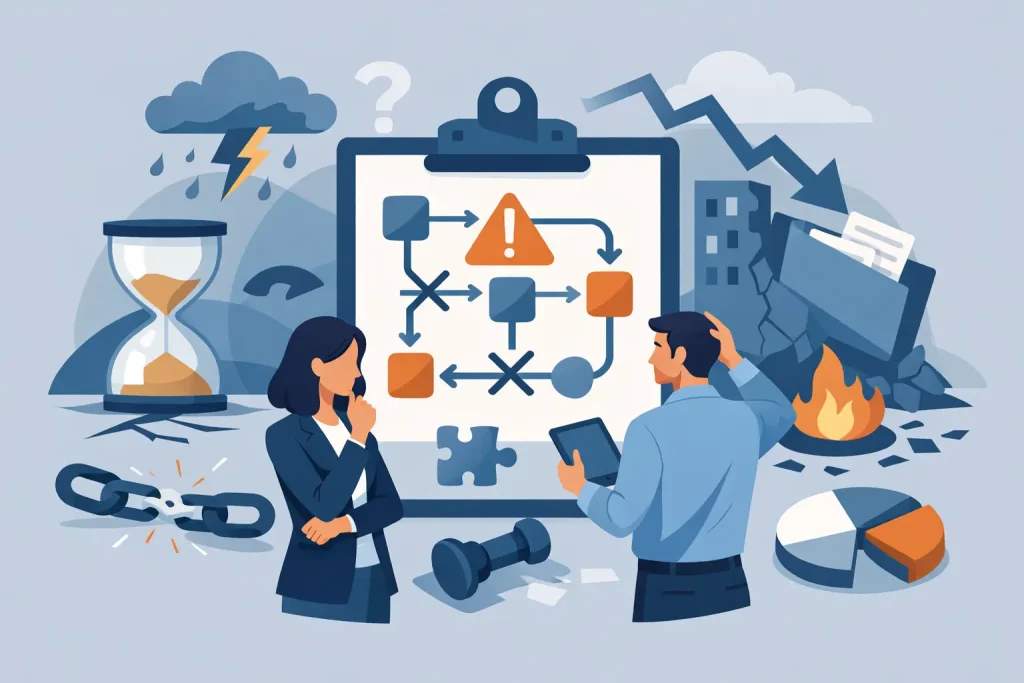
A server outage at 9:00 a.m. feels very different from a theoretical risk discussed in a quarterly meeting. Payroll stalls, phones go quiet, cloud files become inaccessible, and customers start asking questions before your team has answers. That is why the top business continuity planning mistakes matter so much – they do not stay on paper. They show up in lost revenue, damaged trust, missed deadlines, and long recovery periods that smaller organizations can least afford.
For many small to mid-sized businesses, nonprofits, healthcare offices, and community organizations, continuity planning gets treated as a compliance task or a document to file away after an insurance review. The problem is that business continuity is really an operations issue, a communications issue, and a technology issue at the same time. If the plan does not reflect how your organization actually works, it will not hold up when systems fail, staff are unavailable, or vendors go down.
Why top business continuity planning mistakes happen
Most continuity failures do not come from a lack of concern. They come from false confidence. Leadership assumes backups equal continuity. Staff assume IT will handle everything. IT assumes department heads know which functions matter most. Marketing and customer service are often left out entirely, even though public communication during a disruption can shape customer retention as much as the recovery itself.
There is also a scale problem. Large-enterprise continuity frameworks get copied into smaller organizations that do not have the staff, budget, or complexity to support them. The result is a thick plan that looks serious but is too vague to use and too cumbersome to maintain. A practical continuity plan should match your size, your risks, your systems, and the way your team actually makes decisions under pressure.
The top business continuity planning mistakes that create avoidable risk
Mistake 1: Confusing backups with business continuity
Backups are essential, but they are only one part of the picture. A copied set of files does not tell your team how to keep serving customers, switch communications, access key systems, or prioritize what comes back first. If your accounting software can be restored in 24 hours but your scheduling platform is down for three days, that may be a bigger operational problem depending on your organization.
Continuity planning starts with business functions, not just data. Which systems support revenue, patient care, donor communication, scheduling, inventory, or public service? What is the real impact if each one is unavailable for two hours, one day, or one week? Those answers drive smarter recovery decisions than a general statement that everything is backed up.
Mistake 2: Writing the plan around technology only
Technology is a major part of continuity, but not the only part. Staff availability, vendor dependencies, physical access to facilities, internet service disruptions, and customer communications all affect recovery. A nonprofit may have clean cloud backups and still be unable to operate if only one person knows how to process donations or access the phone tree. A clinic may restore systems quickly but still struggle if staff cannot reach patients with updated scheduling information.
A useful plan connects infrastructure with people and processes. It should identify who is responsible for decisions, who has authority when leadership is unavailable, what workarounds exist for critical tasks, and how external communication will be handled. This is where organizations often need a broader operational lens, not just a technical checklist.
Mistake 3: Failing to rank business priorities clearly
Not every system, service, or department needs to be restored at the same speed. Yet many plans say everything is critical, which is another way of saying nothing has been prioritized. When a disruption hits, that lack of ranking creates confusion, internal conflict, and delayed response.
The better approach is to define recovery priorities in plain business language. What absolutely must continue first? What can pause briefly without major harm? What can wait? A manufacturer, a museum, and a medical office will answer those questions differently, and they should. Continuity planning works best when it reflects your actual operating model rather than a generic template.
Mistake 4: Leaving out communication planning
This is one of the most expensive gaps because even a short outage can become a reputation problem if customers, members, patients, or partners are left in the dark. People are often more forgiving of disruption than silence. They want timely updates, clear expectations, and a point of contact.
Internal communication matters just as much. Staff need to know where updates will come from, which channels to use if email is unavailable, and who is authorized to speak externally. If your website, hosted email, phones, and social channels are managed in separate silos with no continuity coordination, communication breaks down fast. That is one reason integrated planning produces better outcomes than fragmented vendor relationships.
Mistake 5: Ignoring third-party and cloud dependencies
Many organizations have moved critical operations into cloud platforms and outsourced tools, which is often the right decision. But outsourcing a service does not outsource the impact of downtime. If your point-of-sale platform, hosted email provider, website host, payment processor, or line-of-business application has an outage, your organization still owns the customer experience.
A continuity plan should account for vendor dependencies, support contacts, escalation paths, and realistic service expectations. It should also answer a harder question: if a key provider is down, what can you still do manually or through an alternate process? In some cases, the right solution is redundancy. In others, it is a documented workaround. It depends on the cost of interruption and the role that vendor plays in daily operations.
How to avoid top business continuity planning mistakes
Start with a business impact view
Before discussing tools, look at consequences. Which services generate revenue, fulfill mission obligations, protect client relationships, or maintain compliance? How long can each function be interrupted before the damage becomes serious? This exercise often reveals that organizations are protecting the wrong things first or underestimating a weak point that has nothing to do with cybersecurity headlines.
Keep the plan usable, not theoretical
A continuity plan should be easy to find, easy to understand, and specific enough to act on under stress. If it takes too long to interpret, it will not help when your team needs quick direction. Clear contacts, simple decision paths, system priorities, communication steps, and recovery procedures usually matter more than long narrative language.
For smaller organizations, brevity is often a strength. A concise, current plan that leaders review regularly is more valuable than an impressive document no one uses.
Test the plan in realistic scenarios
Testing is where confidence becomes evidence. Many organizations skip this because they assume testing is expensive or disruptive. It does not have to be. A tabletop exercise, a simulated internet outage, a recovery verification for critical files, or a communications drill can expose problems early.
The goal is not to prove the plan is perfect. The goal is to find friction before a real event does. Maybe the backup restores slowly. Maybe key contacts are outdated. Maybe one department relies on a personal device or local file no one knew about. Those are useful discoveries if you make them during a controlled exercise rather than a live incident.
Update the plan when the business changes
Continuity planning is not a one-time project because your business does not stay still. New software, staffing changes, office moves, mergers, remote work arrangements, and service expansion all affect risk. If the plan has not been reviewed in a year, there is a good chance it no longer reflects reality.
A practical rhythm is to review the plan after any major operational change and at least annually. For organizations with regulated data, healthcare responsibilities, or multiple locations, more frequent review may make sense.
A stronger continuity plan supports growth, not just recovery
There is a common misconception that continuity planning is mainly defensive. In practice, it also supports better day-to-day management. It clarifies priorities, exposes technology gaps, strengthens vendor oversight, and improves communication processes across departments. That makes an organization more stable and easier to lead even when nothing has gone wrong.
It also protects the public-facing side of your business. Your website, customer communication channels, online reputation, and service responsiveness are part of continuity now. A disruption is never just an IT issue when customers experience it directly. Organizations that align technical infrastructure with communication strategy are in a far better position to preserve trust while recovery is underway.
For businesses and institutions that do not have deep in-house IT resources, this is where an experienced partner can make a real difference. Epuerto helps organizations enhance their business with comprehensive digital solutions that connect infrastructure, cybersecurity, communication systems, and public-facing channels into a more resilient whole.
The real test of continuity planning is simple: when something breaks, can your organization keep moving with clarity and confidence? If the answer is uncertain, that is not bad news. It is a chance to fix the gaps now, while the stakes are still low.