
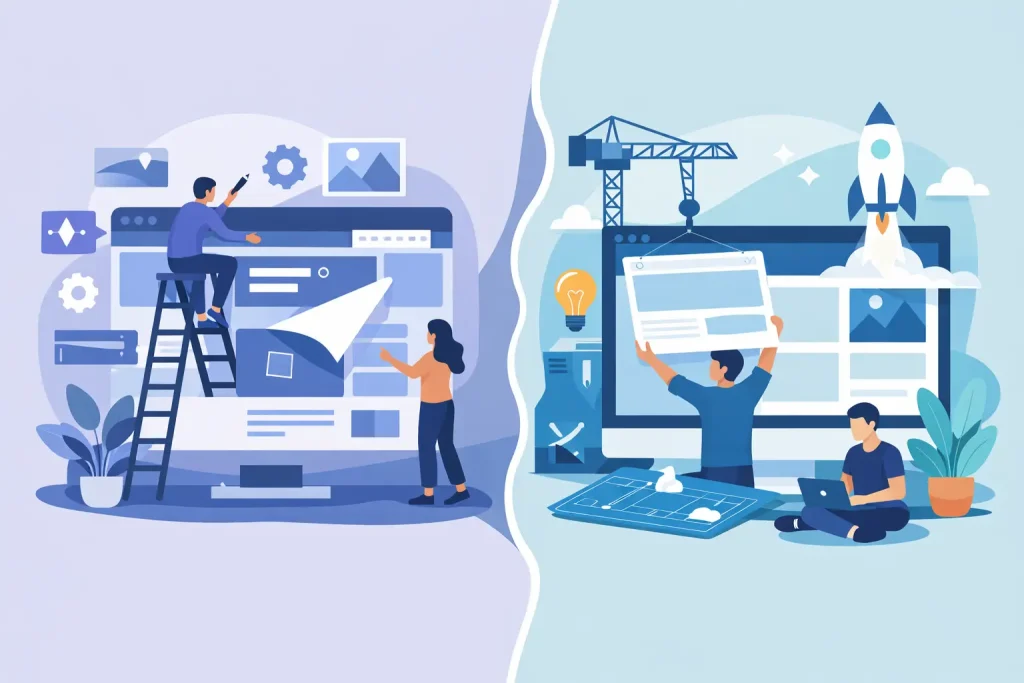
A lot of organizations wait too long to ask the real question. They keep patching pages, updating photos, or swapping headlines when the bigger issue is structural. If you are weighing website redesign vs new website, the right choice comes down to more than appearance. It affects security, search visibility, user experience, maintenance costs, and how well your site supports day-to-day operations.
For a small business, nonprofit, clinic, museum, or community organization, that decision can shape growth for years. A redesign can be efficient and cost-effective when the foundation is strong. A new website can be the smarter investment when the current platform is holding your business back. The challenge is knowing which situation you are actually in.
Website redesign vs new website: what is the difference?
A website redesign means improving the site you already have. That may include a visual update, new messaging, stronger calls to action, better mobile usability, refreshed navigation, or selected page rebuilds. In some cases, a redesign also includes performance tuning, SEO cleanup, and content restructuring while keeping the same platform and core architecture in place.
A new website is a more complete rebuild. It usually involves a new framework, a new page structure, updated functionality, modern integrations, and in many cases a content migration from the old site into a new system. You are not repainting the house. You are replacing the frame, the wiring, and often the floor plan.
That distinction matters because many organizations ask for a redesign when they really need a rebuild. Others assume they need to start over when a strategic refresh would get them where they need to go faster.
When a website redesign makes sense
A redesign is often the right move when your site still has a solid technical base. If your content management system is current, your hosting environment is stable, and your pages load reasonably well, a redesign can enhance your business without unnecessary disruption.
This is common when the main problems are public-facing. Maybe the site looks dated, the branding no longer fits, the navigation confuses visitors, or the homepage fails to explain what you do. In those cases, you may not need a new build. You need sharper messaging, cleaner page layouts, stronger visual hierarchy, and a better path from visitor interest to inquiry.
A redesign also works well when you have built search authority over time and want to preserve what is already performing. If your service pages rank, your local search presence is solid, and your existing URLs have value, a carefully managed redesign can improve conversion without resetting your momentum.
For many organizations, this is the practical middle ground. You improve what customers see and how they move through the site, while avoiding the time and cost of rebuilding systems that are still doing their job.
Signs your current site is worth improving
If your website is secure, manageable, mobile-capable, and compatible with the tools your team uses, that is a strong argument for redesign over replacement. The same is true if your site structure mostly works and the biggest complaint is that it feels old or underwhelming.
In that situation, a redesign can produce real, measurable outcomes. Better page structure can improve engagement. Better calls to action can increase leads. Better content organization can help visitors find information faster. Those gains matter, especially for businesses and institutions trying to make the most of existing assets.
When a new website is the better investment
Sometimes the smartest decision is to stop trying to rescue a site that was never built for where your organization is now. A new website is usually the better option when the problems are not cosmetic. They are foundational.
If your site runs on an outdated platform, has security weaknesses, breaks on mobile devices, or requires constant workarounds just to publish simple updates, a redesign may only cover up deeper issues. The same is true when your website cannot integrate with forms, scheduling tools, CRMs, payment systems, hosted email tools, analytics platforms, or accessibility improvements your organization now needs.
A new website also makes sense when the original site was built without a clear strategy. Many older websites grew page by page over time. New sections were added as needs changed, but no one stepped back to rethink the whole user journey. The result is usually cluttered navigation, duplicate content, inconsistent branding, and no clear path to conversion.
If that sounds familiar, rebuilding from the ground up can be more efficient than continuing to edit around the edges.
Website redesign vs new website for growth-focused organizations
Growth changes what a website needs to do. A five-page brochure site might have been enough when your organization was smaller. It may not be enough now if you need stronger local SEO, better lead tracking, event promotion, donor engagement, service segmentation, multilingual content, online forms, or role-based user access.
In those cases, a new website gives you room to build for the next stage instead of repairing the last one. That matters for organizations that want comprehensive digital solutions rather than another short-term fix.
The cost question is not as simple as it looks
Budget always matters, but the cheaper option upfront is not always the less expensive choice over time. A redesign can cost less initially because you are reusing part of the existing system. That is a clear advantage when the system is healthy.
But if your team keeps spending time on plugin conflicts, broken forms, confusing admin tools, slow load times, or security patches for an aging platform, those costs add up. So do missed opportunities from a site that fails to convert visitors or support marketing campaigns.
A new website typically requires a larger investment at the start, but it can reduce long-term maintenance, lower risk, and improve performance across departments. For many organizations, that creates better value over the life of the site.
The right question is not just, “What does it cost to launch?” It is, “What will this website cost us to operate, secure, market, and grow over the next three to five years?”
Consider the hidden technical issues
This is where many decision-makers get stuck. A site may look decent enough from the front end while serious problems sit behind the scenes. Weak hosting, poor backup practices, outdated code, missing security controls, and unreliable integrations can turn a website into a business risk.
That is especially relevant for healthcare organizations, nonprofits, and businesses that collect inquiries, payments, or customer data. In those settings, the website is not just a marketing tool. It is part of your operational infrastructure.
If the technical backbone is unstable, redesigning the surface may not solve the actual problem. A new website built with stronger hosting, backup, monitoring, cybersecurity, and platform management can protect your business while improving the user experience.
Content and SEO should influence the decision
A redesign or rebuild should never be based on design alone. Your content strategy matters just as much.
If your existing content is strong, your service pages are useful, and your search rankings are stable, preserving and refining that content can make redesign the better path. You can improve page flow, update calls to action, strengthen local signals, and modernize presentation without throwing away valuable authority.
If your content is thin, outdated, duplicated, or built around old services and old terminology, a new website gives you a chance to reorganize your message around current goals. That can be especially useful for organizations that have added services, expanded locations, or shifted their audience focus.
The same applies to local visibility. If your site does not support clear location signals, service-specific pages, or conversion-focused content, rebuilding around a smarter SEO structure may be the better long-term move.
How to make the right choice
Start by looking past appearance. Ask whether the current website supports your business operationally, not just visually. Can your team manage it easily? Is it secure? Does it perform well on mobile? Can it integrate with the systems you rely on? Does it help people take the next step?
Then look at your goals. If you need better branding, cleaner messaging, and stronger conversions, a redesign may be enough. If you need a better platform, stronger security, modern functionality, and a site structure built for growth, a new website is likely the better fit.
It also helps to think about internal capacity. If your staff is already stretched thin, a piecemeal approach can become expensive in hidden ways. Working with a partner that understands both infrastructure and marketing can simplify the process and reduce the risk of solving one problem while creating another.
That is where an integrated approach stands out. A website is tied to hosting, email, cybersecurity, analytics, search strategy, branding, and customer communication. When those pieces are planned together, the result is usually stronger and easier to maintain. For organizations that want one experienced partner across those moving parts, Epuerto brings that broader perspective.
The best websites do more than look current. They support trust, visibility, and day-to-day business performance. If your site still has a solid foundation, a redesign can move you forward efficiently. If that foundation is already working against you, starting fresh may be the move that finally gives your organization room to grow.