
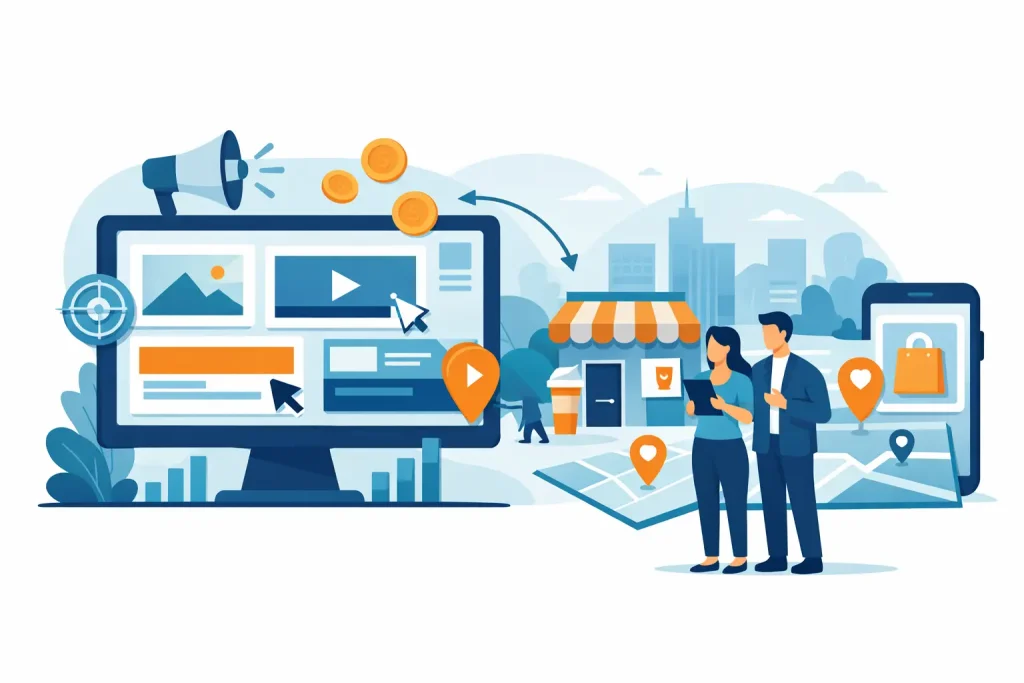
A local customer sees your message three times before they ever visit your website. First on a screen in town. Then in a social post. Then again while reading local news on their phone. That is why digital display advertising for local business works best when it is not treated as a standalone tactic, but as part of a broader visibility system.
For small and mid-sized organizations, display advertising is often misunderstood. Some assume it is only for national brands with big budgets. Others run a few banner ads, see weak results, and decide the channel does not work. In reality, local display can be highly effective when the targeting, creative, placement, and follow-up all match the way real people move through a community.
What digital display advertising for local business actually does
Digital display advertising puts visual messages in front of people as they browse websites, use apps, watch local content, or encounter digital screens in their region. That can include banner ads, mobile placements, retargeting ads, geofenced campaigns, and community-based digital signage.
For a local business, the real value is not just impressions. It is repeated visibility in the right geography. A restaurant wants to stay top of mind with nearby diners. A clinic wants to build recognition and trust before a patient needs care. A museum, chamber, or nonprofit may want to increase awareness of programs, events, or memberships among local residents and visitors.
This is where display has an edge. Search marketing captures demand that already exists. Display helps create it. When people already recognize your name, your search ad performs better, your social engagement tends to improve, and your website traffic becomes more qualified.
Why local businesses often get better results with display than they expect
Local markets are different from broad national campaigns. You are not trying to reach everyone. You are trying to become familiar to the right people within a practical service area.
That changes the math. A campaign does not need millions of impressions to be valuable. It needs enough frequency in a defined geography to make your business recognizable. For many organizations, that means a more disciplined campaign can outperform a larger but less focused one.
It also helps that local buyers tend to respond to relevance. A message about seasonal services, local events, community support, same-day availability, or regional expertise can outperform generic branding. People notice when a business feels connected to where they live.
There is a trade-off, though. Hyper-local targeting can reduce scale. If your audience is too narrow, the campaign may struggle to gather momentum. If it is too broad, you may pay for attention from people who will never become customers. The strongest campaigns usually find the middle ground – tight enough to stay relevant, wide enough to support repeat exposure.
The placements matter as much as the creative
A strong ad in the wrong environment is still a weak investment. Local businesses need placements that match customer behavior, not just low-cost inventory.
Website display ads can be useful for regional awareness, especially when they appear on locally relevant sites or content categories. Mobile ads help when people are actively moving through your service area. Retargeting works well for businesses with decent website traffic because it keeps your brand visible after someone has already shown interest.
Digital screens in the community add another layer. They are especially effective when your audience is local, your message is visual, and your offer benefits from repeated exposure. A healthcare provider, tourism organization, retailer, or service company can all benefit from being seen in high-traffic local settings where trust and familiarity matter.
This is where integrated strategy becomes important. A business that combines display ads with a functional website, clear branding, accurate business information, and a consistent follow-up path is positioned for better results than one that treats every channel separately.
Good local display ads are simple, not crowded
Many local ads try to say too much. They add the logo, phone number, full address, every service, a long slogan, and a stock image that could belong to any company in any city. The result is easy to ignore.
A good display ad usually does three things well. It identifies the business, presents one clear message, and gives the viewer a next step. That next step might be visiting a website, learning about an event, calling for service, or simply remembering the business name for later.
The design should be clean and readable at a glance. The headline matters more than clever copy. Strong local creative often includes place-based cues, familiar service needs, or timely calls to action. For example, a coastal hotel, local clinic, or regional home service company should look and sound like it belongs in that market.
There is also a practical point here. Display ads are often seen for a second or two. If the value is not obvious immediately, the ad has already lost ground.
Targeting is where strategy becomes measurable
The biggest advantage of digital display over traditional broad-reach advertising is targeting. A local business can focus on geography, interests, browsing behavior, device use, and even recent visits to specific areas through geofencing.
That creates real opportunity, but it also requires discipline. Not every business needs advanced targeting. A neighborhood restaurant may do well with simple geographic reach and time-based promotions. A specialty medical office or B2B service provider may need more refined audience segmentation. A nonprofit promoting an event may care less about deep targeting and more about broad regional visibility over a short timeline.
The right setup depends on the goal. If the objective is awareness, reach and frequency matter. If the objective is traffic or lead generation, audience quality and landing page alignment matter more. If the objective is foot traffic, geographic precision becomes a bigger priority.
This is also why campaign reporting needs context. High impressions alone do not prove success. Neither do clicks. A local display campaign may influence phone calls, walk-ins, branded searches, repeat website visits, and direct traffic in ways that do not fit into one simple metric. What matters is whether the campaign contributes to real, measurable outcomes.
Display works better when the rest of your digital presence is ready
A well-placed ad can win attention. It cannot fix a weak website, confusing branding, or broken follow-up process.
If someone clicks and lands on an outdated site, trust drops. If your business hours are inconsistent online, people hesitate. If your pages load slowly on mobile, conversion suffers. If your branding changes from one channel to another, recognition is diluted.
This is one reason many local organizations benefit from working with a partner that understands both infrastructure and promotion. Your public-facing marketing performs better when the underlying systems are stable, secure, and organized. Display advertising does not exist apart from your website, your hosting environment, your analytics setup, or your broader communications strategy. It sits on top of all of them.
For businesses trying to consolidate vendors and simplify operations, that matters. Coordinated digital systems are easier to manage, easier to measure, and more likely to support long-term growth.
When digital display is the right fit
Digital display is a strong fit for businesses and institutions that need local awareness, repeated visibility, and support across a longer customer decision cycle. It works especially well for organizations with a defined service area and a need to stay visible between direct interactions.
That includes local retailers, service providers, healthcare groups, cultural organizations, visitor-oriented businesses, chambers, schools, and nonprofits. It can also support seasonal promotions, event campaigns, new location announcements, and reputation-building efforts.
It may be less effective if the offer is too broad, the budget is too thin to create frequency, or the landing experience is weak. It can also disappoint when expectations are unrealistic. Display is usually not the fastest path to immediate conversions. It is often the channel that improves how all your other channels perform.
That is an important distinction. The businesses that get the most from display are usually the ones looking to build local market presence, not just chase one-click wins.
Building a smarter local visibility system
The best local advertising is coordinated. Your display ads should reinforce your website, support your search performance, align with your branding, and reflect the community you serve. If you also have access to local screens, social distribution, email touchpoints, print support, or community channels, the impact becomes stronger because people encounter your message in more than one place.
That kind of connected visibility is where many local businesses start to see momentum. Instead of asking whether one ad generated one sale, they begin building a presence that makes their organization more familiar, more credible, and easier to choose.
For businesses that want to enhance their business with comprehensive digital solutions, display should not be viewed as isolated ad space. It should be treated as part of a practical system for reaching nearby audiences and staying visible where local decisions are made. That is the kind of work Epuerto helps organizations do every day.
The strongest local brands are not always the loudest. They are the ones people keep seeing, keep recognizing, and keep remembering when the need becomes real.