
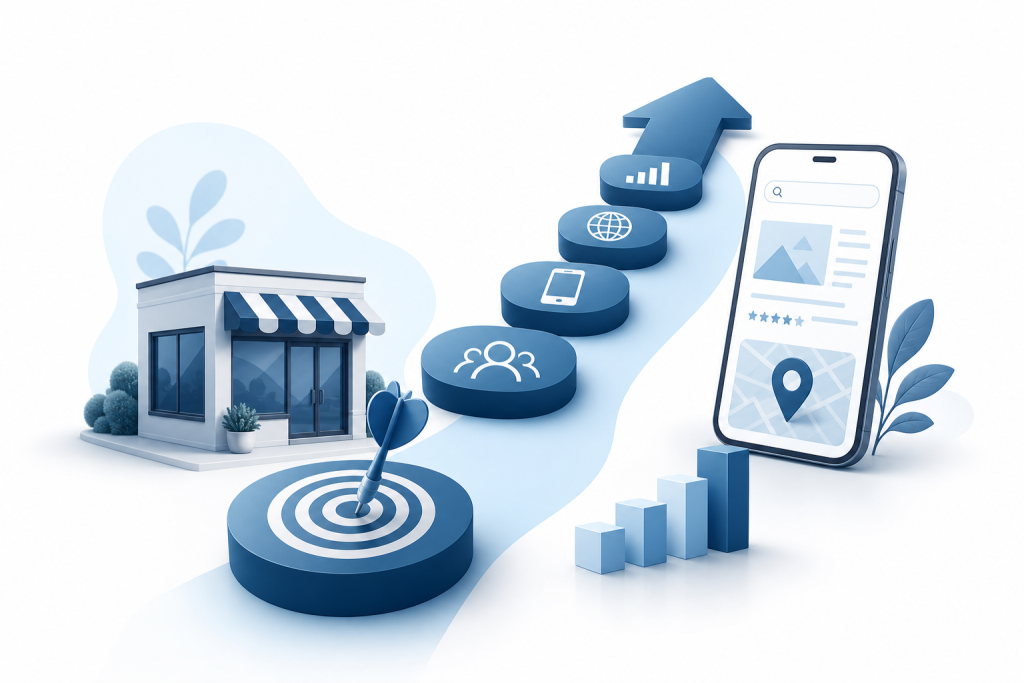
Digital marketing for small business starts with one measurable goal. Pick that goal, identify your audience, make your website mobile-ready, choose one acquisition channel, set up tracking, and schedule a monthly review. This six-step sequence keeps spending focused and lets you build on what actually works before expanding to new channels.
Most small businesses already have customers searching for them online. The gap is not budget. It is the absence of a plan. A clear, ordered sequence of actions, done consistently, produces better results than a large spend scattered across channels you have not tested yet.
Why Digital Marketing Matters for Small Businesses
The benefits of digital marketing for small businesses come down to one practical fact: your customers are already online, and the businesses that show up when they search are the ones that earn the sale.
U.S. small businesses number approximately 33.2 million and represent 99.9% of all U.S. firms. That is a crowded field. Standing out in a local market increasingly means being visible in search results, on mobile screens, and in the places where your specific customers spend time. Businesses that are not visible in those places are effectively invisible to a large share of potential buyers.
The stakes are real. Sales growth for U.S. small businesses averaged just 2.4% in 2025, less than half the historical average, according to Xero's 2026 report. Flat revenue is often a visibility problem before it is a product problem.
Local search behavior makes the case plainly. Approximately 33% of local search queries lead to a purchase within 24 hours. When someone searches for a service near them, they are not browsing. They are ready to buy. A business that does not appear in those results hands that sale to a competitor.
Mobile optimization is not optional here. About 61% of online users are more inclined to contact businesses that offer a mobile-optimized website. If your site loads slowly or breaks on a phone, most of those ready-to-buy searchers will leave before they ever contact you.
The six steps ahead address each of these gaps in the order you should tackle them.
Step 1: Pick One Goal and Know Your Audience
The most common mistake in building a digital marketing strategy for a small business is starting with a channel instead of a goal. Picking a platform before you know what result you need is like choosing a delivery truck before you know what you are shipping or where it is going.
Select a single desired business result. [S1] Be specific about what you want digital marketing to do for your business in the next 90 days. "More customers" is not a goal. "Ten new landscaping clients from the north side of town by the end of Q3" is a goal. The more concrete the target, the easier it is to choose the right channel and measure whether it is working.
Make the goal measurable and time-bound. Attach a number and a deadline. If you cannot measure it, you cannot tell whether your spending is producing anything.
Identify your target audience and your specific offer. [S2] Write down who your best current customer is. Where do they live? What problem brings them to you? What do they search for when they need what you sell? This is not a demographic exercise. It is a practical filter that tells you which channels are worth your time and which are not.
Then define your offer clearly. What specific service or product are you promoting, and what makes it worth choosing over a competitor? Salesforce research found that 67% of SMB leaders view community support as vital to their company's survival. That insight matters here: a locally grounded offer, one that speaks to your specific neighborhood or service area, often outperforms a generic pitch, even against larger competitors with bigger budgets.
Once you have one goal and one audience, every channel decision gets easier. You stop asking "should I be on social media?" and start asking "does social media reach the specific people I need, in the time frame I have?" That is a question you can actually answer.
Key Takeaway: One goal, one audience, one offer. Write all three down before you spend a dollar or post a single piece of content.
Step 2: Build Your Digital Foundation, Website and Local SEO
What are the essentials of digital marketing for small businesses starting from scratch? A mobile-ready website and a claimed Google Business Profile. Everything else, paid ads, social content, email campaigns, depends on these two foundations being in place first.
Start with your website. Your website is the one digital property you fully control. Social platforms change their algorithms. Ad costs fluctuate. Your website stays yours. For most small and mid-sized businesses (SMBs), the priority is not a complex site. It is a fast, mobile-optimized site with a clear call to action on every page.
About 61% of online users are more inclined to contact businesses with a mobile-optimized website. If you are unsure where to start with planning your site, the Small Business Website Planning Guide (an Epuerto resource) covers the decisions you need to make before you build. Choosing the right partner matters too. The best website company for a small business is one that understands your local market and can support you after launch, not just during the build.
Claim and complete your Google Business Profile. Google Business Profile lets local businesses manage how they appear in Google Maps and search results, including hours, photos, and customer reviews. It is free to use, and for businesses with a physical location or a defined service area, it is the fastest way to appear in local search results. Only businesses with physical contact with customers or a defined service area can claim a profile.
Fill in every field. Add photos. Respond to reviews. These actions directly affect how often your profile appears when someone nearby searches for what you offer.
Set up seo marketing basics with Google Search Console. Google Search Console is a free tool that shows you which search phrases are already bringing people to your site and where your pages rank. Install it as soon as your site is live. It tells you what is working before you spend money trying to improve it.
For a deeper look at how to audit and improve your local search presence, the Local SEO Audit Guide for Community Businesses (an Epuerto resource) walks through each step in detail.
Step 3: Choose Your Primary Acquisition Channel
Four core channels drive most small business digital marketing: search engine optimization (SEO), social media, content marketing, and paid advertising like Google Ads. Each one works. None of them works well when you split your attention across all four at once.
Pick one channel to start. Run it for 90 days before adding a second.
Here is a plain-language breakdown of each option and who it suits best:
-
SEO marketing. SEO is the practice of making your website rank higher in organic (unpaid) search results for the phrases your customers actually type. It takes three to six months to show meaningful results, but the payoff compounds. Branding Bytes reported in 2026 that organic search results convert 2.7x faster than paid advertisements for small businesses, though that finding reflects specific conditions and is not a guarantee for every market. SEO suits businesses with a longer planning horizon and a defined local service area. If you want a structured starting point, the Local Digital Advertising Guide for Growing Businesses covers channel selection in detail alongside paid options.
-
Social media. Social channels work best when your audience is visually driven or community-oriented. The travel app Going Solo used Instagram to build an audience of over 140,000 followers. That kind of result requires consistent posting and a clear visual identity. Social is a slower path to direct revenue than search, but it builds brand recognition over time. For more ideas on reaching a local audience across channels, see local marketing strategies for small businesses.
-
Content marketing. Blog posts, guides, and videos that answer your customers' questions build trust and support SEO simultaneously. This channel rewards patience. It is a strong fit for service businesses where buyers research before they commit.
-
Google Ads (paid search). Google Ads puts your business in front of people searching right now. You pay per click, which means costs are direct and measurable. Results are immediate compared to SEO, but they stop the moment your budget runs out. This channel suits businesses that need leads quickly and have a clear cost-per-acquisition target. Semrush offers keyword research tools and competitor traffic analysis that help you identify which search terms are worth bidding on, including a free version with limited access.
A simple decision rule: If you need results within 30 days, start with Google Ads. If you can invest three to six months, start with SEO or content. If your customers are highly active on one social platform, start there. Do not start everywhere.
Step 4: How Should You Allocate Your Digital Marketing Budget?
A digital marketing plan without a budget framework is just a wish list. One practical way to structure limited spend is to divide your budget into three tiers based on how much evidence you have for each channel.
Put the largest share of your budget toward channels and tactics you have already tested and know produce results. Spend a smaller portion on approaches that show promise but have not yet proven themselves in your specific market. Reserve a small slice for experiments: new platforms, formats, or audiences you have not tried before.
This structure prevents two common mistakes. The first is spending everything on proven channels and never discovering what could work better. The second is chasing every new platform and spreading budget so thin that nothing gets a fair test.
Here is how that might look in practice for a small business with a modest monthly marketing budget:
- Proven channels (majority of budget). If Google Ads is generating leads at an acceptable cost, that is where most of your budget stays. If your Google Business Profile and local SEO are driving inbound calls, invest in keeping that content fresh and your profile complete.
- Developing tactics (secondary slice). Maybe email marketing is showing early signs of working. Or a specific social channel is driving traffic but not yet converting. This slice funds the next stage of testing.
- New experiments (small reserve). A short video campaign, a sponsored post on a platform you haven't used, a local sponsorship with a digital component. Keep experiments small and time-limited so you can evaluate them clearly.
Review the allocation every 90 days. Move budget toward what is working and cut what is not. The three-tier split is not a permanent formula. It is a starting structure you adjust as your evidence grows.
Step 5: Set Up Tracking and Optimize Your Conversion Path
Knowing whether your digital marketing is actually working requires more than watching website traffic. Traffic is a vanity metric if it never turns into a phone call, a form submission, or a sale.
Set up full-funnel tracking. [S5] Google Search Console shows you which search phrases bring visitors to your site and which pages they land on. Pair it with a free analytics tool to track what those visitors do after they arrive. You want to know: how many visitors contacted you, which channel they came from, and which page they were on when they decided to act.
Approximately 33% of local search queries lead to a purchase within 24 hours. A meaningful share of your site visitors are ready to act quickly. If your tracking shows traffic but no conversions, the problem is almost always the conversion path, not the channel.
Optimize your conversion path. [S3] Check three things on every key page of your site. First, is your call to action visible without scrolling? Second, does your phone number or contact form appear on mobile without the visitor having to hunt for it? Third, does the page load in under three seconds? A slow page or a buried contact option will lose a ready buyer before they ever reach you.
Review your conversion data every 30 days. Find the page where most visitors leave without acting, and fix that page before you increase ad spend or add a new channel.
Step 6: Review, Learn, and Expand, When Should You Bring in Expert Help?
A monthly review keeps your digital marketing plan from drifting. Set a recurring calendar block, 60 to 90 minutes, on the last week of each month. In that session, check three numbers: leads or sales generated, cost per lead by channel, and which page or ad drove the most conversions. That is enough to make a clear decision about where to shift budget next.
After 90 days, you will have real evidence. Some channels will show a pattern. Others will not. At that point, the question is not whether to keep going. It is whether to scale what is working, cut what is not, and whether you have the time to manage both.
That last point is where many small business owners hit a wall. Running one channel well takes consistent attention. Running two or three takes systems, tools, and time that most owners do not have on top of running the actual business.
A few signals suggest it is time to bring in outside help:
- You are generating 10 or more leads per month but cannot attribute them to a specific channel.
- Your Google Ads spend is rising but your cost per lead is not improving.
- You have not updated your Google Business Profile or website content in more than 60 days.
- You want to add a second channel but have not fully measured the first one.
This is where a done-for-you agency makes practical sense. Epuerto is a digital and IT services agency that manages multi-channel marketing campaigns for small and mid-sized businesses, including local search, paid advertising, social media, and a proprietary network of mobile apps and digital screens. If you want a clearer picture of what working with a local agency actually involves, the Local Digital Marketing Agency guide covers what to expect before you commit.
Prices and plan limits verified as of October 2026.
FAQs
How should you split your digital marketing budget?
One practical approach is to divide your budget into three tiers based on evidence. Put the largest share toward channels you have already tested and know produce results. Spend a smaller portion on approaches that show early promise but are not yet proven in your market. Reserve a small slice for new experiments. The split is not fixed. Review it every 90 days and move money toward what the evidence supports.
How to start digital marketing for a small business with no budget?
Start with channels that cost time rather than money. Claim and fully complete your Google Business Profile, which is free for eligible businesses. Install Google Search Console to see how your site already performs in search. Publish answers to the questions your customers ask most. These three actions build a foundation before you spend anything on paid advertising.
How long does it take to see results from SEO marketing?
Most small businesses see meaningful movement in organic search rankings between three and six months after making consistent improvements to their site and local listings. The timeline depends on how competitive your local market is, how often you publish new content, and whether your site has technical issues slowing it down. Paid search produces faster results, but those stop when your budget does.
Do small businesses really need Google Ads, or is organic search enough?
It depends on your timeline. Organic search builds over months and tends to produce durable results. Paid search through Google Ads delivers visibility immediately but requires ongoing spend. Branding Bytes reported in 2026 that organic search results convert 2.7x faster than paid ads for small businesses in certain conditions, though that finding does not apply equally to every market or category. If you need leads within 30 days, Google Ads is the faster path. If you can invest three to six months, organic search is worth prioritizing.
What is the difference between a digital marketing strategy and a digital marketing plan?
A digital marketing strategy defines what you are trying to achieve and why: your goal, your audience, and the channel best suited to reach them. A digital marketing plan is the operational document that says how you will execute that strategy, which tactics you will use, what budget you will allocate, and how you will measure results. Strategy comes first. The plan is how you carry it out.
Conclusion
Digital marketing for your small business does not require a large budget or a full-time team. It requires a clear goal, a defined audience, and the discipline to test one channel at a time before expanding. The six steps in this guide give you that sequence in the order it actually works.
Start with what you can do this week: write down one specific 90-day goal, claim your Google Business Profile if you have not already, and install Google Search Console. Those three actions cost nothing and give you the foundation every other step depends on.