
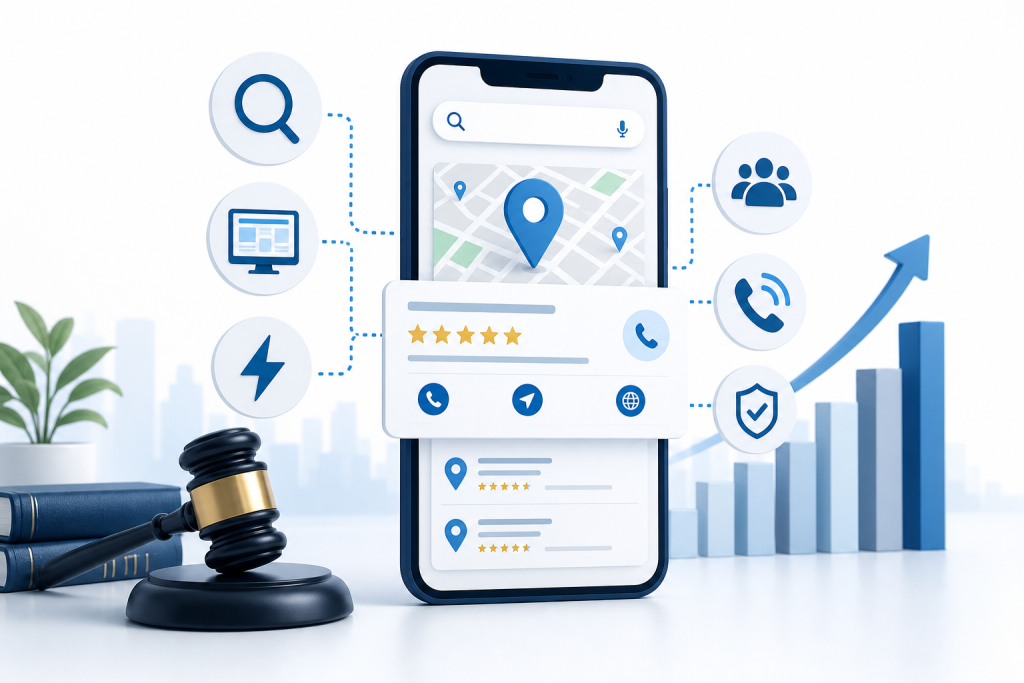
Marketing for law firms in 2026 works best as a sequence: claim local search visibility first, then build a conversion-ready website, respond to leads fast, stay compliant with bar advertising rules, and track signed cases rather than clicks. Following these steps in order prevents wasted spend and gives every channel a fair chance to produce real cases.
Most law firms already spend money on marketing. The problem is that spend rarely connects cleanly to signed cases. A firm might run Google ads, post on social media, and maintain a website, yet still struggle to say which of those activities actually filled the intake calendar. This guide sequences the steps in the order they matter, so each one builds on the last.
Step 1: Understand How Legal Clients Actually Find a Firm
Search engines dominate the discovery phase for legal clients. According to OpenCase's 2026 report, 96% of people seeking legal advice use a search engine as their first step. That single figure shapes everything that follows in this guide.
In practice, a potential client does not start by asking a friend, browsing social media, or calling a number from a billboard. They open Google, type a phrase like "divorce attorney near me" or "personal injury lawyer in [city]," and scan the first screen of results. If your firm does not appear there, the conversation never starts.
That first screen has three distinct zones. The paid ads sit at the top. Below them, the local pack shows three map listings with star ratings and phone numbers. Organic results follow. Most clicks go to the local pack and the top organic results. Paid ads capture attention, but the local pack is where many legal clients make their first decision about who to call.
The local marketing strategies that work for other small businesses apply here too, but law firms face a more competitive and more regulated version of the same challenge.
Step 2: Claim and Optimize Every Local Search Listing
Getting into the local pack is not automatic. It requires specific, deliberate actions across several platforms. The good news is that most of these actions are free and one-time, though they need periodic maintenance.
Work through these steps in order:
-
Claim your Google Business Profile. Search for your firm on Google Maps. If a listing exists but is unclaimed, claim it through Google's verification process. If no listing exists, create one. Fill in every field: practice areas, hours, phone number, address, website, and a description that names your city and the specific legal services you offer.
-
Verify your NAP consistency. NAP stands for name, address, and phone number. These three pieces of information must appear identically across every platform where your firm is listed. A suite number written as "Ste 200" on your website but "Suite 200" on Yelp creates a small inconsistency that search engines notice. Audit your existing listings and correct any mismatches. The guide on managing local citations for SEO covers this process in detail.
-
List your firm on the major legal directories. Avvo, FindLaw, Justia, and Lawyers.com each carry domain authority that search engines respect. A complete profile on each one creates an additional path for clients to find you and signals to Google that your firm is a real, established practice.
-
Collect and respond to Google reviews. Star ratings appear directly in the local pack. Ask satisfied clients to leave a review after a matter closes. Respond to every review, positive or negative, in a professional tone. Review volume signals activity to search engines more than rating alone. For a deeper look at this, the article on online review management explains what an ongoing process looks like.
-
Add photos and posts to your Google Business Profile. Profiles with photos receive more clicks than those without. A monthly post, even a short one about a recent case result or a legal tip, signals to Google that the profile is active.
None of these steps requires a marketing budget. They do require time and attention to detail. Firms that skip them hand visibility to competitors who did not skip them.
Step 3: Build a Website That Converts Visitors into Callers
A website that ranks but does not convert is a traffic problem disguised as a marketing success. The site itself must move visitors toward the phone.
Phone calls matter more in legal than in almost any other service category. Ruler Analytics reported that 56.3% of legal conversions happen over the phone. That means your phone number needs to be impossible to miss: in the header, in the footer, and on every practice-area page. On mobile, it should be a tap-to-call link, not text a visitor has to copy manually.
Speed matters. Most legal searches happen on a phone, and a site that takes more than three seconds to load on a mobile connection loses a significant share of visitors before they read a single word. Test your site's mobile load time and fix what slows it down.
Each practice area deserves its own page. A single "Services" page that lists family law, criminal defense, and estate planning in three bullet points does not give search engines enough content to rank any of those areas, and it does not give a visitor enough information to feel confident calling. Write a dedicated page for each area you want cases in, naming the city or region you serve on each one.
Trust signals reduce hesitation. Bar association membership badges, years in practice, named attorneys with photos, and case result summaries (where bar rules permit) all tell a visitor that this is a real firm with real experience. A site that looks like it was built in 2014 and has no visible attorneys creates doubt, even if the firm is excellent.
A clear, low-friction contact form on every page gives visitors who are not ready to call a second option. Keep it short: name, phone number, and a brief description of the legal issue. Long intake forms on a website lose people before they submit.
Step 4: Does Your Intake Process Lose Cases Before They Sign?
Fast marketing can still fail at the intake stage. A potential client who fills out a contact form at noon on Tuesday has already made a significant decision: they chose your firm over every other result on that search page. What happens next determines whether that decision holds.
The data here is striking. A Hennessey Digital study found that 74% of law firms responded to online leads within a seven-day period in 2025. Read that carefully: most firms take up to a week to respond to someone who asked for help. By that point, the client has almost certainly called someone else, signed with a competitor, or simply given up.
Best practice is same-day response, and faster is better. A lead that comes in during business hours should get a phone call within the hour. After hours, an automated acknowledgment that sets a clear callback time keeps the prospect from feeling ignored. The goal is to reach the person while the problem still feels urgent and while your firm is still fresh in their mind.
A few intake habits make a measurable difference:
- Answer the phone. Calls that go to voicemail during business hours lose a large share of callers who will not leave a message.
- Train whoever answers first. The first voice a prospect hears shapes their impression of the entire firm. That person needs to know how to gather basic case information and set expectations for next steps.
- Follow up more than once. A single unanswered email does not mean the lead is dead. A second contact attempt, by phone if the first was email, recovers a meaningful number of cases that would otherwise fall through.
Marketing spend is wasted if intake is the bottleneck. Fix the response process before adding more traffic.
Step 5: What Are the Top Marketing Channels for Law Firms in 2026?
No single channel wins every case. The right mix depends on your practice area, geography, and budget. That said, some channels consistently outperform others for law firms right now, and the order in which you invest matters.
Here are the top channels to prioritize, ranked by where most firms see the clearest return:
-
Local SEO and Google Business Profile. This is the foundation, covered in Steps 1 and 2. It costs nothing beyond time and produces compounding returns. A well-optimized local presence generates calls without ongoing ad spend. If you have not completed Steps 1 and 2, start there before spending on anything else. The guide on improving local SEO for calls goes deeper on the technical side.
-
Local Services Ads (LSAs). Google's LSA program places your firm above standard paid ads with a "Google Screened" badge. Leads come in as direct calls or messages, and you pay per lead rather than per click. Lead costs vary significantly: in large, competitive metros, legal LSA leads run considerably higher than in smaller or mid-sized markets. If your firm serves a less saturated geography, LSAs can deliver strong returns at a lower cost than traditional pay-per-click. For a fuller breakdown of paid search options, the article on PPC attorney ads covers what to expect.
-
AI-driven search visibility. Search behavior is shifting. A Right Hat survey found that half of legal services buyers want to know how a firm uses AI to deliver its services. Beyond client expectations, AI-powered search features like Google's AI Overviews now summarize answers directly on the results page, reducing clicks to sites that are not cited as sources. Structured, authoritative content on your practice-area pages improves your chances of appearing in those summaries.
-
Social media. Organic social works best for brand awareness and referral reinforcement, not direct case generation. Family law and estate planning firms find more traction on Facebook, where the relevant demographic is active. Criminal defense and personal injury firms sometimes see results on YouTube with short explainer videos. Post consistently, keep content educational rather than promotional, and stay inside bar advertising rules (covered in Step 6).
-
Email to past clients and referral sources. A quarterly email to former clients and professional contacts, attorneys in other practice areas, financial advisors, social workers, keeps your firm top of mind for referrals. According to CallRail, only 57% of law firms expect to increase their marketing budgets, which means firms that use low-cost channels like email efficiently have a real advantage over those that rely entirely on paid traffic.
Step 6: How Do State Bar Advertising Rules Affect Your Marketing?
Bar advertising rules are not a footnote. They are a hard constraint that shapes what you can say, where you can say it, and how you must say it. Violating them risks disciplinary action, not just a poor ad result.
The rules vary significantly by state, and they change. What is permitted in Texas may be restricted in New York. What was acceptable two years ago may require a disclaimer today. The only reliable source for your current obligations is your state bar's rules of professional conduct, specifically the rules governing advertising and solicitation. Treat any general guidance, including this article, as a starting point, not a final answer.
A few areas where firms commonly run into compliance problems:
Testimonials and client reviews. Some states restrict or prohibit client testimonials in attorney advertising. Others permit them with specific disclaimers. Before you ask clients for Google reviews or feature quotes on your website, confirm what your state bar allows.
Guarantees and outcome claims. Phrases like "we win" or "guaranteed results" are prohibited in most jurisdictions. Even softer language, such as "we'll get you the best outcome," can cross the line. Stick to factual descriptions of your experience and practice areas.
Specialization claims. Calling yourself a "specialist" in a practice area is restricted in many states unless you hold a formal certification recognized by the bar. "Experienced in" or "focused on" are generally safer alternatives.
Required disclosures. Many states require specific language on attorney advertising, such as "Attorney Advertising" or "Prior results do not guarantee a similar outcome." These disclosures must appear on websites, ads, and social media posts in some jurisdictions.
Review your marketing materials against your state bar's current rules before publishing. When in doubt, your state bar's ethics hotline can give informal guidance quickly and at no cost.
Step 7: Are You Measuring Signed Cases or Just Vanity Metrics?
Most law firms track the wrong numbers. Page views, social media followers, and ad impressions tell you that something is happening, but they do not tell you whether marketing is producing signed cases.
Research by Martindale-Avvo shows that 61% of legal professionals have low confidence in their ability to measure marketing ROI. That is not a small gap in reporting sophistication. It means most firms are spending money without knowing what is working.
The metrics that actually matter are signed cases, cost per signed case, and which channel produced each one. Call tracking assigns a unique phone number to each marketing channel, so you know whether a call came from a Google ad, a local services ad, or an organic search result. A spreadsheet with columns for date, client name, practice area, channel (Google Ads / LSA / organic), and cost per lead lets you calculate which channels produce cases at a low cost per signed case and which ones run far higher.
According to a Williams Lea report, 80% of senior legal marketing leaders saw budget increases over the past year. More budget without better measurement just scales the guesswork.
Epuerto is a digital marketing agency that handles this kind of multi-channel tracking and campaign management as a done-for-you service, for firms that want the measurement problem solved without building the process internally.
Prices and plan limits verified as of November 2026.
FAQs
What is the 80/20 rule for lawyers in the context of marketing?
For most law firms, a small share of marketing activities produces the majority of signed cases. That share is typically local search visibility and fast intake response. Identifying which channels and which practice areas actually produce signed cases, then concentrating resources there, outperforms spreading budget evenly across every available channel.
Is free marketing enough for a small law firm, or does paid advertising always win?
Free marketing, meaning local SEO, a well-optimized Google Business Profile, legal directory listings, and consistent review collection, can generate a steady flow of calls without any ad spend. Paid advertising accelerates results and fills gaps, but it amplifies what is already working rather than replacing the foundation. A small firm with a limited budget should complete every free step first, then add paid channels once the organic presence is solid.
How does social media marketing for law firms differ from other industries?
The biggest difference is bar compliance. Law firms cannot make outcome guarantees, use certain testimonials, or claim specializations without meeting specific bar requirements, all of which are common practice in other industries. Beyond compliance, social media rarely drives direct case inquiries for most practice areas. It works best for staying visible to past clients and referral sources, and for building enough familiarity that someone who finds you through search feels confident calling.
What should a law firm post on Reddit or online forums without violating bar rules?
Stick to general legal education rather than specific legal advice. Explaining how a process works, what factors typically affect an outcome, or what questions someone should ask an attorney are all useful without crossing into an attorney-client relationship. Avoid identifying yourself as representing anyone in a specific matter, and include your state and bar number when your profile identifies you as an attorney. Check your state bar's rules on online communications before engaging regularly.
What are the top three trends shaping the legal industry in 2026?
First, AI-driven search features are changing how clients find attorneys, with Google's AI Overviews surfacing answers directly on the results page and reducing clicks to sites that are not cited as sources. Second, client expectations around AI use are rising: a Right Hat survey found that half of legal services buyers want to know how a firm uses AI in its work. Third, measurement pressure is increasing as budgets grow but ROI confidence stays low, pushing firms toward call tracking and signed-case attribution rather than vanity metrics.
Conclusion
Marketing for law firms in 2026 comes down to a clear sequence: be findable in local search, give visitors a website that makes calling easy, respond to leads the same day, stay inside bar advertising rules, and measure what produces signed cases rather than what generates traffic. Each step depends on the one before it, which is why firms that skip the foundation and jump straight to paid ads often feel like they are spending without results.
Start by checking whether your firm appears in the local pack for your main practice areas and city. If it does not, Steps 1 and 2 are your entire focus until that changes. Once local visibility is solid, audit your intake response time, because fast marketing with slow follow-up loses cases that were already won.