
- Why Video Matters for Small Businesses Right Now
- The Build-It-Yourself Path: What You Actually Need
- The Outsource Path: What You Get and What It Costs
- Build vs. Outsource: A Side-by-Side Look
- When Building In-House Makes Sense
- When Outsourcing Makes More Sense
- How Video Fits Into a Broader Local Marketing Strategy
- Making the Decision: A Practical Framework
- Frequently Asked Questions
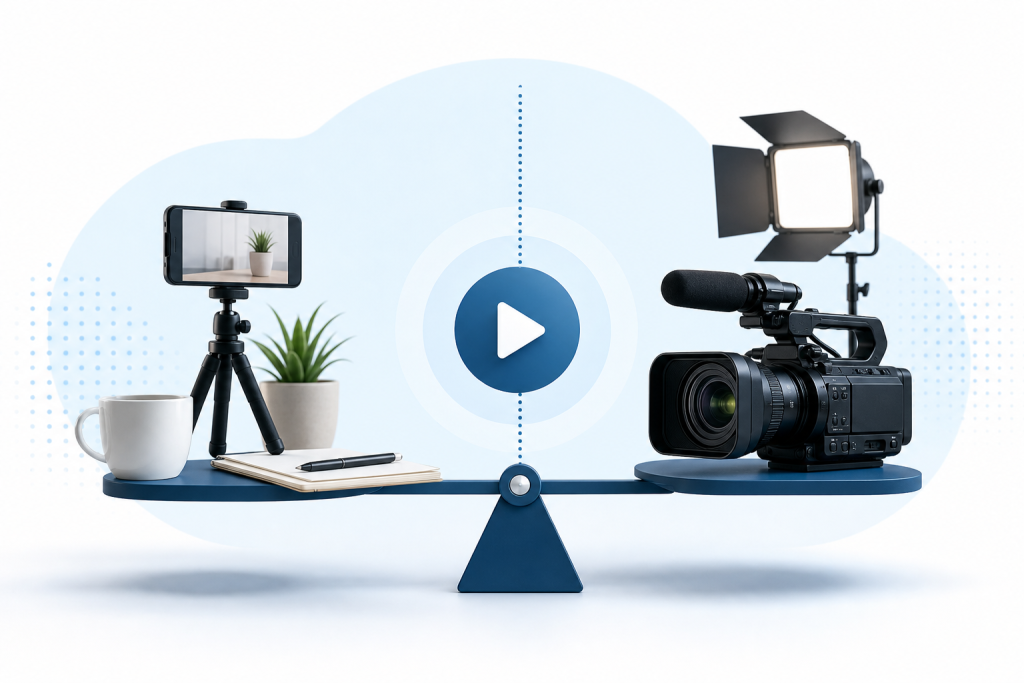
Video marketing for small business owners sits at an awkward intersection: everyone agrees video works, but the moment you start pricing it out, the numbers get uncomfortable fast. Do you buy a camera, learn editing software, and carve out hours each week? Or do you hand it off to someone who does this every day? Here is a breakdown of the real costs on both sides so you can make a decision that actually fits your budget and your time.
Why Video Matters for Small Businesses Right Now
Customers research before they buy. They want to see the people behind the business, understand what you do, and feel some level of trust before picking up the phone. A short, well-made video on your homepage or social profiles does that work faster than a paragraph of text ever will.
For local businesses especially, video builds the kind of familiarity that drives foot traffic and phone calls. A restaurant showing its kitchen, a contractor walking through a finished project, a clinic introducing its staff — these are low-stakes videos that carry real weight with local audiences.
The question is never really "should we do video?" It is "who should produce it, and what will it actually cost?"
The Build-It-Yourself Path: What You Actually Need
Going in-house sounds appealing because it feels cheaper. But "cheaper" depends entirely on what you count.
Equipment
A capable smartphone shoots excellent video in 2026, so a dedicated camera may not be necessary. What you will need:
- A tripod or stabilizer (roughly $30 to $150)
- An external microphone — bad audio kills good video, so budget $50 to $200
- Lighting, even a basic two-light kit ($80 to $300)
- A case or bag to keep everything organized
You can get started for a few hundred dollars. If you want a dedicated camera with interchangeable lenses, expect to spend significantly more, plus lenses.
Software
Free options like DaVinci Resolve handle most small business needs. Paid tools like Adobe Premiere Pro or Final Cut Pro add polish and speed but come with subscription or one-time costs. Budget $0 to $600 per year depending on what you choose.
Your Time
This is the cost most owners underestimate. Scripting a two-minute video, filming it, reviewing footage, editing, adding captions, and exporting for different platforms can take four to eight hours for someone learning as they go. That time has a dollar value, even if it never shows up on an invoice.
If you are already stretched thin running a small team with no dedicated marketing staff, those hours come directly out of operations or your personal time. That is the real cost of building in-house.
Consistency
One video is easy to commit to. A consistent video presence — monthly or weekly content, seasonal promotions, product spotlights, behind-the-scenes clips — requires a system. Without one, in-house video tends to start strong and quietly fade after the first few months.
The Outsource Path: What You Get and What It Costs
Hiring a professional video production team or a full-service agency means paying for skill, speed, and consistency. The output is typically better, produced faster, and delivered without pulling you away from your actual work.
What Professional Video Production Includes
A professional shoot typically covers pre-production (scripting, shot planning), the shoot itself, post-production (editing, color correction, sound mixing, captions), and delivery in the formats you need. Some agencies also handle distribution — posting to your website, social channels, and any paid placements.
The Cost Range
Costs vary widely based on scope, location, and the type of video. A simple talking-head testimonial or product overview is less expensive than a cinematic brand video with drone footage and multiple locations. Most agencies do not list pricing publicly, so you will need to request quotes. Key things to ask about:
- Per-video pricing versus a monthly retainer
- How many revisions are included
- Whether distribution and posting are part of the scope
- Turnaround time
For local businesses in Oregon, working with a local agency means you can walk through the space together, review footage in real time, and avoid the coordination overhead that comes with a remote team.
What You Give Up
When you outsource, you hand over some degree of creative control. A good agency will collaborate with you on messaging and tone, but you need to communicate your brand clearly. You also depend on their schedule, which matters when you need a quick turnaround for a time-sensitive promotion.
Build vs. Outsource: A Side-by-Side Look
| Factor | Build In-House | Outsource |
|---|---|---|
| Upfront cost | Low to moderate (equipment) | Low to none (no equipment needed) |
| Ongoing cost | Your time + software | Agency or production fees |
| Quality ceiling | Depends on skill and practice | Professionally produced from the start |
| Consistency | Requires discipline and systems | Built into the engagement |
| Speed | Slow at first, faster over time | Faster, especially for complex work |
| Creative control | Full | Collaborative |
| Time demand | High | Low |
Neither path is wrong. The right answer depends on how much time you have, how important video quality is to your brand, and whether you can realistically sustain consistent output on your own.
When Building In-House Makes Sense
In-house video works well when:
- Someone on your team genuinely enjoys making content and has the time to do it well
- Your video needs are simple and informal — behind-the-scenes clips, quick social posts, staff introductions
- You are in an early stage and want to test formats before investing in professional production
- Your audience responds to raw, authentic content over polished production
A smartphone and a decent microphone can produce content that connects with local audiences, especially on platforms where authenticity outperforms polish.
When Outsourcing Makes More Sense
Outsourcing makes sense when:
- You want video on your homepage, in paid ads, or on digital display screens in public venues — places where quality directly affects first impressions
- You need consistent output and no one on your team has the bandwidth to maintain it
- You have tried in-house and the content has stalled or gone inconsistent
- You want video to be part of a broader marketing strategy that includes SEO, social media, and local distribution
For businesses in Coos Bay and the surrounding area, professional video that gets distributed across multiple channels — not just posted once to Instagram — multiplies the value of the production cost.
How Video Fits Into a Broader Local Marketing Strategy
A single video sitting on your website does some work. That same video appearing on your website, in an email newsletter, pushed through a mobile app, displayed on digital screens in local restaurants and gyms, and shared across social media does far more work for the same production cost.
That is the difference between treating video as a standalone project and treating it as one piece of a coordinated local marketing system. When distribution is built into the strategy from the start, the cost-per-impression of professional video drops considerably.
Epuerto's multi-channel marketing network covers exactly that kind of distribution — from a mobile app with more than 7,000 downloads to a physical mailer reaching more than 26,000 recipients per month, plus digital screen placements across community venues in Coos County. Video content produced for one channel can be adapted and pushed across all of them. If you want to explore how that fits your business, start the conversation at Epuerto.
Making the Decision: A Practical Framework
Three questions worth asking before you commit either way:
1. Who will own this? If no one on your team has both the skill and the time to produce video consistently, in-house is likely to underdeliver. Ownership matters more than equipment.
2. Where will it appear? Informal social content has a lower quality bar. Homepage video, paid ads, and display screens in public spaces need professional production.
3. What is your actual budget? In-house video is not free. Add up equipment, software, and the hourly value of your time, then compare that to what an agency would charge for the same output. The gap is often smaller than it looks.
Frequently Asked Questions
Is video marketing worth it for a small local business?
Yes, particularly for businesses that rely on local trust and word of mouth. Video lets potential customers see your space, your team, and your work before they ever contact you. For service businesses, contractors, clinics, and restaurants, that familiarity shortens the decision cycle.
How much does it cost to produce a professional business video?
Costs vary based on length, complexity, and location. A simple one-to-two-minute video is less expensive than a multi-location brand film. The best approach is to request quotes from local production teams or agencies and compare what is included in each scope.
Can I use my smartphone for business video?
A modern smartphone shoots high-quality video. The limiting factor is usually audio and lighting, not the camera itself. An external microphone and basic lighting make a significant difference in perceived quality. For informal social content, a smartphone setup works well. For homepage or display screen video, professional production is worth the investment.
How long should a small business video be?
It depends on where it will appear. Social media content performs best under 60 to 90 seconds. Homepage or explainer videos can run two to three minutes if the content holds attention. Testimonials are most effective when kept under two minutes.
What types of video work best for local businesses?
Customer testimonials, behind-the-scenes walkthroughs, staff introductions, and short service explainers all perform well for local audiences. Drone footage works particularly well for businesses with a physical location or outdoor work — landscapers, contractors, event venues.
Should I hire a local agency or a national one for video production?
A local agency can visit your location, understand your community context, and coordinate on short notice. For businesses in smaller markets like Coos Bay, local production also means the team understands your audience and can help tailor messaging accordingly.
What is the biggest mistake small businesses make with video marketing?
Producing one video and stopping. A single video has limited reach and a short shelf life. Consistent output — even simple, short-form content on a regular schedule — outperforms a single polished piece that never gets followed up. If you cannot maintain consistency in-house, outsourcing or partnering with an agency that handles distribution is the more reliable path.
Video marketing for small business is not about having the best camera or the biggest budget. It is about making a realistic plan, matching production quality to where the video will appear, and building in distribution so the content actually reaches people. Whether you build in-house or outsource, the businesses that see results are the ones that treat video as an ongoing channel — not a one-time project.