
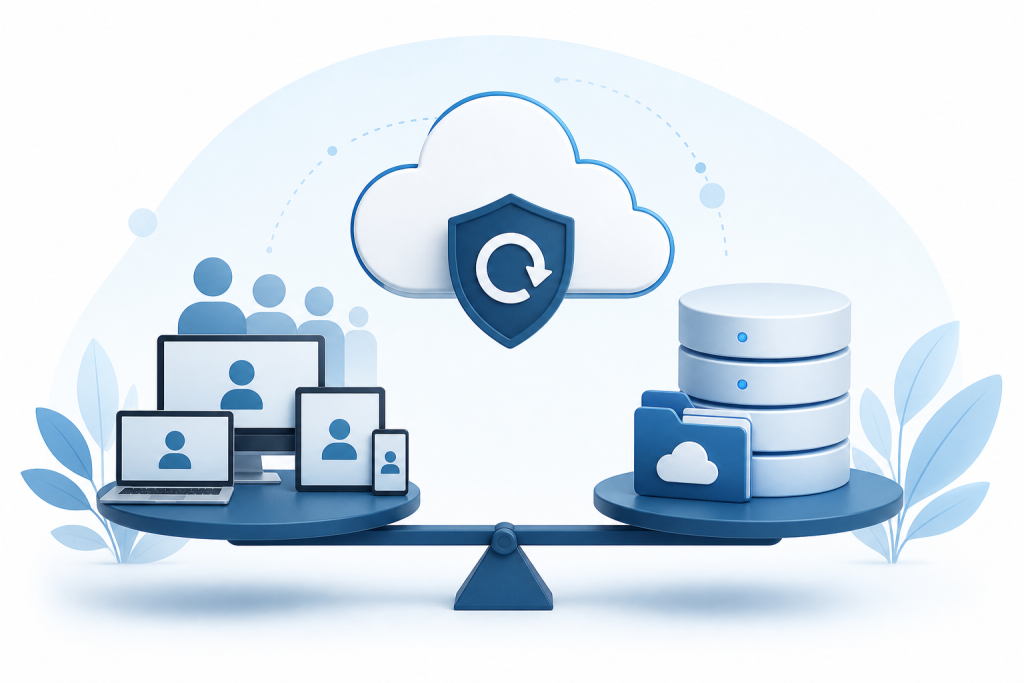
The best cloud backup service for your business depends on what you need to protect. Per-storage plans like IDrive suit teams with many devices; per-user plans like Backblaze or CrashPlan fit smaller endpoint fleets. Industry analysis from 2025 shows that ransomware and data-loss incidents can cost small businesses between $25,000 and $254,000 per event, which makes the right plan worth scrutinizing carefully.
This article breaks down the two dominant pricing models, compares eight services side by side, and explains when a managed IT partner makes more sense than a self-serve platform. The goal is to help you match a plan to your actual environment before you commit. Pricing structures and coverage limits vary widely, so the comparisons below focus on those differences rather than quoting figures that change frequently. Pricing structures and coverage limits vary widely, so the comparisons below focus on those differences rather than quoting figures that change frequently.
Per-User vs. Per-Storage Pricing: Which Model Fits Your Business?
The two dominant pricing structures for cloud backup services for business are per-user (or per-device) and per-storage. Choosing the wrong one can cost you more than necessary.
Per-user pricing charges a flat rate for each person or computer you enroll. Backblaze Business Backup and CrashPlan both follow this model. It works well when you have a small number of endpoints and each user generates a large volume of data, because the storage is typically unlimited. Costs scale directly with headcount.
Per-storage pricing charges based on total data stored, regardless of how many devices or users you have. IDrive Business uses this model and covers unlimited users, devices, servers, virtual machines (VMs), and network-attached storage (NAS) devices under a single storage pool. For businesses with many endpoints but modest total data, this structure is often cheaper.
If you have more than 10 devices but your total backup data stays under a few terabytes, per-storage pricing usually wins. Fewer devices with heavy individual data loads favor per-user unlimited storage.
Best Cloud Backup Services for Business: 8 Options Compared
No single service fits every environment. The eight options below cover the range from simple endpoint tools to full enterprise cloud backup platforms, with 6 of the major providers offering plans suited to SMBs, and per-computer annual pricing for some services starts around $99/computer/year.
| Service | Best For | What It Protects | Pricing Tier |
|---|---|---|---|
| Acronis Cyber Protect | IT-managed environments needing backup + security | Physical, virtual, and cloud workloads | Premium |
| Backblaze Business Backup | Small teams with Mac/PC endpoints | Workstations and external drives | Premium per-computer |
| IDrive Business | Multi-device teams with servers and NAS | Servers, VMs, NAS, and unlimited devices | Budget per-storage |
| Veeam Data Cloud | Microsoft 365 and Azure-heavy organizations | M365, Azure, Salesforce | Budget per-user (annual) |
| Carbonite Safe | SMBs needing disk imaging and Hyper-V support | Computers, servers, Hyper-V VMs | Premium |
| AWS Backup | Businesses already running AWS infrastructure | AWS resources and on-premises workloads | Usage-based (not publicly listed) |
| MSP360 | IT teams managing their own cloud storage | Endpoints and servers via bring-your-own-storage | Mid-tier |
| CrashPlan | Endpoint-focused teams wanting continuous protection | Files and endpoints | Budget per-user |
A few distinctions matter here. Backblaze does not support NAS or network drive backups, per helpcompare.com, and web-based restores cap at 500 GB per request. Carbonite's core plan limits coverage to 250 GB across 25 computers; NAS and external drive support requires a higher plan. MSP360 does not include storage at all; you pay a third-party provider separately. Acronis and Veeam are the strongest options for server and VM protection, but both require IT administration to manage effectively.
Security and Compliance: What to Look for in Enterprise Cloud Backup Solutions
Security requirements separate consumer-grade backup tools from true enterprise cloud backup options. Three areas deserve your attention before you sign up.
Encryption should cover data both in transit and at rest. Look for AES-256 encryption at minimum, and confirm whether you or the vendor holds the encryption key. Private-key encryption means only you can decrypt your files, which matters for regulated industries.
Ransomware protection is increasingly a baseline requirement, not a premium feature. Acronis Cyber Protect includes AI-based ransomware detection built into the backup agent itself, which can detect and stop an attack before it reaches your backup files. CrashPlan uses end-to-end encryption but focuses on file protection rather than active threat detection.
Compliance certifications such as HIPAA and SOC 2 are not universal across these platforms. Medical offices, financial firms, and other regulated businesses should verify certification status directly with any vendor before purchasing. Do not assume a tool is compliant because it mentions encryption. Ask for documentation.
Cloud Backup and Recovery: How Fast Can You Actually Restore?
Cloud backup and recovery speed depends on two variables: your internet bandwidth and the total volume of data you need to restore. Neither is fixed, which is why recovery time objectives (RTOs) vary widely across organizations.
Most services offer two restoration paths. A cloud download pulls files directly over the internet, which works well for individual files but slows sharply for full-system restores measured in terabytes. Veeam Data Cloud provides managed infrastructure so recovery of Microsoft 365 data does not depend on your local bandwidth. Carbonite offers disk-image recovery, which can restore an entire system to a new machine rather than file by file.
For businesses in areas with limited bandwidth, physical shipping or a local managed recovery option is often the only practical path to a fast restore. The business backup and disaster recovery guide covers RTO and recovery point objective (RPO) planning in more detail.
Is a Self-Serve Plan Enough, or Do You Need a Managed Backup Service?
Self-serve cloud backup platforms work well when someone on your staff has the time and skill to configure policies, monitor alerts, test restores, and respond when something fails. That is a real ongoing job, not a one-time setup.
A lot of SMBs get tripped up here. They deploy the agent on a few machines, assume the backup is running, and months later discover a misconfigured policy excluded their most critical folder, or that no one noticed the backup had been failing for three weeks.
Medical offices, nonprofits, and small retail operations rarely have a dedicated IT staff member watching backup logs. For those businesses, a managed approach handled end-to-end by an IT partner is a more reliable model than a self-serve subscription.
Epuerto is a managed IT services provider that handles cloud backup as part of a broader IT and cybersecurity program. Backup policies are configured, monitored, and maintained by the IT partner rather than by your staff. For more on what managed IT actually includes, see Managed IT Services for Small Business: What You Actually Get and What It Costs.
Decision Checklist: Choosing the Right Cloud Backup Plan for Your Business
Use this checklist before committing to any plan:
- Count your devices and users separately. If device count far exceeds user count (shared workstations, servers, NAS), per-storage pricing usually costs less.
- Identify what you are protecting. Endpoint-only backup tools will not cover servers, VMs, or NAS devices. Confirm coverage before you buy.
- Set your RTO and RPO targets. Decide the maximum data loss and downtime your business can tolerate, then verify the tool can meet those targets.
- Check compliance requirements. If you handle health, financial, or legal data, ask vendors for HIPAA or SOC 2 documentation directly.
- Confirm ransomware protection. Look for immutable backups or active threat detection, not just encryption.
- Assess your internal IT capacity. If no one on staff will actively manage the platform, a managed service is more reliable than a self-serve subscription.
- Test a restore before you rely on it. A backup you have never tested is an assumption, not a plan.
Prices and plan limits verified as of October 2026.
FAQs
Is cloud backup worth paying for if my business already uses Microsoft 365?
Microsoft 365 retains deleted items for a limited window and does not provide a full backup of your data. If a file is overwritten, corrupted, or deleted beyond the retention period, Microsoft will not restore it. A dedicated cloud backup service like Veeam Data Cloud covers Microsoft 365 data, including email, SharePoint, and OneDrive, with point-in-time recovery that Microsoft's native tools do not offer.
What is the difference between cloud backup and cloud storage?
Cloud storage, such as OneDrive or Google Drive, syncs files between devices and gives you access from anywhere. Cloud backup creates a separate, versioned copy of your data specifically for recovery. If ransomware encrypts your synced files, cloud storage will sync the encrypted versions. A cloud backup service retains clean historical versions you can restore from, which is a fundamentally different function.
How do I migrate from one cloud backup provider to another without losing data?
Run both services in parallel for at least 30 days before canceling the old one. Verify that the new service has completed at least two full backup cycles and that you can successfully restore a test file. Export any configuration settings or backup policies from the old platform. Only cancel the previous subscription after confirming the new backup history meets your RPO requirements.
Which cloud backup services are HIPAA-compliant?
HIPAA compliance requires a vendor to sign a Business Associate Agreement (BAA) and meet specific data security standards. Not all cloud backup tools offer a BAA. You must verify current certification status and BAA availability directly with each vendor. Do not assume compliance based on marketing materials alone.
How much storage does a small business typically need for cloud backup?
A 10-person office with standard productivity workloads typically generates between 500 GB and 2 TB of backup data, depending on whether you include servers and email archives. Businesses with large media files, databases, or line-of-business servers can exceed that quickly. Start by auditing your current data volume, then add a growth buffer for the next two years when sizing a plan.
Conclusion
Choosing a cloud backup service comes down to three things: what you need to protect, how fast you need to recover, and who will manage the platform day to day. Per-storage plans suit multi-device environments; per-user plans suit smaller endpoint fleets with heavy data loads. Security features and compliance certifications are not optional if your business handles regulated data.
Before you commit to a plan, run through the checklist above and test a restore on any platform you shortlist. If your business lacks the internal capacity to manage backup policies and monitor for failures, a managed IT service is a more reliable path than a self-serve subscription. A backup that no one is watching is not a backup strategy.