
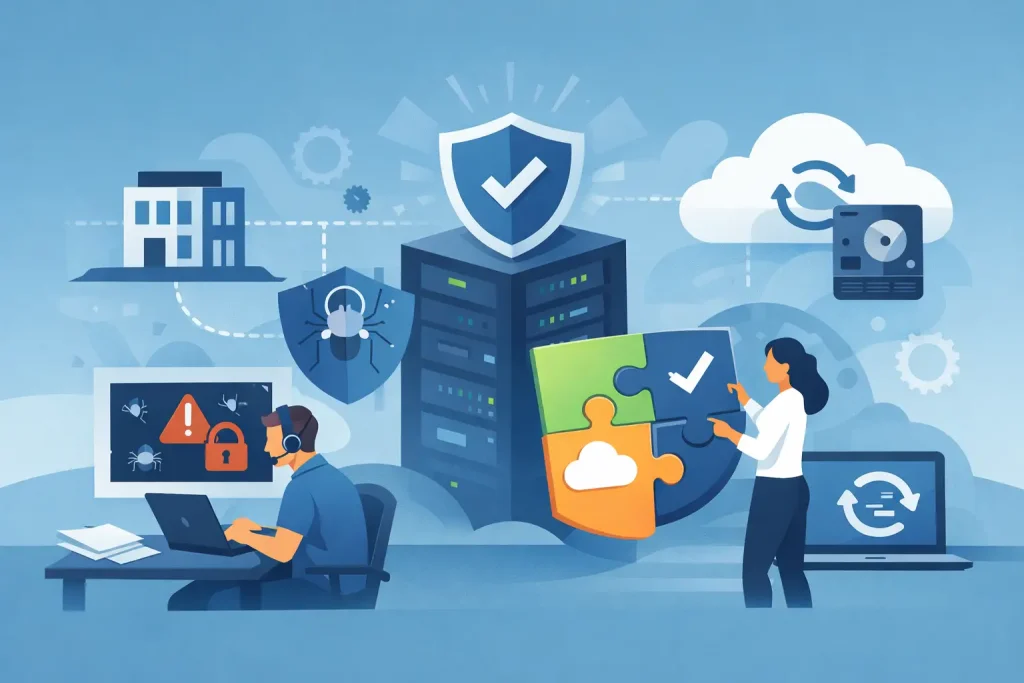
At 8:12 on a Tuesday morning, the front desk could not open shared files, accounting was locked out of the server, and the phones started ringing with customers asking why email confirmations had stopped. That is what a real cyberattack recovery example looks like for many small and mid-sized organizations – not a dramatic movie scene, but a normal workday that suddenly stops.
For business owners, nonprofit leaders, and office managers, the hardest part is rarely the technical label of the attack. It is the business interruption. Payroll is delayed. Staff improvise. Customers notice. If your website, email, files, or scheduling tools are central to daily operations, recovery is not just an IT event. It is a business continuity event.
A cyberattack recovery example from a typical local organization
Imagine a regional healthcare-adjacent nonprofit with 22 employees, a small on-site server, Microsoft 365 accounts, cloud file sharing, and a website that collects contact form submissions. It does meaningful community work, but like many organizations, its technology grew over time. Some systems were current, some were not, and cybersecurity processes depended too much on staff being careful.
The attack started with a phishing email sent to an employee in administration. It looked like a routine document-sharing request from a known vendor. The employee clicked, entered credentials into a fake login page, and unknowingly handed over access. Within hours, the attacker logged into email, created forwarding rules, and used that account to send more convincing internal messages. By evening, remote access tools were abused, several file shares were encrypted, and a ransom note appeared.
This is where many leaders ask the wrong first question: Do we pay? The better first question is: What still works, what is affected, and how do we contain this before the damage spreads further?
First 4 hours: contain, verify, communicate
The first priority was isolation. Internet access for the affected server was cut. Workstations showing suspicious behavior were removed from the network. Password resets began immediately, starting with administrator accounts, email accounts, and remote access credentials. Multifactor authentication was enforced where it had not yet been required.
At the same time, leadership needed a plain-English status update. Not a forensic report. Not speculation. Just the facts available at that moment: file access is disrupted, email may be compromised, restoration work has started, and staff should avoid opening unusual messages or reconnecting disconnected devices.
This stage matters because confusion creates secondary problems. Employees may keep using infected machines. Someone may reply to a malicious email thread. A well-meaning manager may reboot a device that should be preserved for investigation. Good recovery depends on technical control and calm communication moving together.
Day 1: understand the scope before restoring blindly
By midday, the IT team confirmed three affected areas: compromised user accounts, encrypted shared files on one server, and suspicious outbound email activity. The website itself was not breached, but form notifications tied to email were unreliable because mailbox rules had been altered by the attacker.
This is a critical decision point. Restoring too quickly can recreate the problem. If you bring systems back online before you know how access was gained, the attacker may still be inside. In this example, recovery paused long enough to review logs, disable unnecessary remote access, inspect endpoint activity, and confirm whether backups were intact and isolated from the attack.
The good news was that backups existed and were recent. The less comforting news was that not every system had the same recovery speed. Shared documents could be restored relatively quickly. Rebuilding a secure server environment and validating user access would take longer. Recovery is rarely one switch. It is a sequence.
What made this cyberattack recovery example successful
The organization did not escape damage. It lost productive time, had to notify stakeholders, and faced real stress. But it recovered without paying ransom because several fundamentals were already in place.
First, backups were separated enough from production systems to remain usable. That single factor often determines whether a business has options. Second, the organization had outside technical support available quickly, which prevented delays caused by uncertainty. Third, leadership accepted temporary disruption in exchange for cleaner recovery. That trade-off is not easy, but it is usually the right one.
There were also weaknesses. Multifactor authentication had not been fully enforced before the incident. Staff phishing awareness was inconsistent. Remote access was more permissive than it should have been. Those gaps did not cause the entire event alone, but they made the attacker’s job easier.
Day 2 through Day 5: restore operations in the right order
The recovery plan prioritized business function, not just system count. Email security came first because communication was needed for vendors, staff, and clients. Core file access came next because program delivery and accounting depended on shared documents. After that, the team rebuilt affected systems, validated backups, reissued credentials, reviewed user permissions, and checked all connected devices for signs of persistence.
This order matters. Some organizations spend too much time trying to bring every device back at once. A better approach is to ask which systems restore revenue, service delivery, compliance, and communication fastest. For a medical office, that may be scheduling and patient communication. For a museum or chamber, it may be email, donor records, event systems, and the website. For a retailer, payment and inventory systems may take priority.
In this example, limited website updates were posted through unaffected channels to reassure the public that services were continuing. That public-facing piece is often overlooked. Customers and community members do not need every technical detail, but they do need confidence that the organization is responding responsibly.
The business lessons behind the recovery
A cyberattack exposes more than security gaps. It reveals whether your technology, communications, and leadership workflows are coordinated. If your IT provider handles only servers, your web team handles only the site, and no one owns public messaging, recovery becomes fragmented fast.
That is why integrated support matters. A business under attack may need endpoint containment, backup restoration, hosted email remediation, network review, website checks, and customer communication guidance within the same 24-hour window. Treating those as separate silos slows the response.
For many small and mid-sized organizations, the practical takeaway is not to build an enterprise-scale security operation. It is to create a realistic recovery structure before an incident happens. That means knowing who can isolate devices, who can approve emergency spending, who can message staff, and how your public-facing channels will stay trustworthy if email is compromised.
What this example says about preparation
The clearest lesson from this cyberattack recovery example is that prevention and recovery are connected. You do not prepare for recovery after a breach. You prepare for it in the ordinary weeks when systems seem fine.
That preparation should include tested backups, multifactor authentication, endpoint protection, patch management, limited user permissions, staff training, and a written incident response plan simple enough to use under pressure. It should also include business-side planning: alternate communication methods, website control access, vendor contact records, and a decision-making chain that does not depend on one person being available.
There is no perfect defense. A well-run organization can still get hit. But the difference between a short, controlled disruption and a long, expensive crisis often comes down to visibility, speed, and coordination.
For local businesses and institutions, there is another layer to consider: reputation in the community. A cyber incident can interrupt customer trust just as much as operations. Fast, honest communication and a disciplined recovery process help protect both. That is where a partner with experience across IT systems, web infrastructure, and business communications can make a measurable difference.
If your organization cannot clearly answer how it would restore email, files, access, and customer communication after an attack, that is the place to start. The goal is not fear. The goal is readiness that can enhance your business, protect your continuity, and keep your organization moving when the unexpected happens.